Introduction
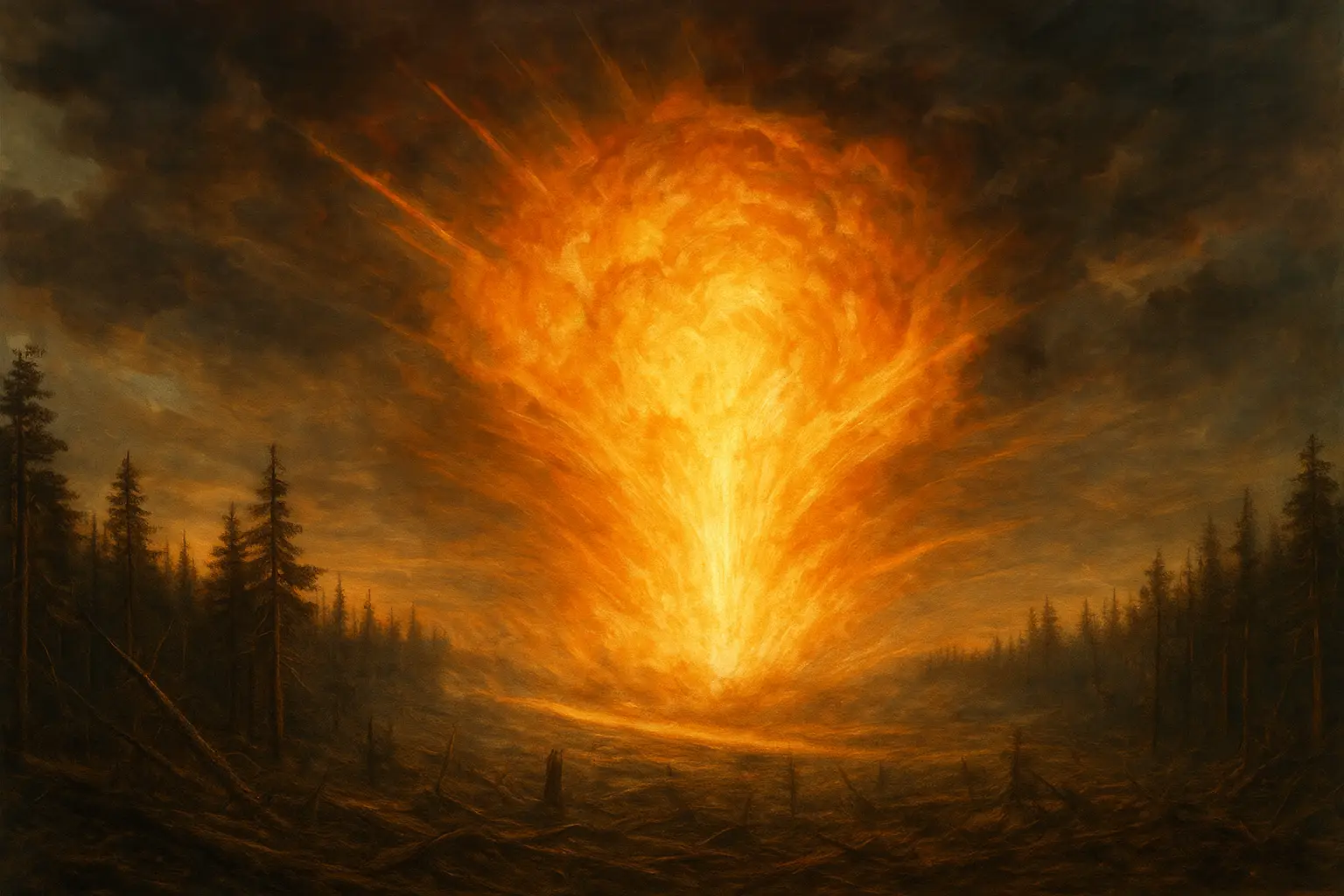
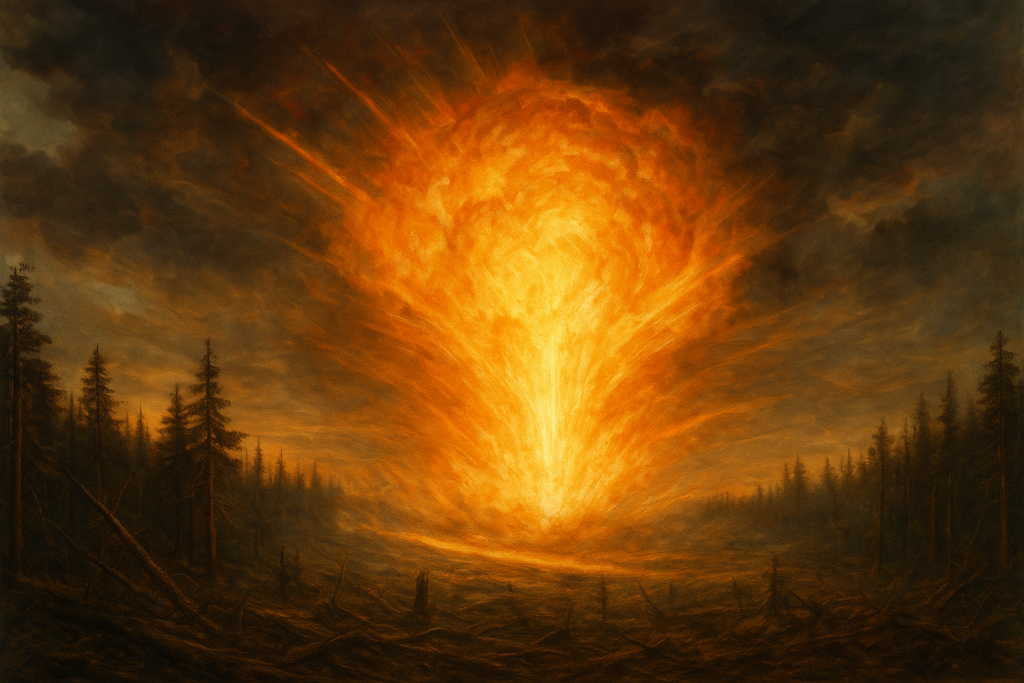
On the morning of June 30, 1908, a colossal explosion ripped through the sky over a remote region of Siberia, near the Tunguska River. The blast flattened around 80 million trees across 2,150 square kilometers — an area larger than London or New York City. Witnesses described a blinding fireball, a shockwave that knocked people off their feet, and a noise louder than thunder that echoed for hundreds of kilometers.
Yet, despite the immense destruction, no impact crater was ever found. No meteor fragments, no volcanic activity, and no clear explanation for what caused the explosion. For over a century, scientists, historians, and theorists have struggled to uncover the truth behind what has come to be known as the Tunguska Event — one of the strangest and most powerful unexplained phenomena in modern history.
The Morning the Sky Exploded
At around 7:17 a.m. local time, residents of the Evenki (Tungus) tribes and Russian settlers in central Siberia reported seeing a massive streak of light moving rapidly across the sky. Moments later, a blinding flash lit up the horizon, followed by a thunderous explosion that sent a shockwave traveling around the world — recorded by barometers as far away as England.
One eyewitness, Semen Semenov, who lived about 40 miles from the blast, described the scene vividly:
“Suddenly in the north sky…the sky was split in two, and high above the forest the whole northern part of the sky appeared covered with fire. At that moment there was a bang in the sky and a mighty crash… followed by noises like stones falling or guns firing.”
The explosion was so powerful that it registered on seismic stations across Eurasia. People hundreds of kilometers away were thrown from chairs, glass windows shattered, and strange glowing skies illuminated Europe for nights afterward — bright enough that people in London could read newspapers at midnight without artificial light.
The Search for Evidence
In 1908, Siberia was one of the most inaccessible places on Earth. No immediate investigation occurred, and the first expedition didn’t reach the site until 1927, nearly 19 years later. It was led by the Russian scientist Leonid Kulik, who had studied reports of the explosion and believed it was caused by a meteorite impact.
What Kulik found, however, deepened the mystery. The trees in the blast zone were flattened in a radial pattern, all pointing away from a central point — clear evidence of an explosion. But at the center, trees remained standing upright, stripped of their branches but not burned.
Most puzzling of all, there was no crater — no sign of an object having struck the ground. The soil showed no traces of meteoric iron, and no fragments were recovered. Kulik concluded that the explosion must have occurred in the air, above the ground — but what could have caused such a massive detonation in the atmosphere?
The Power of the Blast
Modern studies estimate the energy of the Tunguska explosion to be between 10 and 15 megatons of TNT — roughly 1,000 times stronger than the atomic bomb dropped on Hiroshima. Trees were flattened over an area of 2,150 square kilometers, and the shockwave circled the Earth twice.
The pattern of destruction suggests that the explosion occurred 5 to 10 kilometers above the ground. This fits the behavior of a large meteoroid or comet entering Earth’s atmosphere and exploding before impact, a phenomenon known as an airburst.
Simulations and modern data from similar but smaller events (like the Chelyabinsk meteor in 2013) support this idea. The Chelyabinsk object — a 20-meter-wide rock — exploded over Russia with the force of 500 kilotons of TNT, injuring over 1,500 people but leaving no crater. The Tunguska object, scientists believe, could have been 50–80 meters wide, large enough to cause catastrophic damage even without striking the ground.
The Leading Scientific Theory: A Cosmic Visitor
Most scientists today agree that the Tunguska Event was likely caused by the airburst of a stony asteroid or comet. As it entered Earth’s atmosphere at speeds exceeding 27,000 kilometers per hour, the friction and heat would have caused the object to vaporize explosively, releasing immense energy.
This theory explains the absence of a crater, as the object never actually hit the ground. The intense heat and pressure wave would have flattened trees and set the forest ablaze — though the region’s swampy terrain likely prevented widespread fires.
In 2013, an international team of researchers found microscopic silicate and magnetite spheres in the peat layer dating back to 1908, supporting the idea that extraterrestrial material was involved.
Still, despite this evidence, the event’s exact cause and composition remain unproven — partly because no large fragments have ever been found.
Alternative Explanations and Wild Theories
As with many great mysteries, the absence of a definitive answer has fueled a wide range of theories — some scientific, others imaginative or even bizarre.
1. Comet Theory
Some researchers believe the object was a comet, not an asteroid. Comets are made mostly of ice and dust, which would vaporize completely during atmospheric entry, leaving no solid fragments behind. This could explain the lack of debris and crater.
2. Natural Gas Explosion
Another idea suggests that methane gas from Siberia’s permafrost or underground pockets might have erupted and ignited, causing a massive explosion. However, this doesn’t account for the reports of a fireball streaking across the sky before the blast.
3. Black Hole or Antimatter
In the 1970s, some speculative physicists proposed that a tiny black hole or a particle of antimatter entered the Earth’s atmosphere, releasing massive energy before disappearing. While imaginative, these ideas lack any physical evidence.
4. Alien Hypothesis
A favorite among UFO enthusiasts is that Tunguska was caused by an alien spacecraft explosion or a failed extraterrestrial experiment. While there’s no credible data supporting this, the theory persists in popular culture, inspiring novels, films, and documentaries.
5. Nikola Tesla’s “Death Ray”
Perhaps the most outlandish theory links the explosion to inventor Nikola Tesla. At the time, Tesla was experimenting with wireless energy transmission using his Wardenclyffe Tower in New York. Some have speculated that he accidentally directed a beam of energy toward Siberia — but there’s no record of such an experiment, and Tesla himself never made the claim.
Modern Research and Discoveries
Since the 1990s, technological advancements have reignited scientific interest in the Tunguska Event. Satellite imagery, computer models, and soil analysis have provided new insights.
In 2007, Italian researchers claimed to have found a possible impact crater — Lake Cheko, about 8 kilometers from the explosion’s epicenter. Sonar scans revealed a cone-shaped depression consistent with a small impact. However, later studies showed the lake may predate 1908, leaving the question unresolved.
In 2020, Russian scientists published computer simulations showing that a 50–60 meter-wide iron asteroid could have grazed Earth’s atmosphere and then bounced back into space after releasing its energy — a phenomenon called a “grazing impact.” This could explain the lack of debris and crater, though the theory remains under debate.
Global Significance
The Tunguska Event remains the largest impact-related explosion in recorded history, and it serves as a sobering reminder of Earth’s vulnerability to cosmic threats.
Had the Tunguska object exploded over a populated area instead of remote Siberia, millions could have died. The event inspired greater interest in tracking near-Earth objects (NEOs) — asteroids and comets that could pose future danger.
Today, NASA’s Planetary Defense Coordination Office and international observatories monitor the skies for potential impact threats, partly motivated by historical events like Tunguska and Chelyabinsk.
Cultural Impact
Beyond science, the Tunguska Event has become a part of global folklore and imagination. It appears in literature, movies, and video games, often portrayed as evidence of alien activity, secret technology, or supernatural forces.
Works like “The X-Files,” “Doctor Who,” and numerous documentaries have reimagined Tunguska as a mystery beyond human understanding. Yet, at its core, it remains a testament to the awesome power of nature — and how fragile our civilization is in the face of cosmic forces.
Conclusion
The Tunguska Event stands as one of the strangest and most fascinating episodes in modern history — a reminder that the universe can unleash unimaginable power without warning.
While the most credible explanation points to a cosmic airburst — a space rock exploding in Earth’s atmosphere — many details remain uncertain. No definitive physical evidence, no crater, and no confirmed fragments mean that even after more than a century, Tunguska still holds secrets.
It is a story that bridges the line between science and mystery — a cosmic riddle reminding us how much we have yet to learn about our planet, our solar system, and the forces that shape them.
As we continue to explore the skies and search for answers, the flattened forests of Tunguska whisper a timeless truth: the universe is vast, unpredictable, and full of wonders we still do not understand.