Introduction
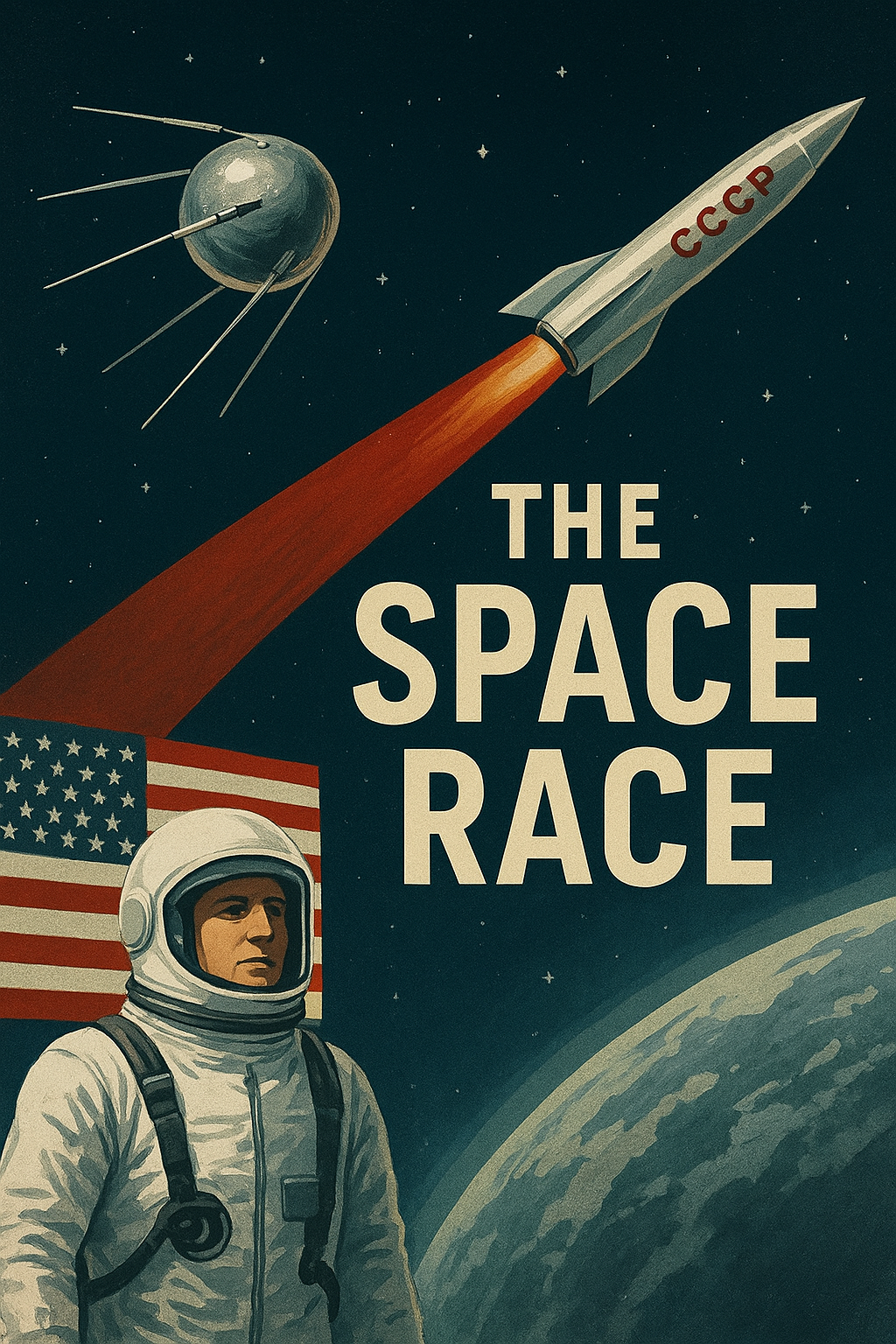
In the mid-20th century, the night sky became a new battlefield. Two superpowers—the United States and the Soviet Union—were locked in a fierce competition not over territory or weapons, but over the future of space. What began as a military rivalry evolved into one of humanity’s greatest adventures: the quest to reach beyond our planet.
The Space Race, spanning roughly from 1957 to 1975, was more than a scientific endeavor—it was a struggle for global prestige, technological supremacy, and ideological dominance. It produced triumphs and tragedies, heroes and martyrs, and it forever changed the way humanity sees itself and its place in the universe.
The World After War
When World War II ended in 1945, the world was divided into two ideological blocs. The United States represented capitalist democracy, while the Soviet Union championed communism. The two nations emerged as superpowers, and their rivalry quickly evolved into a Cold War — a contest of influence fought through propaganda, espionage, and technological competition rather than direct military confrontation.
Rocket technology became a central part of that struggle. Both sides recognized that whoever mastered the skies could dominate not only the battlefield but also the world’s imagination.
The foundation of the Space Race was laid by the wartime work of German engineer Wernher von Braun, who had developed the V-2 rocket for Nazi Germany. After the war, both the U.S. and the Soviet Union raced to recruit German scientists. The Americans secured von Braun and his team through Operation Paperclip, while the Soviets obtained their own share of engineers and equipment.
The stage was set for a cosmic duel.
Sputnik: The Beep Heard Around the World
On October 4, 1957, the Soviet Union stunned the world by launching Sputnik 1, the first artificial satellite to orbit Earth. The small metal sphere, about the size of a beach ball, emitted a rhythmic “beep” that could be heard by radio operators across the globe.
This sound—simple yet haunting—signaled a new era. Humanity had entered space.
For the United States, Sputnik was a psychological earthquake. If the Soviets could launch a satellite into orbit, they could potentially deliver nuclear weapons across continents. American newspapers declared a “Sputnik Crisis,” accusing the government of falling behind in science and technology.
In response, President Dwight D. Eisenhower created the National Aeronautics and Space Administration (NASA) in 1958, marking the formal beginning of America’s race to catch up.
Yuri Gagarin and the Soviet Triumphs
The Soviets continued to outpace their rivals in the early years. Under the leadership of visionary engineer Sergei Korolev, known only by the codename “Chief Designer,” the USSR achieved milestone after milestone.
- In 1959, the Luna 2 probe became the first human-made object to impact the Moon.
- In 1961, the Soviets achieved their crowning glory: Yuri Gagarin became the first human to travel into space and orbit the Earth aboard Vostok 1.
On April 12, 1961, Gagarin’s words—“Poyekhali!” (“Let’s go!”)—echoed across the world. When he returned safely, he became an instant global hero, celebrated as a symbol of human courage and Soviet supremacy.
For the U.S., it was another painful blow. But it also became the catalyst for an unprecedented surge of ambition.
Kennedy’s Challenge
On May 25, 1961, U.S. President John F. Kennedy addressed Congress with a bold declaration:
“I believe that this nation should commit itself to achieving the goal, before this decade is out, of landing a man on the Moon and returning him safely to the Earth.”
It was a breathtaking promise—especially since the U.S. had only just managed to send astronaut Alan Shepard on a brief suborbital flight weeks earlier. But Kennedy understood that the Space Race was not merely about exploration; it was a test of political will and a demonstration of the strength of democracy itself.
Thus began Project Apollo, an effort that would mobilize over 400,000 engineers, scientists, and technicians, and cost more than $25 billion (over $200 billion today). The United States was betting its pride and future on a lunar dream.
The Road to the Moon
NASA’s journey was filled with both triumph and tragedy.
Mercury and Gemini
Before humans could reach the Moon, they had to master the basics of spaceflight.
- The Mercury program (1958–1963) tested single-astronaut missions and spacecraft re-entry.
- The Gemini program (1965–1966) followed, testing spacewalks, orbital docking, and long-duration flights — essential for future lunar missions.
These missions paved the way for Apollo, the grand lunar project that would define NASA’s legacy.
Tragedy of Apollo 1
On January 27, 1967, disaster struck. During a ground test, a fire broke out in the Apollo 1 command module, killing astronauts Gus Grissom, Ed White, and Roger Chaffee. The accident shocked the nation and temporarily halted the program.
NASA responded with humility and resolve, overhauling safety standards and spacecraft design. The tragedy, rather than halting the mission, deepened the determination to succeed.
The Moon Landing: “One Small Step for Man”
On July 20, 1969, the world watched in awe as Apollo 11 descended toward the Moon. Millions huddled around black-and-white televisions as astronaut Neil Armstrong guided the Eagle lunar module down to the dusty surface.
At 10:56 p.m. EDT, Armstrong stepped onto the Moon and spoke words that would echo through history:
“That’s one small step for man, one giant leap for mankind.”
Moments later, Buzz Aldrin joined him, and the two men planted the American flag, collected samples, and left behind a plaque reading:
“We came in peace for all mankind.”
The United States had done it. After years of Cold War rivalry, humiliation, and scientific struggle, they had achieved the seemingly impossible. The Space Race had reached its climax.
After the Moon: The Race Winds Down
After Apollo 11, the world witnessed five more successful lunar landings (Apollo 12–17), each pushing the boundaries of exploration. But as the 1970s dawned, public enthusiasm waned. The missions were expensive, and the geopolitical urgency faded.
Meanwhile, the Soviet Union shifted focus toward space stations, launching Salyut 1 in 1971 — the world’s first orbiting laboratory. Although they never landed cosmonauts on the Moon, the Soviets achieved long-duration missions and crucial advancements in living and working in space.
The competition officially softened with the Apollo-Soyuz Test Project in 1975, when an American Apollo spacecraft docked with a Soviet Soyuz capsule in orbit. The two crews exchanged handshakes, signaling a new era of cooperation after decades of rivalry.
The Legacy of the Space Race
The Space Race reshaped modern civilization in ways that continue to affect daily life.
1. Technological Innovation
To reach the Moon, scientists had to invent entirely new technologies — from miniaturized electronics to advanced materials and computer systems. These innovations later fueled developments in telecommunications, medical imaging, satellite navigation, and even home appliances.
The integrated circuits designed for Apollo computers laid the groundwork for the digital revolution that transformed the world in the following decades.
2. Scientific Discovery
The data collected during Apollo missions revolutionized our understanding of the Moon’s geology, confirming that it shared a common origin with Earth. The missions also demonstrated that humanity could survive, adapt, and work beyond our planet.
3. Political and Cultural Impact
The Space Race became a symbol of possibility. It showed that competition, when directed toward knowledge and discovery, could inspire rather than destroy. In both the U.S. and USSR, generations of young people were inspired to study science, engineering, and mathematics.
Even in the midst of Cold War tension, space exploration created moments of shared awe — times when political divisions gave way to universal wonder.
From Rivalry to Partnership
By the end of the 20th century, space had shifted from a battlefield to a bridge between nations. The U.S. and Russia became partners in building the International Space Station (ISS), launched in 1998 and continuously inhabited since 2000.
Today, astronauts from dozens of countries work side by side in orbit, conducting experiments and preparing for future missions to the Moon and Mars. This spirit of cooperation is the truest legacy of the Space Race — proof that exploration can unite rather than divide.
Conclusion
The Space Race was born from fear, fueled by rivalry, and crowned by triumph. It pushed humanity to its limits and forced both superpowers to look beyond the horizon of Earth.
What began as a geopolitical contest became a defining chapter of human history — a story not just of rockets and astronauts, but of curiosity, courage, and imagination.
When Neil Armstrong set foot on the Moon, he did not just represent America or the West; he stood for all of humanity’s yearning to explore the unknown.
Today, as new nations and private companies reach for Mars, asteroids, and distant worlds, we are still living in the echo of that first race — the moment humanity learned that our greatest frontier lies not in conquering each other, but in reaching for the stars together.