Introduction
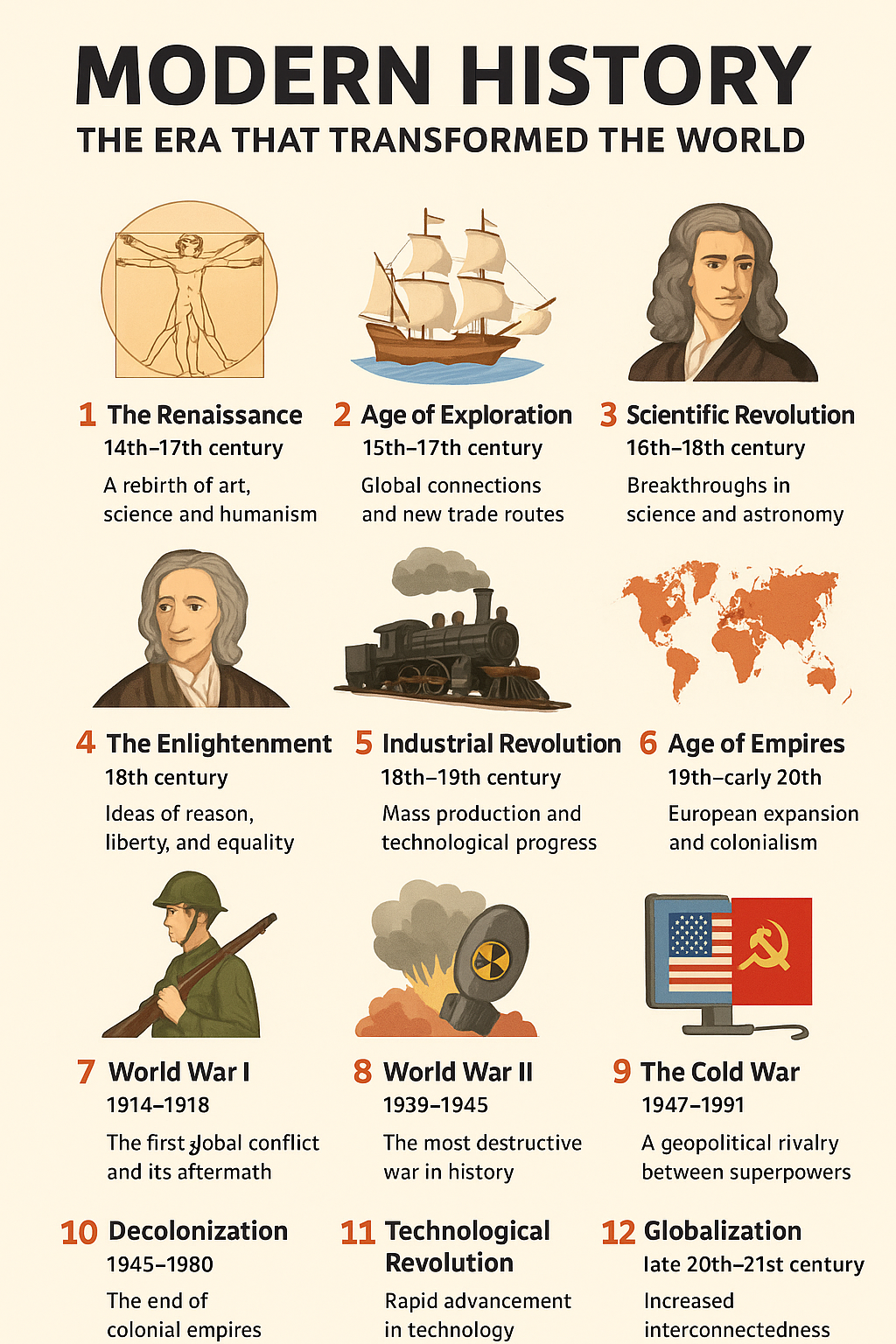
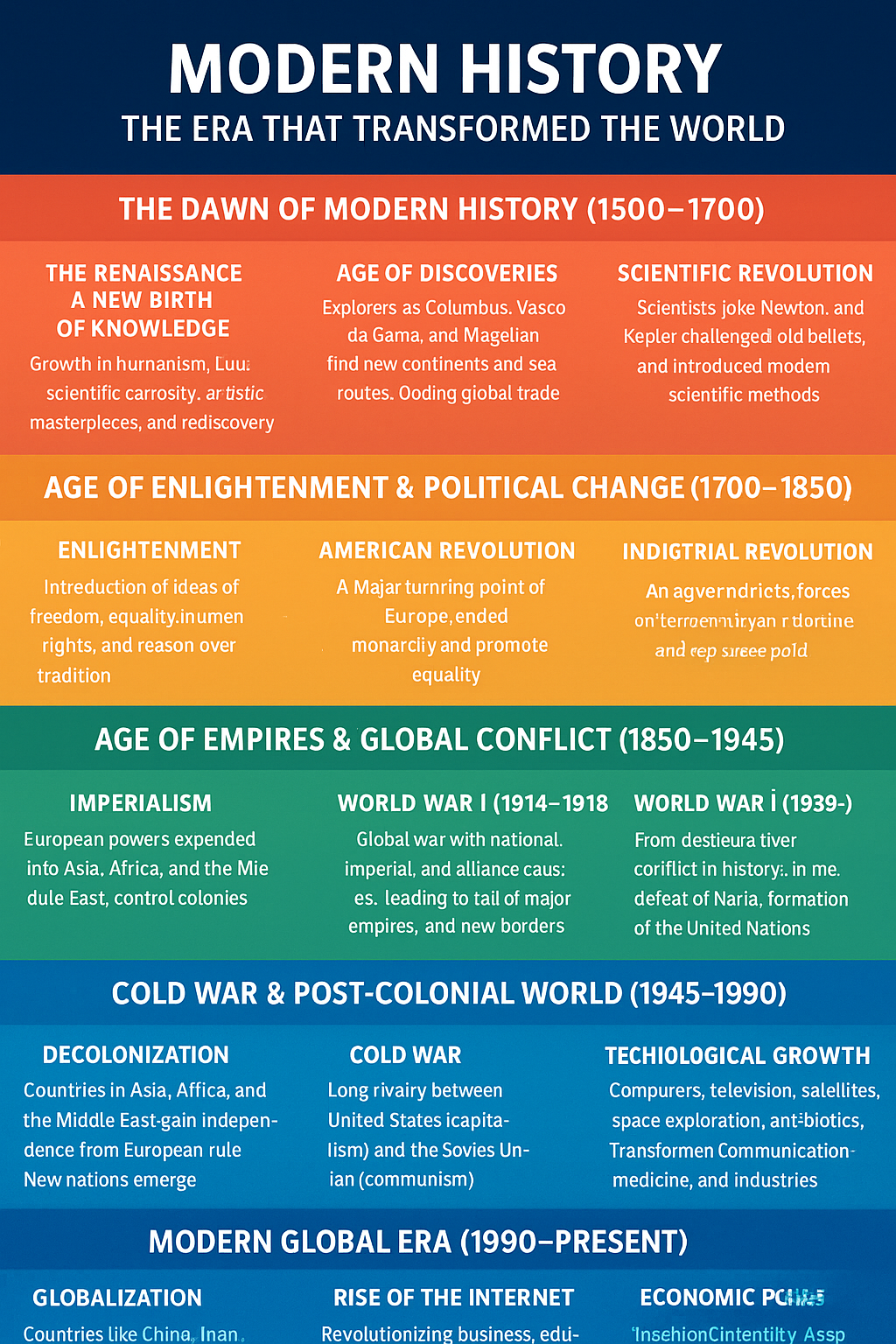
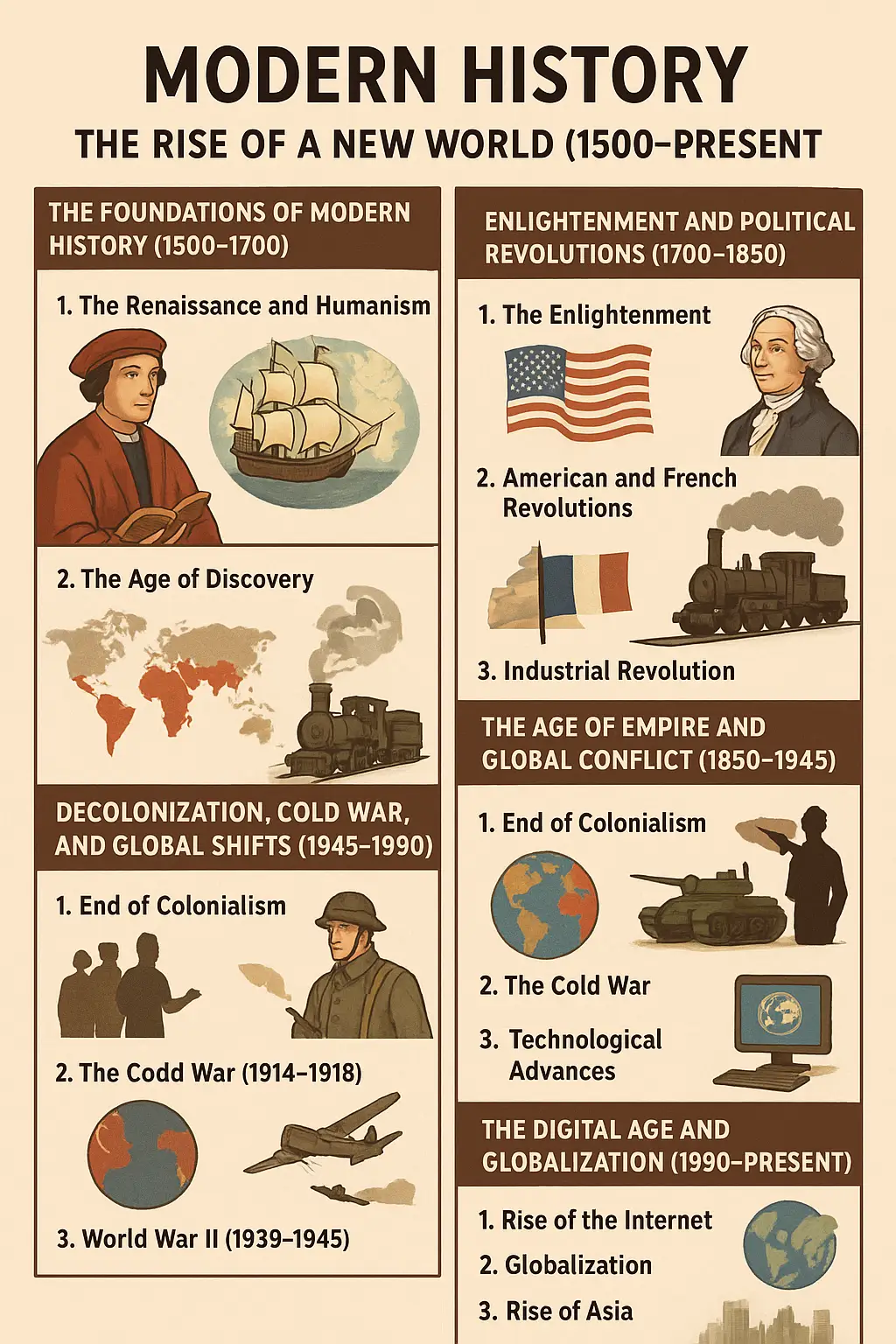
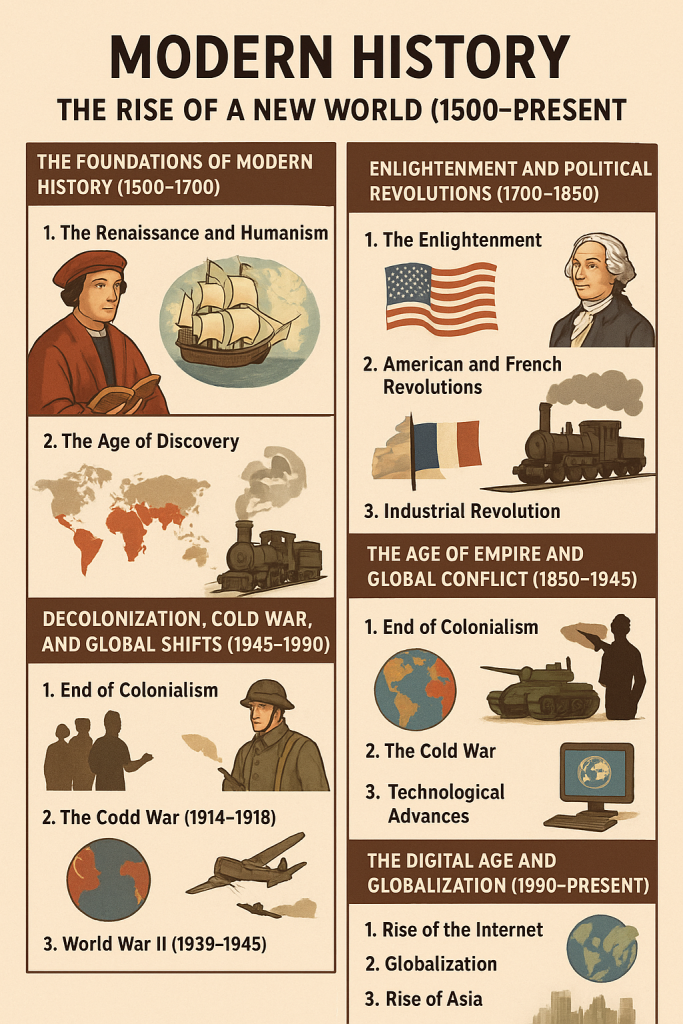
Modern history—spanning from the 16th century to the present—marks one of the most transformative periods in human civilization. This era witnessed the birth of the modern nation-state, massive global trade, scientific revolutions, industrialization, decolonization, world wars, and the digital age. Each century introduced breakthroughs that reshaped politics, economies, technology, and society. Today’s global world—connected, urbanized, and technology-driven—is the direct result of these modern historical developments.
This article explores the major phases of modern history, from the Renaissance and Enlightenment to the Industrial Revolution, world conflicts, and the rise of globalization.
The Foundations of Modern History (1500–1700)
1. The Renaissance and Humanism
The modern age began with the Renaissance, a cultural rebirth in Europe that encouraged learning, art, science, and human-centered thinking. Humanism—the idea that humans can shape their own destiny—challenged old religious and political structures. This shift laid the foundation for modern education, creativity, and scientific thought.
2. The Age of Discovery
European explorers such as Columbus, Vasco da Gama, and Magellan opened sea routes connecting Europe with Asia, Africa, and the Americas. This age launched:
- Global trade networks
- Exchanges of goods, culture, and diseases
- Expansion of empires
It also sparked colonization, which deeply shaped the social and economic structures of many regions.
3. The Scientific Revolution
Between the 16th and 17th centuries, scientists like Galileo, Kepler, and Newton introduced a new way of understanding nature through observation and experiment. Innovations in astronomy, physics, and chemistry ended many medieval beliefs and created the foundation for modern science and technology.
Enlightenment and Political Revolutions (1700–1850)
1. The Enlightenment
Thinkers such as John Locke, Rousseau, and Voltaire challenged absolute monarchies and promoted:
- Human rights
- Freedom
- Democracy
- Separation of powers
Their ideas heavily influenced modern political systems and constitutions.
2. American and French Revolutions
The Enlightenment sparked major revolutions.
American Revolution (1776)
- Established the first modern democratic republic
- Introduced principles of liberty, equality, and constitutional rights
French Revolution (1789)
- Ended absolute monarchy in France
- Promoted citizen participation in government
- Spread revolutionary ideas across Europe
These revolutions forever changed global politics and inspired freedom movements worldwide.
3. Industrial Revolution
Beginning in Britain around 1760, the Industrial Revolution was one of the most significant turning points in history. It introduced:
- Steam engines
- Factories
- Mechanized production
- Railways
- Mass communication
The Industrial Revolution shifted societies from rural agriculture to urban industry and created the basis of the modern economic system.
The Age of Empire and Global Conflict (1850–1945)
1. Imperialism and Global Expansion
European powers expanded aggressively into Asia, Africa, and the Middle East, controlling resources and people. This period increased global trade but also caused:
- Economic exploitation
- Cultural conflicts
- Resistance movements
Many future independence struggles were born during this era.
2. World War I (1914–1918)
The First World War reshaped borders and political structures. New technologies such as tanks, aircraft, and chemical weapons changed warfare forever. The war ended major empires including:
- Ottoman Empire
- Austro-Hungarian Empire
- Russian Empire
It also set the stage for political instability and future conflict.
3. The Interwar Period
The 1920s and 1930s saw:
- Economic depression
- Rise of fascism in Europe
- Weak international peace agreements
These conditions fueled another devastating conflict.
4. World War II (1939–1945)
World War II was the deadliest conflict in history, involving nearly every major nation. Major consequences included:
- Fall of Nazi Germany and Imperial Japan
- Emergence of the United States and Soviet Union as superpowers
- Creation of the United Nations
- Start of the Cold War
The war also led to worldwide movements demanding freedom from colonial rule.
Decolonization, Cold War, and Global Shifts (1945–1990)
1. End of Colonialism
After 1945, countries across Asia, Africa, and the Middle East gained independence. Leaders like Gandhi, Jinnah, Mandela, and Nkrumah helped shape new nations. Decolonization transformed global politics by shifting power away from European empires.
2. The Cold War
The rivalry between the United States (capitalism) and the Soviet Union (communism) dominated modern geopolitical history. Although both avoided direct war, the world experienced:
- Nuclear arms race
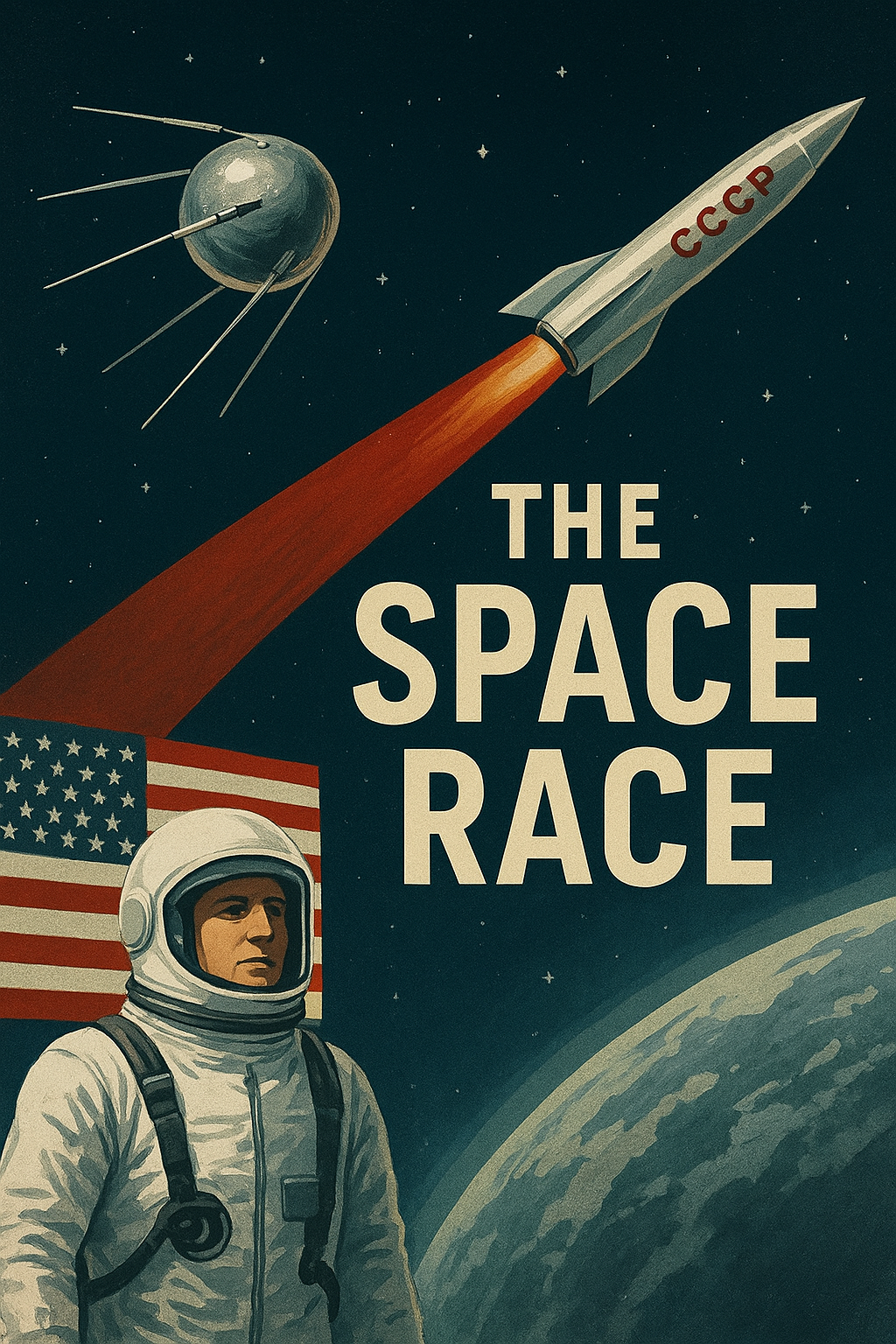
- Space race
- Proxy wars (Korea, Vietnam, Afghanistan)
The Cold War ended in 1991 with the collapse of the Soviet Union.
3. Technological Advances
The second half of the 20th century saw rapid progress:
- Television and satellites
- Nuclear energy
- Computers
- Antibiotics and medical breakthroughs
These innovations set the stage for the digital age.
The Digital Age and Globalization (1990–Present)
1. Rise of the Internet
The internet transformed communication, business, education, and culture. Search engines, smartphones, and social media connected billions of people instantly. Global information exchange became the norm.
2. Globalization
Countries became more connected through:
- International trade
- Migration
- Technology
- Multinational companies
Global supply chains and digital commerce reshaped the world economy.
3. Rise of Asia
Countries like China, India, and South Korea became major economic and technological powers, shifting global influence from West to East.
4. Climate and Environmental Awareness
Modern challenges include:
- Climate change
- Pollution
- Sustainability
Nations and organizations now focus on renewable energy, green technologies, and environmental protection.
5. Artificial Intelligence
In recent years, AI has emerged as one of the most important technological revolutions, transforming industries such as:
- Health
- Finance
- Transportation
- Education
AI marks the latest step in humanity’s modernization journey.
Conclusion
Modern history is the story of humanity’s transformation—from traditional kingdoms to industrial societies, and now to a digital global age. Every step in this journey, from the Renaissance to the Industrial Revolution and from world wars to the internet, shaped the world we live in today.
Understanding modern history helps us see how societies evolve, how conflicts arise, and how innovation drives progress. As we move deeper into the 21st century, new challenges and breakthroughs will continue to define the next chapter of modern history.