Introduction
Hidden in the depths of Yale University’s Beinecke Rare Book & Manuscript Library lies one of the greatest enigmas in human history — a book that has defied every attempt at decoding for over 600 years. Known as the Voynich Manuscript, this peculiar document is filled with strange drawings of unknown plants, mysterious astronomical symbols, and an indecipherable script that no one — not linguists, cryptographers, or even artificial intelligence — has ever conclusively understood.
Often described as “the world’s most mysterious book,” the Voynich Manuscript has inspired countless theories — from the idea that it’s an elaborate hoax to claims that it might be a lost scientific treatise or even a message from another world. Despite decades of study by experts including codebreakers from World War II, its true origin, language, and purpose remain one of history’s most enduring unsolved mysteries.
The Discovery: A Book Without a Past
The modern history of the Voynich Manuscript begins in 1912, when a rare book dealer named Wilfrid Voynich, a Polish-American antiquarian, purchased it among a collection of old manuscripts from the Villa Mondragone, a Jesuit college near Rome.
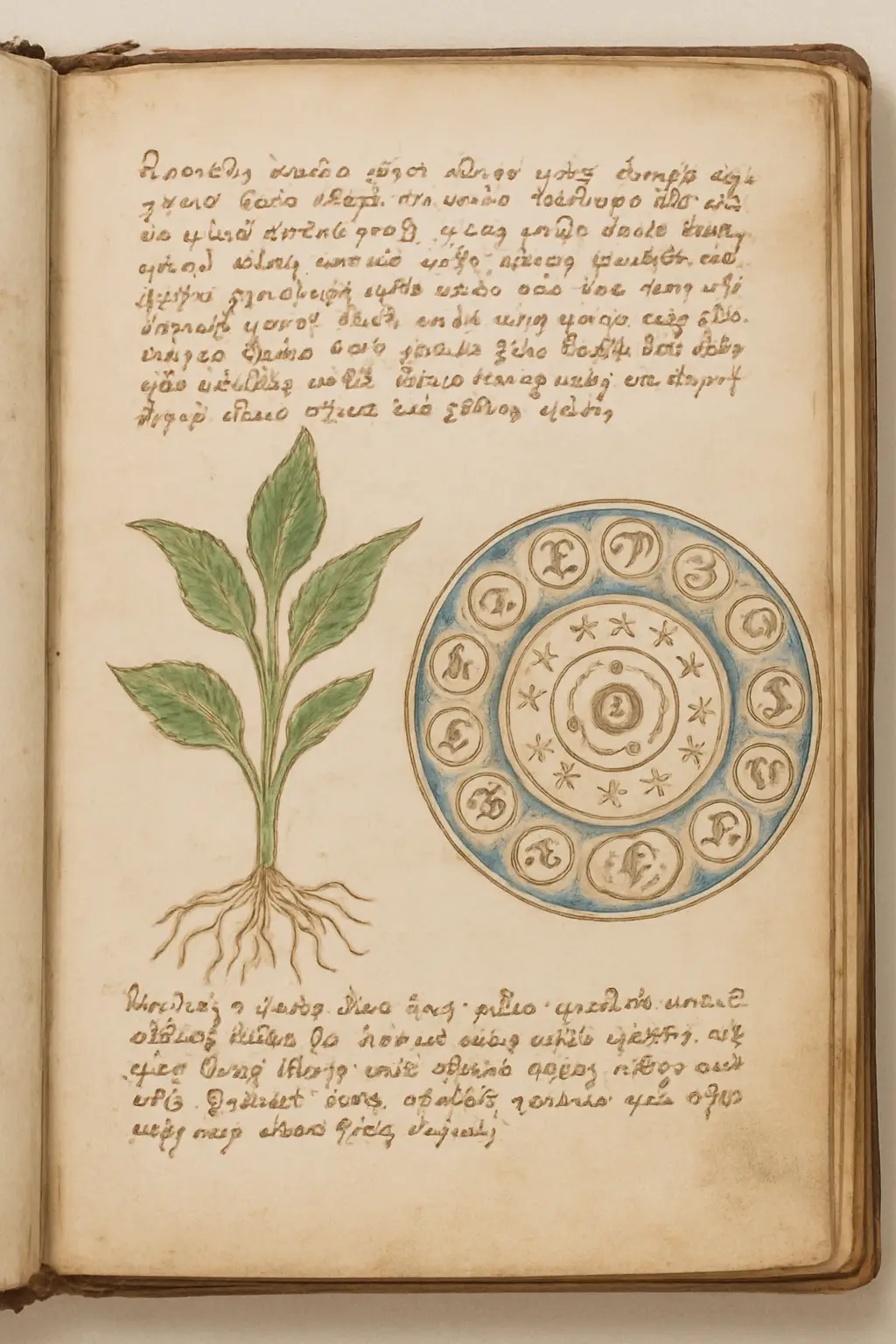
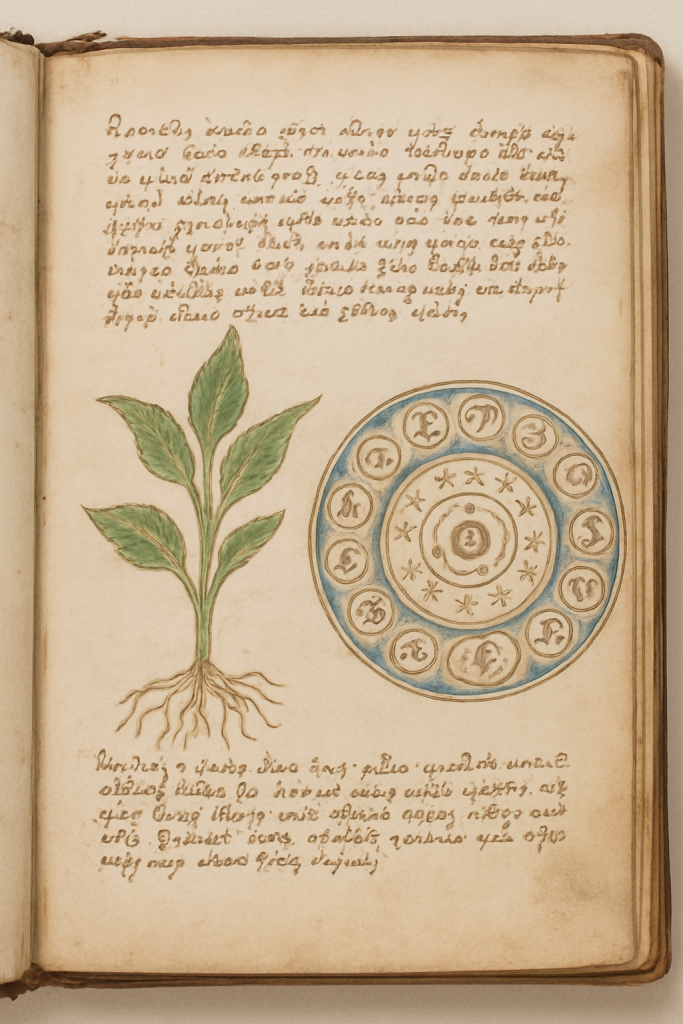
Voynich quickly realized that the book was unlike anything he had ever seen. Its pages were covered in flowing, alien-like handwriting and colorful illustrations of plants, astronomical charts, and strange nude figures bathing in green pools of liquid. Even more baffling was the language — a completely unknown script that bore no resemblance to any known writing system.
The manuscript consists of about 240 vellum pages, although evidence suggests that several are missing. Each page features both text and images, arranged neatly — suggesting it was not random doodling but a carefully structured document.
Voynich spent the rest of his life trying to decipher it, believing it was a lost work of medieval science — perhaps connected to the famed alchemist Roger Bacon (1219–1292). However, no proof ever surfaced, and Voynich died in 1930 with the mystery unsolved.
Physical Characteristics: What We Know
The Voynich Manuscript is a small, thick codex, roughly 23 cm tall and 16 cm wide. Its parchment has been carbon-dated to the early 15th century (1404–1438) — placing it firmly in the late Middle Ages, around the same time as the rise of the Renaissance.
The manuscript is divided into several distinct sections based on its illustrations:
- Botanical – Depictions of unknown plants, some resembling real species, others entirely fantastical.
- Astronomical – Star maps, suns, moons, and zodiac signs, sometimes surrounding human figures.
- Biological – Drawings of naked women connected by tubes and pools, suggesting medical or alchemical imagery.
- Cosmological – Circular diagrams possibly representing the cosmos or metaphysical concepts.
- Pharmaceutical – Images of jars, roots, and herbs, perhaps describing remedies.
- Recipes – Short paragraphs of text with stars as bullet points, possibly lists of instructions.
Each section seems to serve a specific purpose, as if the manuscript were a comprehensive encyclopedia of unknown knowledge. Yet, because no one can read it, we have no idea what it actually says.
The Language That No One Can Read
The most perplexing aspect of the Voynich Manuscript is its writing system, which consists of over 170,000 characters arranged in a consistent grammatical pattern.
Scholars refer to the unknown language as “Voynichese.” It uses about 20–30 unique symbols, written from left to right in smooth, elegant handwriting — suggesting fluency, not randomness.
Statistical analysis reveals that the text has linguistic structure: certain letters frequently appear together, and word lengths follow patterns similar to real languages. This has convinced many researchers that it’s not a hoax, but an authentic language or cipher.
However, decades of attempts to decode it — using traditional cryptography, linguistic analysis, and even artificial intelligence — have yielded only theories, not answers.
Early Attempts and Cryptographic Efforts
Since its discovery, countless scholars and codebreakers have tried to unlock the Voynich Manuscript’s secrets.
1. William Friedman and the WWII Codebreakers
During World War II, William Friedman, the American cryptanalyst who broke Japan’s “Purple” cipher, led a team of experts to examine the manuscript. Despite their success with military codes, they failed to decipher a single word.
Friedman eventually concluded that the manuscript’s text might be written in a constructed language — one invented purely for the book, possibly using an unknown cipher system.
2. Artificial Intelligence and Computer Models
In recent decades, computer scientists have applied machine learning algorithms to analyze Voynichese. Some AI models have suggested it could be a natural language written in code — possibly Hebrew, Turkish, or Latin, encrypted through substitution.
However, none of these theories have been universally accepted. Every proposed “translation” so far has fallen apart under scrutiny, as no consistent decoding produces coherent meaning across the entire text.
3. The Hoax Theory
Some skeptics, including British historian Gordon Rugg, have suggested that the Voynich Manuscript might be an elaborate hoax, designed to fool wealthy collectors in the Renaissance period. Using randomizing tools like “Cardan grids,” one could theoretically produce text that looks meaningful but is actually gibberish.
Still, this theory struggles to explain the manuscript’s complex internal structure and consistent grammar, which seem too sophisticated for a mere prank.
The Mysterious Illustrations
The manuscript’s illustrations are as baffling as its text.
1. The Plants
The botanical section depicts over 100 plant species — but none match real-world specimens exactly. Some plants appear to be composites, combining features from different species, while others resemble imaginary hybrids.
This has led some researchers to speculate that the manuscript might describe plants from an undiscovered land or symbolic representations of alchemical ingredients rather than real flora.
2. The Astronomy and Zodiac
The astronomical pages feature circular diagrams of suns, moons, and constellations. Some include recognizable zodiac signs like Pisces, Taurus, and Sagittarius, suggesting an astrological calendar.
Yet, the arrangement of stars and symbols doesn’t match known medieval systems, indicating that if it represents astronomy, it might be based on a unique cosmology or a lost scientific model.
3. The Human Figures
Among the strangest images are those of nude women bathing in green fluid, connected by pipes or channels. Some appear to be pregnant or holding stars.
Scholars have proposed interpretations ranging from medical illustrations of the female body to alchemical metaphors for purification and rebirth. Others see a more mystical dimension — perhaps representing spiritual transformation.
Possible Origins and Theories
Over the years, numerous theories have been proposed to explain the Voynich Manuscript’s origin and purpose. Some of the most prominent include:
1. A Lost Scientific Text
Many scholars believe the manuscript could be a scientific or medical compendium written in code to protect its knowledge.
During the Middle Ages, alchemists and herbalists often concealed their discoveries to avoid persecution or intellectual theft. The Voynich Manuscript might be a pharmaceutical or botanical guide from such a tradition.
2. An Unknown Language or Culture
Some linguists suggest the manuscript might represent a lost or extinct language — perhaps one spoken by a small community that left no other records.
A study by the University of Alberta in 2018 proposed that the text could be written in phonetic Old Turkish, encoded through word substitution. While intriguing, this claim remains controversial.
3. A Work of Art or Mystical Allegory
Another possibility is that the Voynich Manuscript was never meant to be “read” literally.
It could be an artistic or spiritual work, using invented language and imagery to express mystical or esoteric ideas — much like abstract art or sacred symbolism.
This interpretation aligns with the Renaissance fascination for alchemy, astrology, and secret societies, where knowledge was often cloaked in metaphor.
4. The Alien or Extraterrestrial Hypothesis
While not taken seriously by academics, some fringe theorists have speculated that the book was written by beings not of this Earth — citing the strange plants and nonhuman anatomical drawings.
Although purely speculative, this idea underscores how utterly alien the manuscript feels, even after centuries of study.
Scientific Investigations
Recent scientific analyses have provided a few concrete facts — even if they’ve deepened the mystery.
- Radiocarbon dating of the parchment places it between 1404 and 1438 CE.
- Ink composition matches materials used in Europe during that period.
- Multispectral imaging has shown that the text and illustrations were drawn at the same time, not added later — ruling out forgery.
These findings confirm that the Voynich Manuscript is authentic — a genuine medieval artifact, not a modern fabrication. But they tell us nothing about what it means.
The Human Element: Why It Matters
Beyond its linguistic puzzle, the Voynich Manuscript captivates us because it reminds us of how much of human history remains hidden.
Someone — or perhaps a group of people — devoted immense time and skill to creating this book. They wrote in a language we cannot read, about subjects we cannot understand, in a world we can barely imagine.
Whether it was a scientist, mystic, or artist, the author’s mind reached across centuries to challenge ours. The manuscript becomes less about what it says and more about the mystery of human creativity itself — the universal urge to record knowledge, even if no one else may ever comprehend it.
Conclusion
After more than six centuries, the Voynich Manuscript remains unsolved — a perfect enigma suspended between science and art, reason and imagination.
It has survived wars, fires, and generations of scholars, whispering in an unknown tongue that continues to defy the brightest minds of every era. Its pages — filled with alien plants, cosmic charts, and mysterious women — serve as a timeless reminder that not all mysteries are meant to be solved.
Perhaps its true purpose is not to be decoded, but to remind us of the limits of knowledge — and the boundless curiosity that drives us to explore the unknown.
In a world where nearly every corner of history has been mapped and digitized, the Voynich Manuscript stands as one of humanity’s last great puzzles — a silent message from the past, written in a language that only the universe itself might understand.