Introduction
Trade is one of humanity’s oldest and most transformative activities. From the earliest bartering between neighboring tribes to today’s intricate global supply chains, trade has not only moved goods but also ideas, technologies, and cultures. The history of trade is the history of civilization itself — a continuous thread connecting distant peoples and shaping economies, politics, and empires.
This article explores the evolution of trade across ancient, medieval, and modern times — tracing the major trade routes, commodities, and innovations that transformed societies and laid the groundwork for our interconnected global economy.
1. The Dawn of Trade: From Barter to Early Exchange Systems
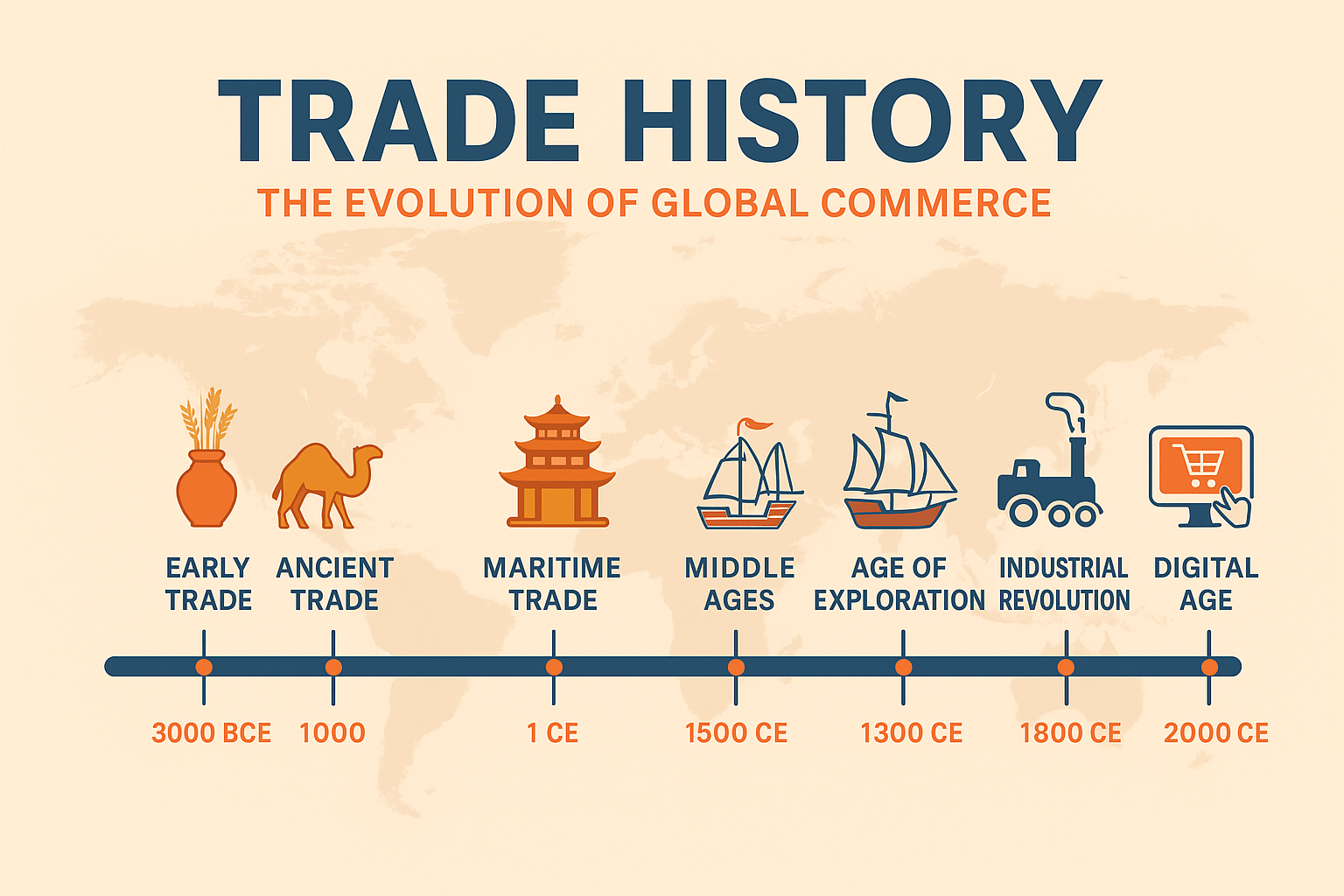
Long before coins, paper money, or banks, humans engaged in barter — the direct exchange of goods and services. Archaeological evidence suggests that organized trade began around 10,000 BCE in the Neolithic period when farming communities started producing surpluses. Farmers exchanged grain, pottery, and livestock for tools or ornaments made by specialized craftsmen.
One of the earliest centers of trade was Mesopotamia, where the Sumerians traded textiles and grains for metals and stones from Persia and Anatolia. The development of writing — particularly cuneiform tablets — was largely driven by the need to record trade transactions. Around 3,000 BCE, merchants in Egypt and the Indus Valley Civilization were conducting long-distance trade via river and coastal routes, exchanging gold, ivory, spices, and textiles.
By 2000 BCE, trade networks stretched from the Mediterranean to South Asia, with caravan routes crossing deserts and maritime trade expanding along coastlines. The invention of the wheel and the sail dramatically boosted mobility, making it possible to transport larger quantities of goods across greater distances.
2. The Silk Road: Connecting East and West
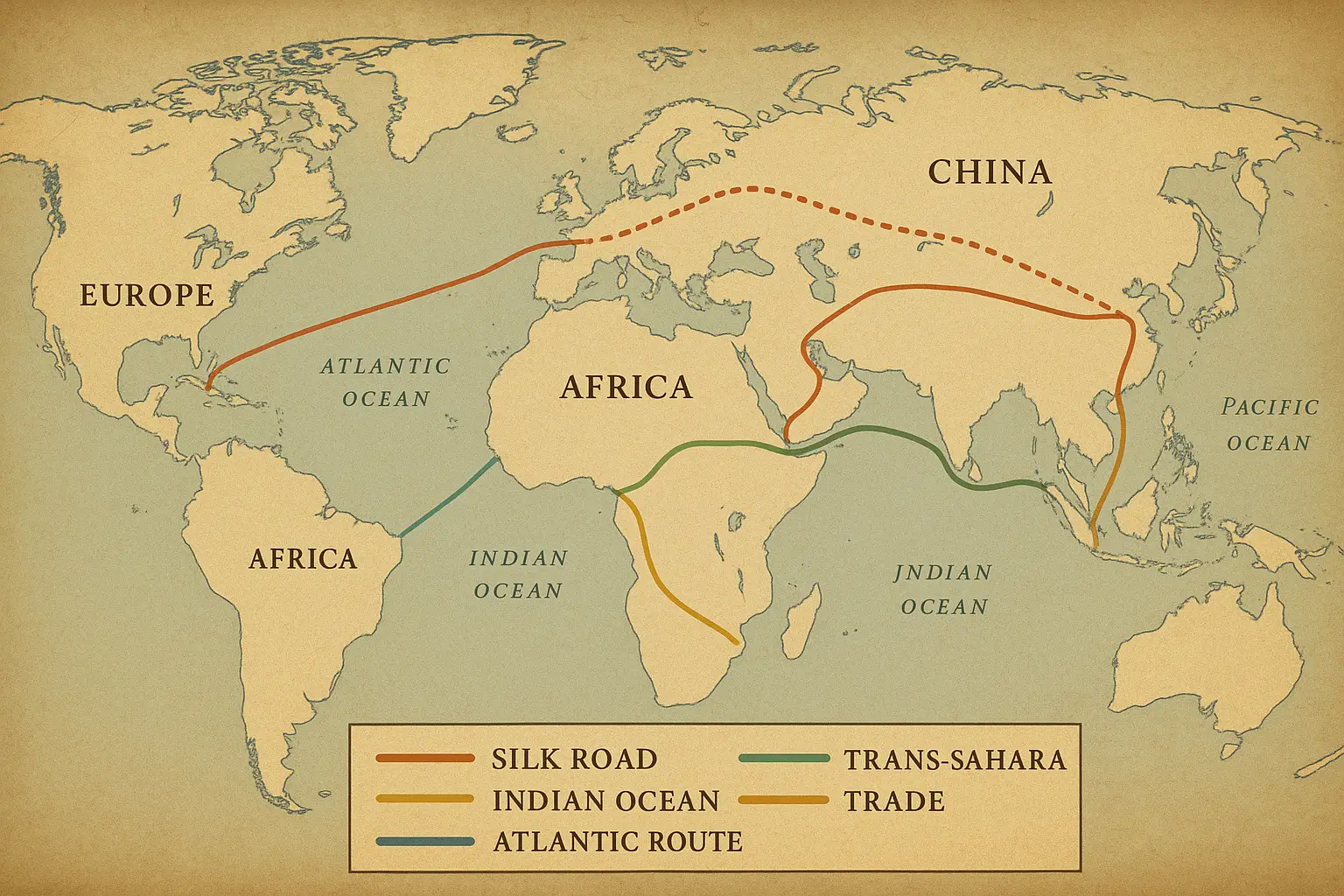
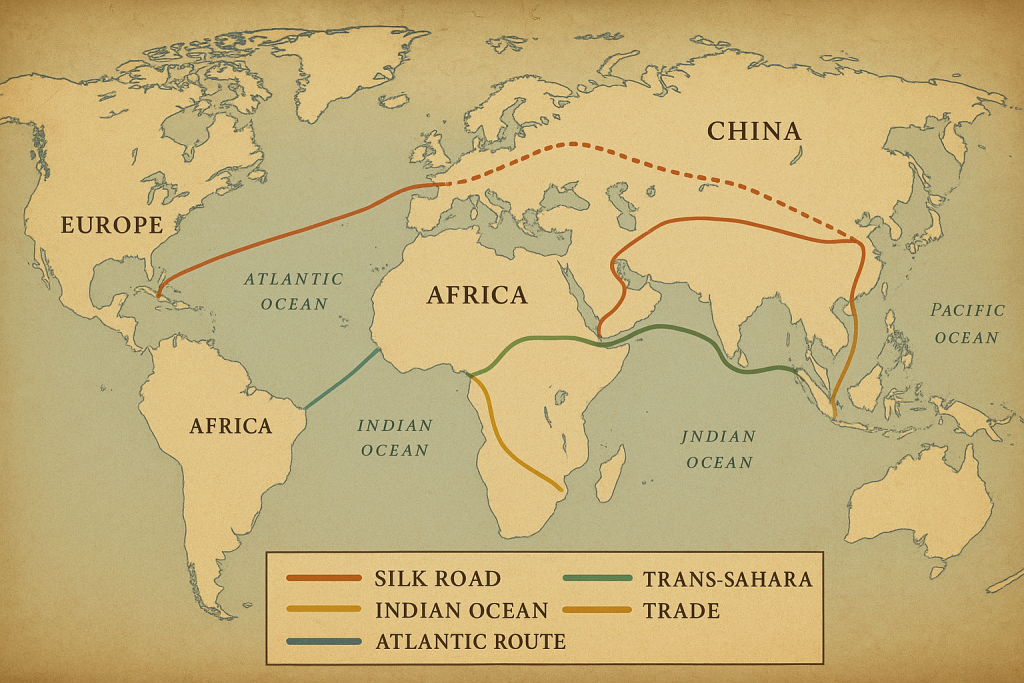
No discussion of trade history is complete without mentioning the Silk Road, perhaps the most legendary network of trade routes in human history. Beginning during the Han Dynasty (206 BCE – 220 CE), the Silk Road linked China to the Mediterranean through Central Asia, covering thousands of miles across mountains, deserts, and plains.
The route got its name from silk — a highly coveted Chinese export — but a vast array of other goods were traded: spices, glassware, gems, ivory, and even paper. The Silk Road wasn’t a single road but a complex web of overland and maritime routes.
Through these routes, the Roman Empire and later Byzantium traded with the Chinese, while merchants in India and Persia acted as intermediaries. But more than goods, the Silk Road facilitated the exchange of ideas, religions, and technologies. Buddhism spread from India into China and East Asia; papermaking and gunpowder traveled westward.
By the 14th century, under Mongol rule, the Silk Road reached its peak, protected by the Pax Mongolica. Yet the rise of maritime trade routes in the 15th and 16th centuries gradually reduced its dominance.
3. Maritime Trade Empires: The Age of Exploration
The late Middle Ages and Renaissance saw a shift from land-based to sea-based trade. European nations sought direct access to the riches of Asia, bypassing the overland routes controlled by Islamic empires. This quest gave rise to the Age of Exploration (15th–17th centuries) — a period that transformed global trade forever.
- Portugal pioneered the maritime route around Africa’s Cape of Good Hope under explorers like Vasco da Gama, establishing trading posts from East Africa to India.
- Spain, following Christopher Columbus’s voyages, created a transatlantic empire linking Europe with the Americas and Asia through the Manila Galleons — ships that carried silver from the New World to China in exchange for silk and porcelain.
- The Dutch and British East India Companies, founded in the early 1600s, became powerful commercial and colonial enterprises. They established monopolies over spices, textiles, and tea, often backed by military might.
These developments ushered in the first era of globalization. Products like sugar, coffee, tobacco, and cotton became staples of European life, while gold and silver from the Americas fueled both trade and empire-building. Yet, this era also carried a dark side: the Atlantic slave trade, which forcibly moved millions of Africans across the ocean to work in plantation economies that enriched European powers.
4. Trade and the Rise of Modern Capitalism
By the 18th century, trade networks had expanded across every continent. The Industrial Revolution further accelerated global commerce by introducing mechanized production, railways, and steamships. Britain’s dominance in textile manufacturing made it the “workshop of the world,” importing raw cotton from India and America and exporting finished goods worldwide.
Trade drove the rise of mercantilism, a system in which nations sought to accumulate wealth through exports and colonies. However, the Enlightenment and the works of economists like Adam Smith challenged these views, arguing for free trade and comparative advantage. The 19th century saw a shift toward liberalized trade policies, exemplified by the Repeal of the Corn Laws (1846) in Britain.
New trade routes — including the Suez Canal (1869) and Panama Canal (1914) — revolutionized maritime logistics, cutting travel times dramatically. The telegraph and later the telephone connected markets and stock exchanges, laying the groundwork for the financial globalization of the 20th century.
5. Colonialism and Unequal Trade
While trade fueled prosperity in Europe, it often had devastating consequences for colonized regions. The British exploitation of India’s resources, the Dutch control over the Spice Islands, and the transatlantic trade in enslaved Africans all reveal the darker side of global commerce.
Colonial powers extracted raw materials at low cost and sold back expensive manufactured goods, creating dependency and economic inequality that persists in many regions today. The so-called “Scramble for Africa” in the late 19th century was as much about securing trade routes and resources as it was about political dominance.
However, colonial trade also led to cultural blending — from language and cuisine to religion and architecture — leaving a complex legacy that continues to shape the modern world.
6. Twentieth-Century Transformation: From Protectionism to Globalization
The two World Wars disrupted trade networks and caused widespread economic turmoil. In response, new systems were established to stabilize and encourage global trade. The Bretton Woods Conference (1944) created institutions like the International Monetary Fund (IMF) and World Bank, and later the General Agreement on Tariffs and Trade (GATT), which evolved into the World Trade Organization (WTO).
Post-war reconstruction and the rise of the United States as an economic superpower ushered in an era of consumerism and mass production. The containerization revolution in the 1950s and 1960s — led by standardized shipping containers — made global shipping cheaper and more efficient than ever before.
By the late 20th century, trade liberalization and the rise of digital communication gave birth to globalization as we know it. Asian economies like Japan, South Korea, and later China became industrial powerhouses, exporting electronics, machinery, and textiles to Western markets. The creation of regional trade blocs like the European Union (EU) and North American Free Trade Agreement (NAFTA) further integrated economies.
7. The Digital Era and the Future of Trade
Today, trade is more complex and interconnected than at any point in history. The digital revolution has created a new kind of commerce — e-trade — where data, software, and services move across borders in milliseconds. Companies like Amazon, Alibaba, and Shopify have redefined what it means to be a global merchant.
Modern trade is also being reshaped by geopolitics, climate change, and supply chain vulnerabilities exposed by events such as the COVID-19 pandemic and conflicts like the Russia-Ukraine war. Nations are increasingly focusing on “friend-shoring” and regional trade alliances to secure essential goods such as semiconductors, energy, and food supplies.
At the same time, sustainability and ethical sourcing have become major priorities. Consumers and corporations alike are rethinking production, demanding transparency and environmental responsibility in trade practices.
Conclusion: The Legacy and Lessons of Trade History
From the clay tablets of Mesopotamia to the algorithms of e-commerce, trade has been the lifeblood of human civilization. It has built empires, connected continents, and spurred innovation — but it has also led to exploitation, inequality, and environmental strain.
Understanding the history of trade is crucial not just for economists but for anyone interested in how human societies evolve. The patterns of past trade — cooperation, competition, innovation, and imbalance — continue to shape the global order today.
As we enter a new era defined by digital economies and climate challenges, the lessons of history remind us that trade is never just about goods — it’s about people, power, and progress. The future of trade will depend on how well humanity learns from its past: balancing profit with fairness, efficiency with sustainability, and globalization with equity.