Introduction
History is filled with events and discoveries that continue to baffle even the sharpest minds. Despite centuries of progress in science, archaeology, and historical research, certain questions remain unanswered — locked behind the veil of time. From the disappearance of civilizations to cryptic codes and vanished explorers, these mysteries persist not merely because they are unsolved, but because they challenge our understanding of what is possible.
In this exploration, we’ll journey through some of the most intriguing historical enigmas that continue to puzzle historians and researchers today — not fictional tales, but genuine, documented cases that resist definitive explanation.
1. The Disappearance of the Indus Valley Civilization
Around 2600 BCE, the Indus Valley Civilization (also known as the Harappan Civilization) flourished across present-day Pakistan and northwest India. With advanced urban planning, drainage systems, and standardized weights and measures, it was one of the world’s first great civilizations.
Yet by 1900 BCE, this sophisticated society mysteriously declined. Archaeological evidence shows that many major cities, including Harappa and Mohenjo-Daro, were abandoned. Scholars have proposed several theories:
- Climate change and river shifts — the drying of the Saraswati River and changes in monsoon patterns may have devastated agriculture.
- Economic and trade decline — loss of trade connections with Mesopotamia weakened urban centers.
- Gradual migration — people may have moved east toward the Ganges plain rather than perishing suddenly.
No single explanation fits all evidence, leaving one of the world’s first urban collapses an enduring riddle.
2. The Lost Colony of Roanoke
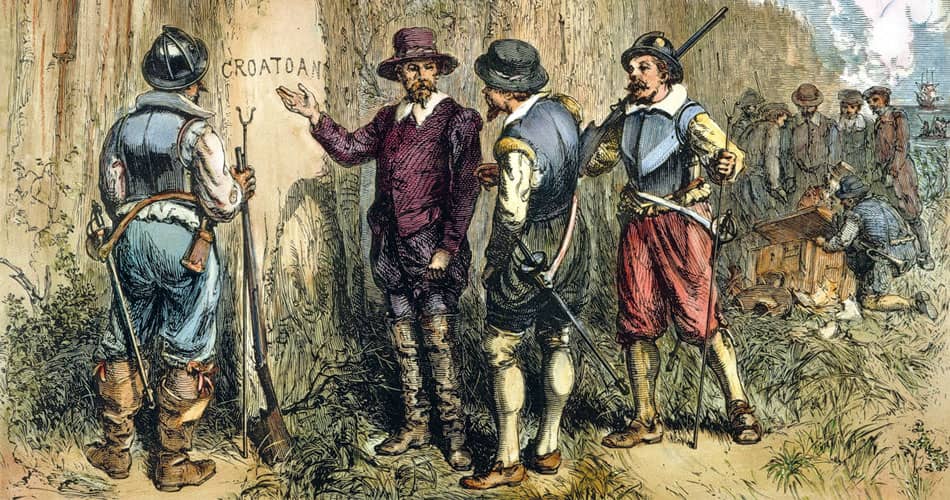
In 1587, more than 100 English settlers landed on Roanoke Island, off the coast of modern North Carolina, aiming to establish England’s first permanent colony in the New World. Their leader, John White, sailed back to England for supplies. When he returned in 1590, the colony had vanished — no bodies, no signs of struggle, and only a single clue carved into a tree: the word “CROATOAN.”
Historians have debated the meaning of that word for centuries. It may have referred to Croatoan Island (now Hatteras Island), suggesting the settlers joined local Native American tribes. DNA studies and oral traditions among some Native communities hint this could be true — yet no definitive archaeological evidence confirms it.
The “Lost Colony” remains one of America’s oldest unsolved mysteries, symbolizing both the courage and peril of early colonial ventures.
3. The Mystery of the Voynich Manuscript
Perhaps no historical artifact has frustrated cryptographers more than the Voynich Manuscript — a 15th-century illustrated book filled with undecipherable writing and strange botanical drawings. Discovered in 1912 by book dealer Wilfrid Voynich, the manuscript’s origins and purpose are unknown.
Radiocarbon dating places it between 1404 and 1438, and it’s written on fine calfskin parchment — but in an unknown language or code. Some believe it’s an elaborate hoax; others think it encodes real scientific or alchemical knowledge.
Despite modern computational analysis, including artificial intelligence efforts, the text remains unreadable. Institutions like Yale University’s Beinecke Library, which holds the manuscript, continue to attract linguists and historians seeking to decode it — a quest that bridges science, history, and mystery.
4. The Fate of the Roman Ninth Legion
The Ninth Legion Hispana was a legendary Roman military unit that vanished from records sometime after 108 CE. Stationed in Britain, the legion suddenly disappears from official Roman documents — with no record of its destruction, transfer, or disbandment.
For decades, historians speculated that the legion was annihilated by rebellious tribes in northern Britain, perhaps during a disastrous campaign. However, newer evidence suggests the legion may have been transferred to the east, possibly to guard the frontier in modern-day Turkey or the Middle East.
Still, the lack of conclusive proof keeps the debate alive. The mystery inspired literature and film — notably Rosemary Sutcliff’s The Eagle of the Ninth — but the historical truth remains uncertain: how could one of Rome’s most formidable legions simply disappear?
5. The Antikythera Mechanism — Ancient Technology Ahead of Its Time
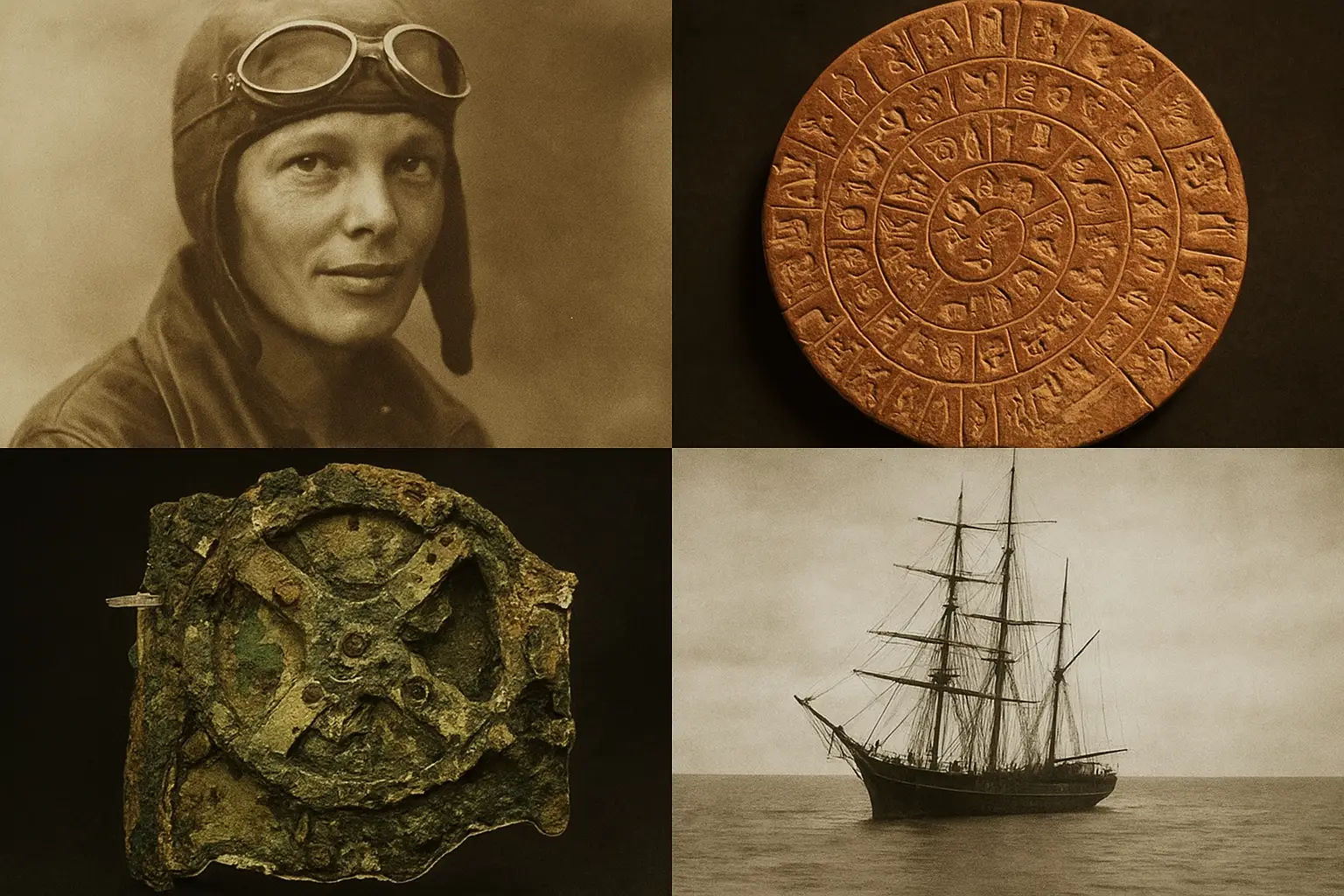
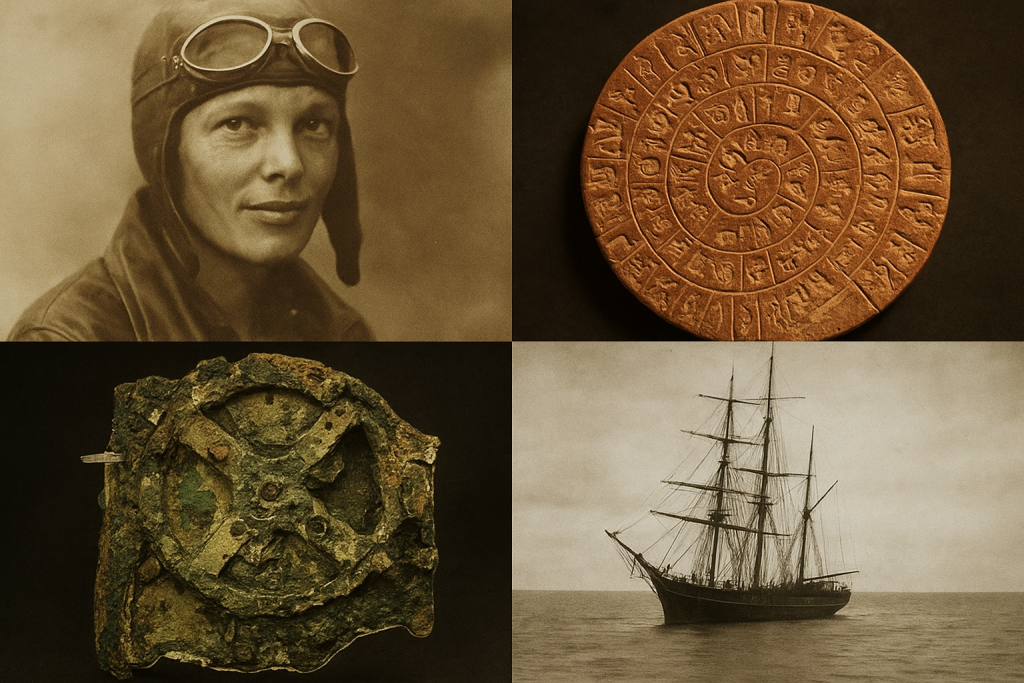
In 1901, divers exploring a shipwreck off Antikythera Island, Greece, recovered a corroded bronze device that would rewrite our understanding of ancient science. Known as the Antikythera Mechanism, the artifact was a complex system of gears used to predict celestial events such as solar eclipses and planetary movements — a kind of ancient “computer.”
Studies by the National Archaeological Museum of Athens and University College London have revealed that the device’s design reflects astonishing mathematical precision. It dates to around 100 BCE, over a millennium before comparable mechanisms appeared again in Europe.
How did ancient engineers acquire such sophisticated knowledge of gears and astronomy? No other surviving artifact from the ancient world shows similar technology. The mechanism’s origins — and why such knowledge disappeared for centuries — remain one of history’s most tantalizing unsolved mysteries.
6. The Disappearance of Amelia Earhart
On July 2, 1937, aviation pioneer Amelia Earhart and her navigator Fred Noonan vanished over the Pacific Ocean while attempting to circumnavigate the globe. Their last known position was near Howland Island, but despite one of the largest search operations in history, no confirmed wreckage has ever been found.
Numerous theories exist:
- Crash and sink — the aircraft ran out of fuel and fell into the ocean.
- Gardner Island hypothesis — Earhart may have landed on Nikumaroro Island (formerly Gardner Island) and died as a castaway.
- Capture theory — some believe she was taken prisoner by the Japanese in the Marshall Islands.
Recent archaeological digs on Nikumaroro by The International Group for Historic Aircraft Recovery (TIGHAR) have uncovered artifacts consistent with the time period, but no conclusive evidence. Earhart’s disappearance remains one of aviation’s greatest unsolved puzzles.
7. The Secret of the Phaistos Disc
Unearthed in 1908 on the island of Crete, the Phaistos Disc is a 15-centimeter clay artifact stamped with mysterious symbols arranged in a spiral. It dates back to around 1700 BCE, associated with the Minoan civilization.
Its 241 symbols appear to form a script unlike any other — not Linear A or B, the known Minoan writing systems. Scholars have proposed theories ranging from a hymn or prayer to an early printing experiment.
Despite decades of research, the disc’s meaning remains undeciphered. Without additional examples of the same writing, the Phaistos Disc continues to defy translation, standing as a mute witness to a lost chapter of human communication.
8. The Mary Celeste: The Ship That Sailed Without a Crew
In December 1872, the Mary Celeste, an American merchant ship, was found drifting in the Atlantic Ocean — completely intact, cargo untouched, yet eerily abandoned. The last log entry was normal, and the crew’s belongings were undisturbed.
Theories abound: a sudden water spout, alcohol fumes causing an evacuation, piracy, or even mutiny. However, no trace of the crew or passengers was ever found. Maritime historians today believe the most likely cause was a temporary evacuation due to an onboard emergency (perhaps a false alarm about fire or explosion), after which the lifeboat drifted away.
Still, without definitive proof, the Mary Celeste endures as one of the sea’s most haunting mysteries.
9. The Identity of Jack the Ripper
No list of historical mysteries would be complete without Jack the Ripper, the unidentified serial killer who terrorized London’s Whitechapel district in 1888. Despite intense investigation and hundreds of suspects over the decades, his identity has never been confirmed.
Modern forensic analysis of letters and crime scene evidence has pointed to several possibilities — from Polish barber Aaron Kosminski to writer Francis Tumblety — but none are definitive. DNA analysis of evidence items has been inconclusive or disputed.
Jack the Ripper remains one of the most infamous figures in criminal history — a reminder of both the limits of 19th-century forensics and the enduring fascination with mystery.
Conclusion
Unsolved mysteries are not just puzzles to be cracked — they are mirrors reflecting the limits of human knowledge. Each unanswered question reveals how fragile our understanding of the past can be. Whether it’s a vanished civilization, a lost explorer, or a coded manuscript, these enigmas remind us that history is never complete.
In a world driven by data and discovery, the persistence of mystery keeps our curiosity alive. It is that curiosity — the hunger to know, to connect, and to understand — that truly defines what it means to be human.
Perhaps someday, technology or chance discovery will shed light on these dark corners of history. Until then, they remain the silent echoes of the past — whispering that some stories are meant to be sought, not solved.