Introduction
History is filled with strange, unexplained phenomena — but few are as unsettling, vivid, and well-documented as the Dancing Plague of 1518. In July of that year, in the bustling city of Strasbourg, then part of the Holy Roman Empire, dozens of ordinary townspeople began to dance uncontrollably in the streets. What began with one woman’s spontaneous movements escalated into a month-long outbreak involving hundreds, many of whom collapsed or even died from exhaustion.
The event has since fascinated scholars across disciplines: historians, psychologists, anthropologists, and medical experts. It challenges the boundaries between faith and science, reason and madness, and reveals how collective belief, environment, and human psychology can interact in unpredictable — even deadly — ways.
In this article, we’ll explore the historical context that made such a phenomenon possible, the key events of the outbreak, the leading theories that attempt to explain it, and what the Dancing Plague still teaches us about mass hysteria and human behavior.
1. Strasbourg in 1518: A City Under Strain
To understand how an entire city could erupt into frenzied, uncontrollable dancing, we must look at Strasbourg’s social and environmental conditions in the early 16th century.
In 1518, Strasbourg (now in modern-day France) was a prosperous trading city within the Holy Roman Empire, but it was also a place of hardship and tension. Europe was in the midst of recurring plagues, famine, and economic instability. That summer, a series of failed harvests had led to widespread hunger. Disease outbreaks, combined with intense heat and poor sanitation, made daily life a struggle.
Adding to this was a deeply religious worldview. People believed that supernatural forces — saints, demons, or divine punishment — could influence physical health and behavior. In such a climate of fear and faith, strange collective phenomena could easily take hold.
In the words of historian John Waller, whose 2009 book A Time to Dance, A Time to Die remains the most detailed study of the event, Strasbourg in 1518 was a “city on edge,” and all it needed was a spark to ignite chaos.
2. The Spark: Frau Troffea’s Mysterious Dance
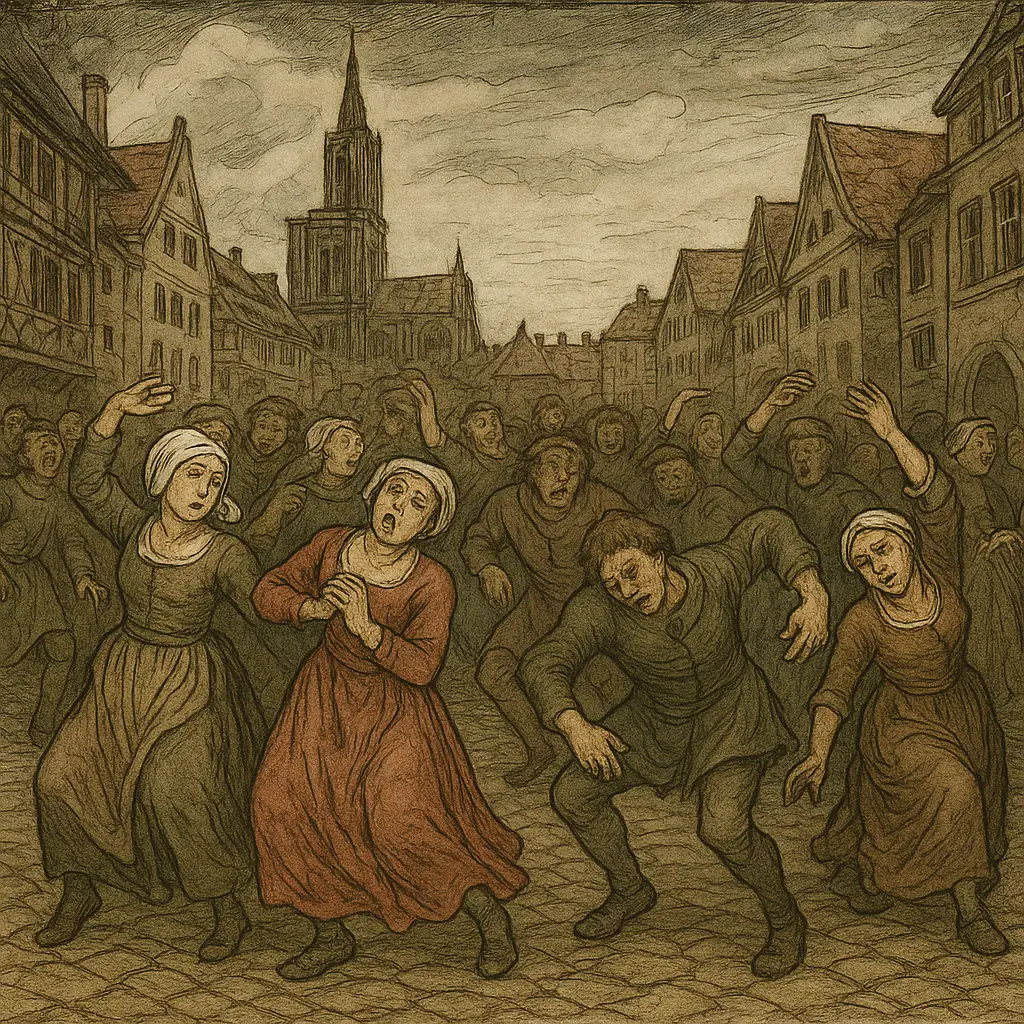
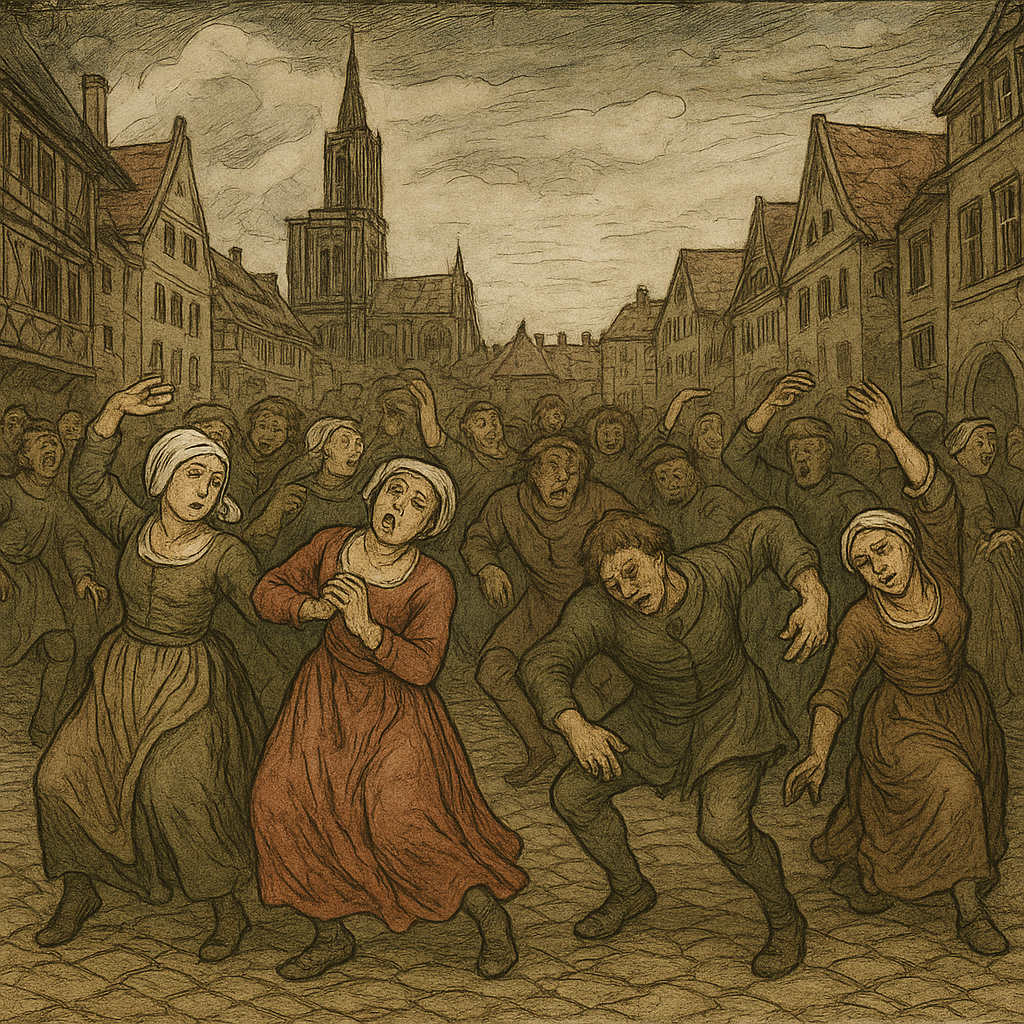
The Dancing Plague began quietly on July 14, 1518. A woman known only as Frau Troffea stepped into the street near her home and began to dance. She danced for hours, showing no signs of fatigue or joy — witnesses said her movements seemed involuntary, mechanical, almost desperate.
At first, curious neighbors gathered to watch. Some laughed, others worried. But when she continued into the next day, and the next, the mood shifted from amusement to alarm. Within a week, more than thirty people had joined her, dancing uncontrollably through the streets.
Eyewitness accounts describe scenes of exhaustion and horror: people collapsing, foaming at the mouth, gasping for breath, yet unable to stop. Some were carried away to their homes, only to resume dancing again later.
The authorities were baffled. Religious leaders claimed it was a curse or divine punishment, perhaps from Saint Vitus, the patron saint of dancers and epileptics — hence the event’s other historical name: “St. Vitus’s Dance.”
3. Escalation: The City Loses Control
As July turned into August, the number of dancers swelled to between 200 and 400. Town officials, believing the dancers would recover if they simply danced the affliction out, took a shocking step: they built a stage and hired musicians to accompany the madness.
According to the Chronicle of Kleinkawel (1526), “They danced day and night without rest, and many fell dead from exhaustion.”
But the authorities soon realized their mistake. Instead of curing the epidemic, the music only encouraged more people to join. Panic spread across Strasbourg. The city council finally intervened, banning public dancing, closing inns, and seizing instruments.
Desperate to end the madness, the council arranged to transport the afflicted to a shrine dedicated to Saint Vitus, located in the nearby mountains. There, priests performed rituals of exorcism and prayer, anointing the dancers’ feet with holy oil. Slowly, the plague subsided — though not before taking an unknown number of lives.
4. Searching for Explanations
The Dancing Plague of 1518 remains one of the most studied cases of mass hysteria in history. While the written records confirm that it happened, no single explanation fully accounts for the scale and intensity of the outbreak. Scholars have proposed several theories.
4.1. Ergot Poisoning
One of the earliest scientific explanations, proposed in the 1970s, blames ergot, a toxic fungus that grows on damp rye. Ergot contains lysergic acid, the same chemical base as LSD, and can cause hallucinations, convulsions, and spasms.
Since 1518 was a year of poor harvests and damp weather, some historians theorized that the townspeople had eaten contaminated bread, leading to hallucinations and frenzied movement.
However, this theory doesn’t fully fit the evidence. Ergot poisoning tends to cause violent convulsions and gangrene, not coordinated, rhythmic dancing — and it would have affected individuals randomly, not collectively for a month.
4.2. Mass Psychogenic Illness (Mass Hysteria)
The most widely accepted modern theory is mass psychogenic illness, also known as mass hysteria. In this view, the dancing was a psychological reaction to stress and fear, expressed through physical movement.
Living under conditions of famine, disease, and intense religiosity, the people of Strasbourg were primed for a collective trance state. Once one person (Frau Troffea) began dancing, the behavior spread through emotional contagion — others subconsciously mimicked her movements, swept up in a shared belief that they were under divine influence.
John Waller argues that the afflicted “believed they had been cursed by Saint Vitus,” and that belief made the physical symptoms real.
This type of psychogenic illness has parallels throughout history — from the Salem witch trials to modern mass fainting incidents — showing how the mind can produce genuine physical responses to psychological stress.
4.3. Religious Ecstasy and Cultural Belief
Another theory emphasizes the role of religion and ritual. In medieval Europe, dancing had spiritual connotations: it was both a form of devotion and a perceived punishment. There were earlier “dancing manias” recorded in Aachen (1374), Cologne, and Metz, often linked to saintly miracles or penance rituals.
In Strasbourg, the cult of Saint Vitus was particularly strong. Some people genuinely believed that failing to honor the saint could lead to divine punishment — often described as “dancing madness.” Once that idea took hold, seeing others afflicted could trigger the same behavior, as if under a spell.
5. The Aftermath: Lessons from a Forgotten Epidemic
By early September 1518, the dancing plague had ended as mysteriously as it began. City officials recorded the incident in local chronicles but offered little analysis — it was seen as divine will, a warning, or a curse lifted.
For centuries, the event was largely forgotten, resurfacing only in 19th- and 20th-century historical studies. Today, it serves as a landmark case in understanding mass psychological phenomena and social contagion.
5.1. Human Vulnerability to Group Behavior
The Dancing Plague reminds us how profoundly social humans are. When fear, faith, and environment combine, people can lose individual control and enter a collective trance. Modern psychologists point to similar phenomena — from financial panics to viral trends — as examples of how group psychology can override logic.
5.2. The Power of Belief
Whether it was divine punishment, spiritual ecstasy, or mental stress, the dancers of Strasbourg acted on their beliefs — and those beliefs made their suffering real. In an age before science could explain disease or neurology, belief systems filled the gap, often with frightening results.
5.3. Environmental and Social Pressure
The 1518 outbreak also shows the role of environment in human behavior. Heat, famine, and disease create physiological stress that can amplify psychological fragility. Even today, under extreme conditions, similar “collective behaviors” can emerge — panic buying, riots, or sudden mass fainting in schools.
6. Modern Reflections: Are We Still Dancing?
It’s tempting to view the Dancing Plague as a relic of medieval superstition, something impossible in our rational modern age. But history suggests otherwise.
Modern “dancing plagues” may not involve physical movement, but they manifest in similar ways — through viral social behavior. From mass online hysteria and conspiracy theories to panic-driven social movements, we still experience collective contagions of emotion and belief.
Psychologist Dr. Robert Bartholomew, an expert on mass hysteria, notes that “the internet has become the new marketplace of contagion.” The same mechanisms that once spread dancing through medieval Strasbourg now spread ideas, fears, and obsessions globally in seconds.
In that sense, the Dancing Plague of 1518 is not just a medieval oddity — it’s a mirror.
Conclusion
The Dancing Plague of 1518 remains one of history’s most haunting examples of how human minds and bodies can respond to extreme stress. What began as one woman’s mysterious compulsion became a month-long tragedy that defied logic and reason.
Though centuries have passed, the story continues to captivate because it speaks to something timeless — the fragile line between mind and body, reason and belief, individual and crowd. Whether it was caused by poison, psychosis, or faith, the dancers of Strasbourg remind us that human behavior, under pressure, can still surprise us.
In a world where modern anxieties spread faster than ever, their story endures as a warning: when belief and fear dance together, reason often sits out.