Introduction
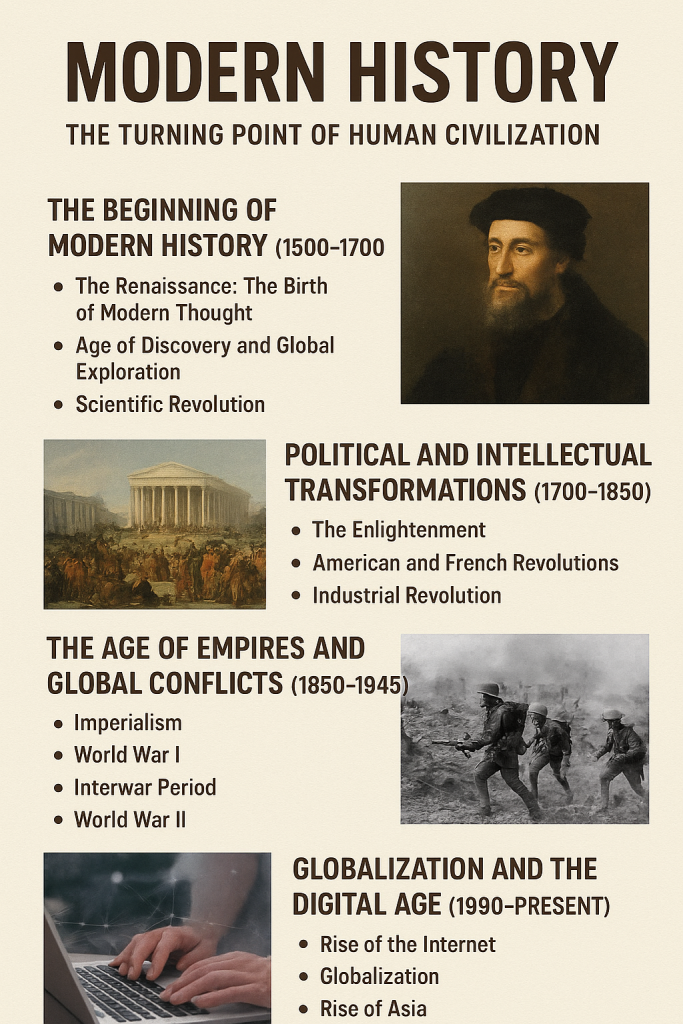
Modern history refers to the period from the late 15th century to the present day, marked by revolutions in science, politics, economy, technology, and society. This era transformed the world from traditional kingdoms and empires into today’s globalized, industrial, and digital society. Modern history is shaped by major events like the Renaissance, Enlightenment, Industrial Revolution, world wars, decolonization, and the rise of the digital age.
This article explores these major phases and how they shaped the modern world.
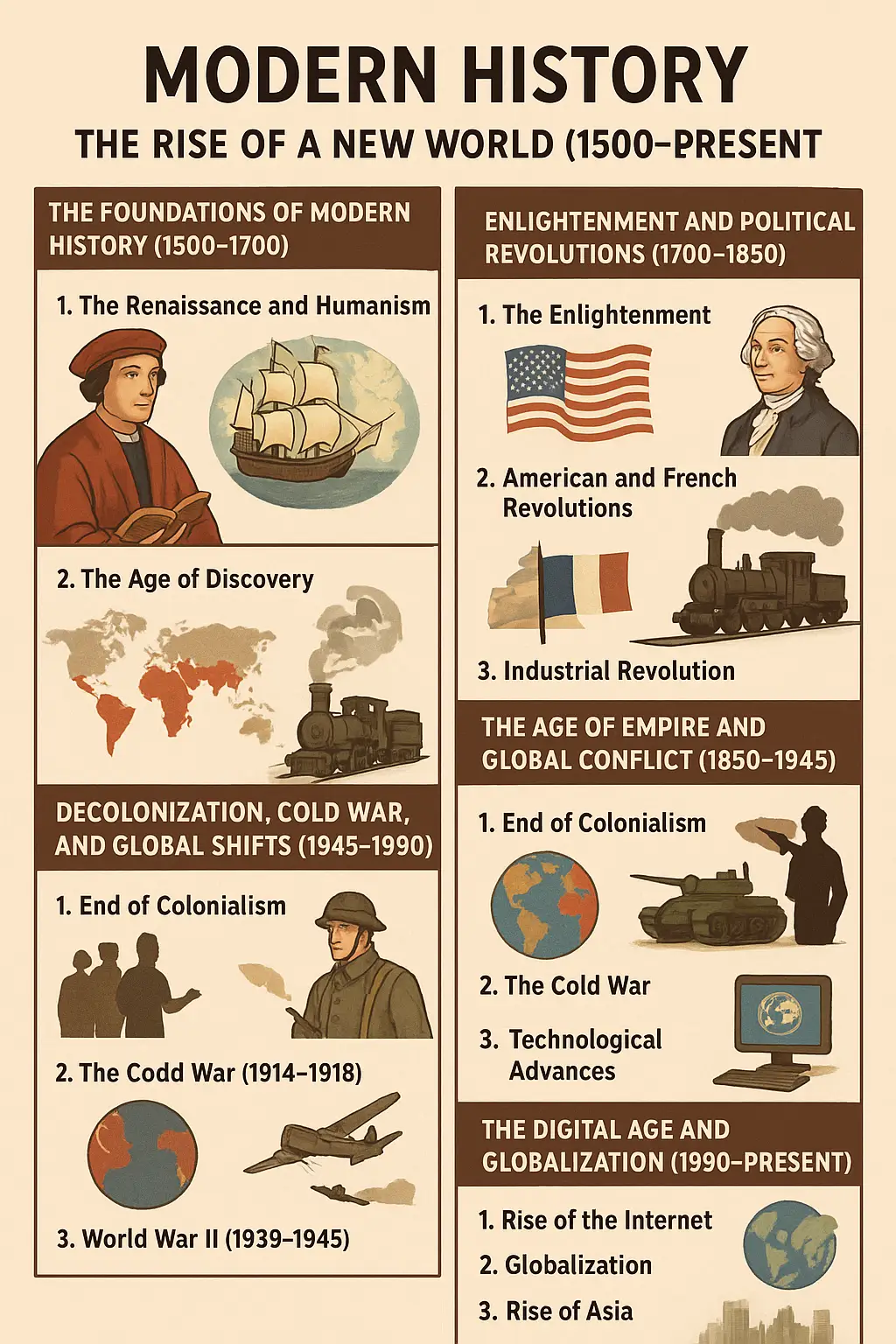
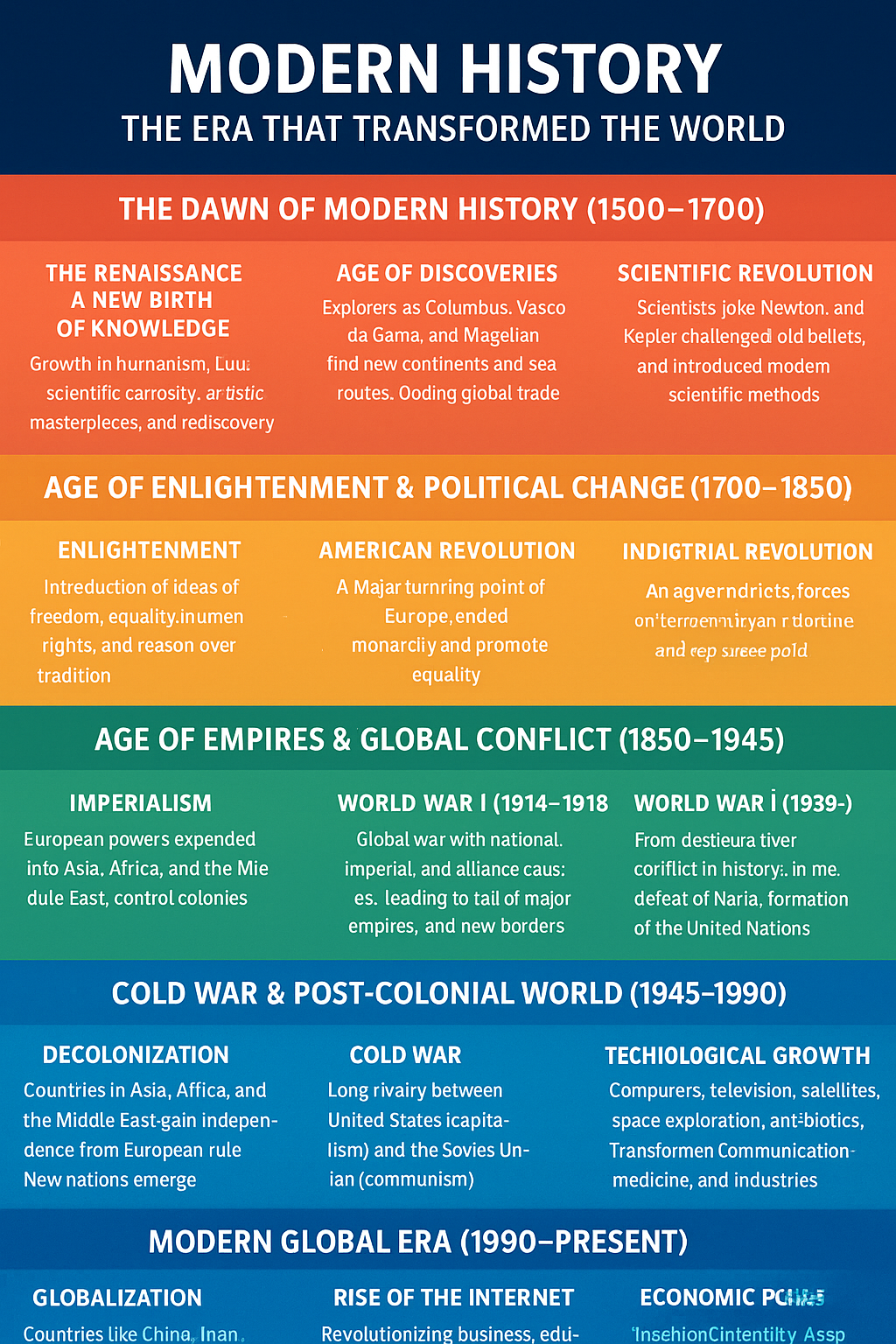
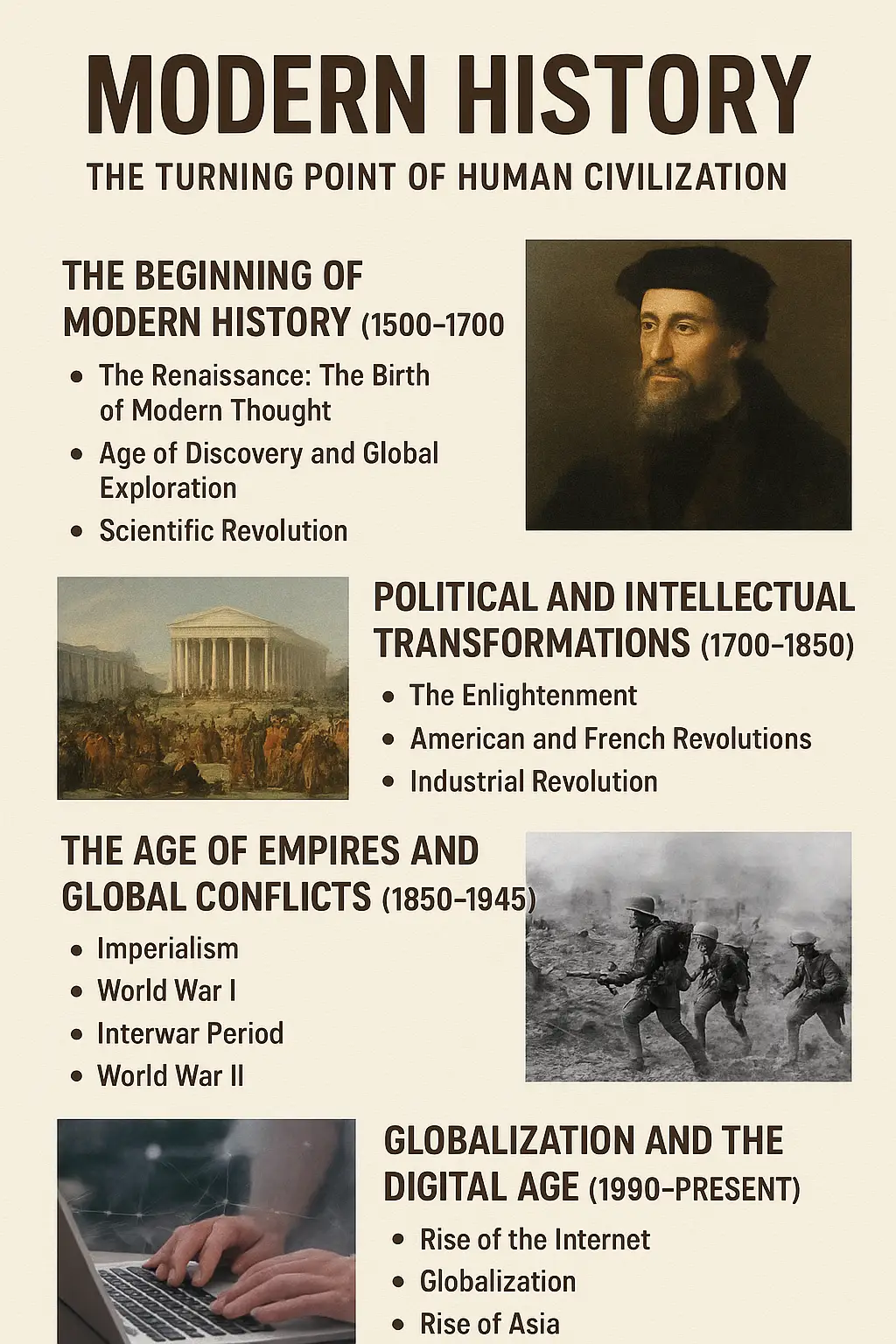
The Beginning of Modern History (1500–1700)
1. The Renaissance: The Birth of Modern Thought
The Renaissance began in Europe, encouraging curiosity, creativity, and learning. Artists like Leonardo da Vinci and Michelangelo and thinkers like Erasmus emphasized humanism—the belief that humans can shape their own destiny.
This era revived classical knowledge, improved education, and set the foundation for modern science, art, and philosophy.
2. Age of Discovery and Global Exploration
European explorers like Columbus, Vasco da Gama, and Magellan opened sea routes connecting Europe with Asia, Africa, and the Americas.
Effects included:
- Spread of new goods (spices, sugar, cotton)
- Rise of global trade
- Beginning of colonization
These explorations connected the world like never before.
3. Scientific Revolution
Scientists such as Galileo, Copernicus, and Newton challenged old beliefs and introduced a new method based on observation, experiment, and reason.
Breakthroughs in astronomy, physics, chemistry, and medicine laid the foundation of modern scientific knowledge.
Political and Intellectual Transformations (1700–1850)
1. The Enlightenment
The Enlightenment brought new ideas about freedom, equality, and human rights. Thinkers like Locke, Rousseau, and Voltaire criticized monarchy and inspired democratic values.
Important ideas:
- Freedom of speech
- Social contract
- Separation of powers
- Equality before law
These principles shaped modern democracies.
2. American and French Revolutions
American Revolution (1776)
This revolution established the first modern democratic republic based on a written constitution, liberty, and rights.
French Revolution (1789)
It ended the monarchy, promoted equality, and influenced political change across Europe and the world.
3. Industrial Revolution
Beginning in Britain, the Industrial Revolution transformed economies by introducing:
- Steam engines
- Factories
- Railways
- Mass production
It moved societies from agricultural life to urban industrial cities. The world economy changed forever.
The Age of Empires and Global Conflicts (1850–1945)
1. Imperialism
European powers expanded into Africa, Asia, and the Middle East. They controlled colonies for raw materials and markets.
This era created global economic networks but also caused exploitation and resistance movements.
2. World War I (1914–1918)
A global war triggered by alliances, imperial competition, and nationalism.
Consequences:
- Fall of empires (Ottoman, Austro-Hungarian)
- Redrawing of borders
- Rise of new political ideologies
3. Interwar Period
The world faced economic depression, political instability, and the rise of fascism in Germany and Italy. These tensions led to another major conflict.
4. World War II (1939–1945)
The deadliest war in human history.
Major outcomes:
- Defeat of Nazi Germany and Imperial Japan
- Creation of the United Nations
- Start of the Cold War
- Beginning of decolonization
WWII reshaped global politics and power structures.
Post-War World and Global Shifts (1945–1990)
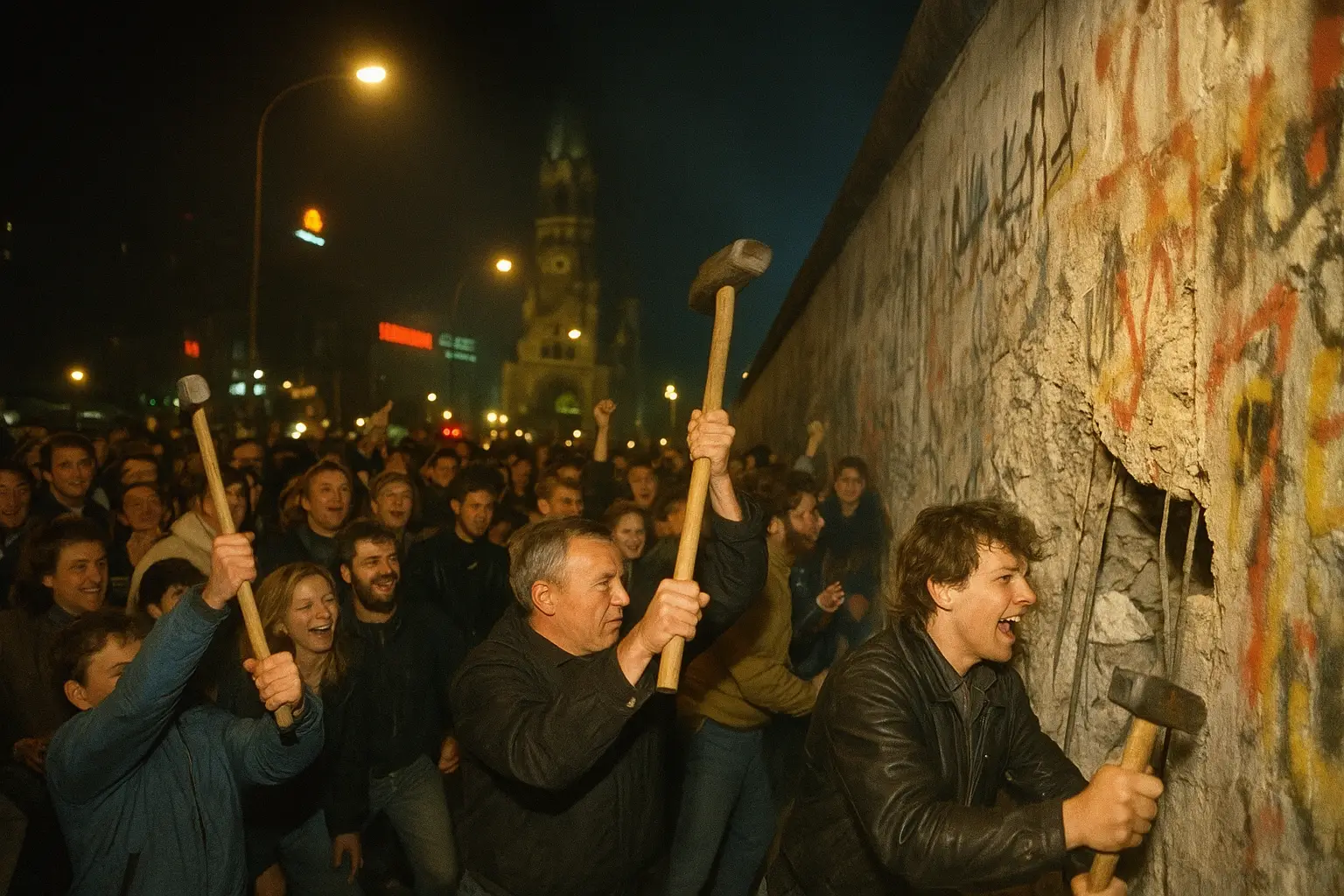
1. Decolonization
Countries in Asia, Africa, and the Middle East gained independence from European rule. New nations emerged, rewriting global political geography.
2. The Cold War
A political and ideological rivalry between the United States (capitalism) and the Soviet Union (communism).
Characteristics:
- Nuclear arms race
- Space race
- Proxy wars (Vietnam, Korea, Afghanistan)
The Cold War ended in 1991 with the collapse of the Soviet Union.
3. Technological Advances
Breakthroughs transformed daily life:
- Television
- Computers
- Satellites
- Antibiotics
- Nuclear energy
These technologies became the backbone of the modern world.
Globalization and the Digital Age (1990–Present)
1. Rise of the Internet
The internet revolutionized communication, business, education, entertainment, and shopping.
It created a fully connected world where information moves instantly.
2. Globalization
Countries became economically linked through:
- International trade
- Migration
- Multinational companies
- Digital markets
Globalization increased cooperation but also competition.
3. Rise of Asia
China, India, Japan, and South Korea became major economic powers, shifting influence from the Western world to Asia.
4. Modern Challenges
The 21st century faces issues like:
- Climate change
- Environmental degradation
- Pandemics
- Cybersecurity threats
- Economic inequality
Nations work together to solve global problems.
5. Artificial Intelligence and Automation
AI is one of the biggest revolutions of modern history, powering:
- Self-driving cars
- Smart devices
- Healthcare tools
- Predictive analytics
It marks the beginning of a new technological era.
Conclusion
Modern history is a story of transformation—from the creativity of the Renaissance to the digital revolution of today. It shaped how people think, work, travel, communicate, and govern themselves.
Understanding modern history helps us understand today’s challenges and tomorrow’s possibilities. This era continues to evolve as technology, globalization, and innovation reshape our world.