Introduction
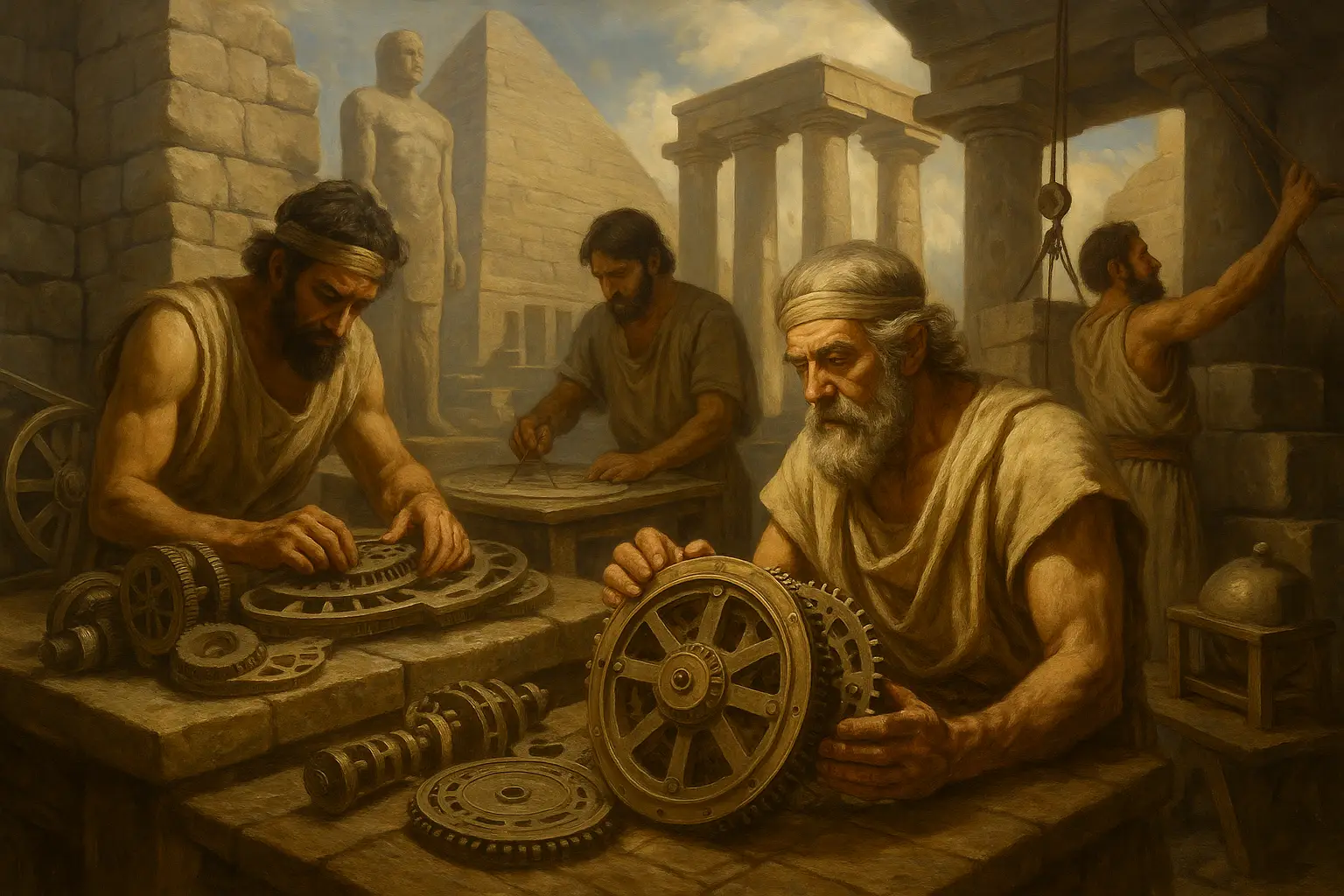
Throughout the rise and fall of civilizations, humanity has created extraordinary ideas, sciences, and technologies—many of which vanished into the depths of time. These fragments of forgotten brilliance, often found carved into stone, buried in ruins, or hinted at in ancient texts, make us wonder: How much did our ancestors know that we no longer understand today?
Lost knowledge isn’t just about missing books or broken artifacts. It is about the disappearance of entire intellectual worlds—mathematics, astronomy, medicine, architecture, engineering, and philosophies that shaped the ancient world.
Today, researchers and historians continue to uncover pieces of this lost intellectual treasure. But the question remains: What else lies hidden, waiting to be rediscovered?
Ancient Technologies That Shouldn’t Have Existed
The Antikythera Mechanism – The world’s first analog computer
Discovered in a shipwreck off the coast of Greece, the Antikythera Mechanism dates back over 2,000 years. It contained gears so precise that similar mechanisms wouldn’t appear again until the 14th century. This device tracked planetary movements, eclipses, and complex astronomical cycles with breathtaking accuracy.
Historians still debate how ancient Greeks developed such an advanced computational tool—especially when no similar device has ever been found.
Roman Concrete – A material stronger than modern concrete
Modern concrete decays in decades; Roman harbors have lasted more than 2,000 years. The secret? A mixture of volcanic ash, lime, and seawater that actually gets stronger over time.
For centuries, this formula was lost. Only recently have scientists begun to reverse-engineer it—realizing ancient builders had mastered a material we still struggle to perfect.
The Damascus Blade – A mysterious lost metallurgical art
Damascus steel swords were legendary for their sharpness, flexibility, and distinctive wavy patterns. Warriors claimed the blades could slice silk in the air or cut through lesser weapons.
But by the 18th century, the technique suddenly vanished.
Modern metallurgists believe the secret involved advanced nanostructures within the steel—a technology centuries ahead of its time.
Lost Sciences and Forgotten Mathematics
The Library of Alexandria – A universe of knowledge erased
One of the greatest intellectual disasters in human history was the destruction of the Library of Alexandria. It housed astronomy, mathematics, engineering, medicine, and philosophical works that spanned centuries.
Among the knowledge lost:
- Early heliocentric models of the solar system
- Detailed medical studies and anatomical texts
- Engineering blueprints for hydraulics and automata
- Advanced geographical maps
The world will never know how much brilliance burned in those flames.
Mayan Astronomy – A cosmic understanding centuries ahead
The Maya charted planetary cycles with astonishing precision. Their calculations of the moon, Venus, and solar movements rival some modern astronomical methods.
Yet many of their codices were destroyed during colonial invasions, erasing mathematical knowledge that linked astronomy, agriculture, and spirituality in sophisticated ways.
Languages That Vanished — And Took Their Knowledge With Them
The Indus Script – An undeciphered language of an entire civilization
The Indus Valley Civilization was one of the most advanced ancient societies, yet their writing remains a mystery. Without decoding it, we cannot fully understand:
- Their political system
- Scientific knowledge
- Trade networks
- Religious beliefs
- Technology and daily life
Thousands of inscriptions remain silent, holding answers we still cannot read.
Linear A – The Minoan language lost to time
The Minoans built impressive palaces, engineered complex water systems, and developed maritime trade networks—but their primary script, Linear A, has never been deciphered.
Solving it could reveal a lost Mediterranean culture whose influence stretched across ancient Europe.
Lost Medical Knowledge That Surprises Modern Science
Ancient Surgical Precision
Archaeological finds show ancient surgeons performed procedures we once thought impossible:
- Trepanation (skull surgery) with high survival rates
- Early dental implants
- Herbal anesthesia
- Complex wound treatment techniques
In some cases, ancient medical knowledge was more advanced than later medieval practices.
The Healing Science of Ancient Egypt
Egyptian papyri describe treatments for infections, fractures, circulatory problems, and even mental health. Some prescriptions used mold and herbs with antibacterial properties—long before modern antibiotics.
Many texts remain incomplete, lost, or destroyed, leaving modern researchers with only fragments of their medical science.
The Knowledge That Might Still Be Hidden
Across deserts, jungles, and oceans, unexplored ruins and undiscovered artifacts may still hold answers to unanswered mysteries:
- Buried libraries
- Lost cities
- Undeciphered scripts
- Unknown scientific instruments
- Forgotten astronomical observatories
As technology improves—LIDAR scanning, underwater exploration, AI-based decipherment—we may soon uncover secrets that have been silent for thousands of years.
Conclusion
Lost knowledge is not just about the past—it is a reminder of the fragility of human progress. Entire civilizations rose in brilliance and fell into silence, taking their achievements with them. Yet every discovery—a broken gear, a stone tablet, a forgotten manuscript—reminds us how advanced our ancestors truly were.
The search for lost knowledge continues, driven by curiosity, archaeology, and the belief that unlocking the wisdom of the past can help us understand the present—and shape the future.