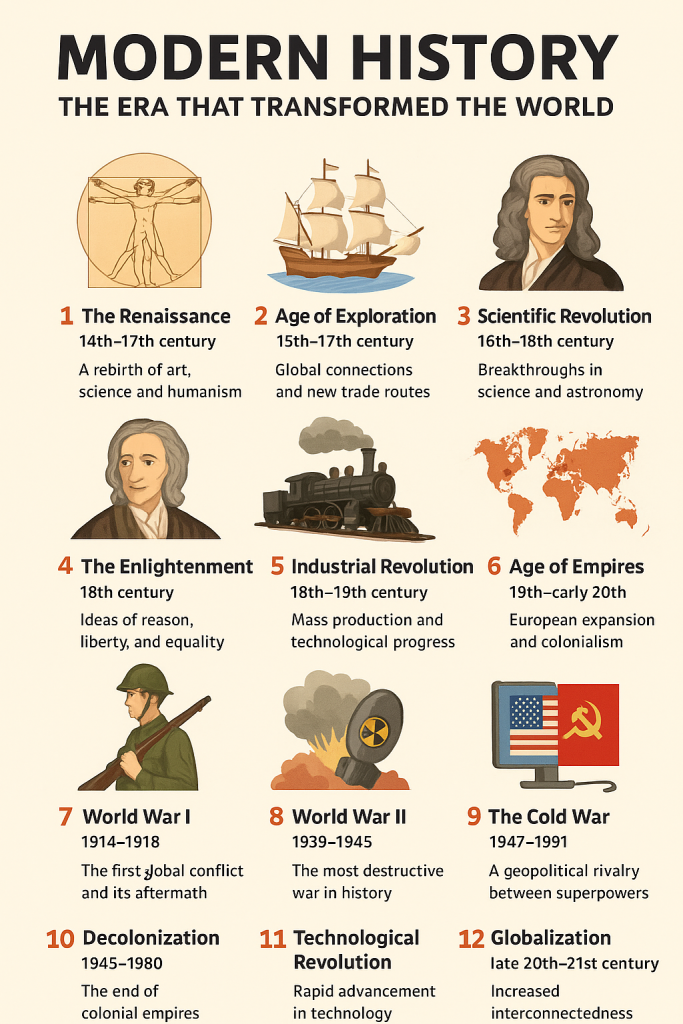
Introduction
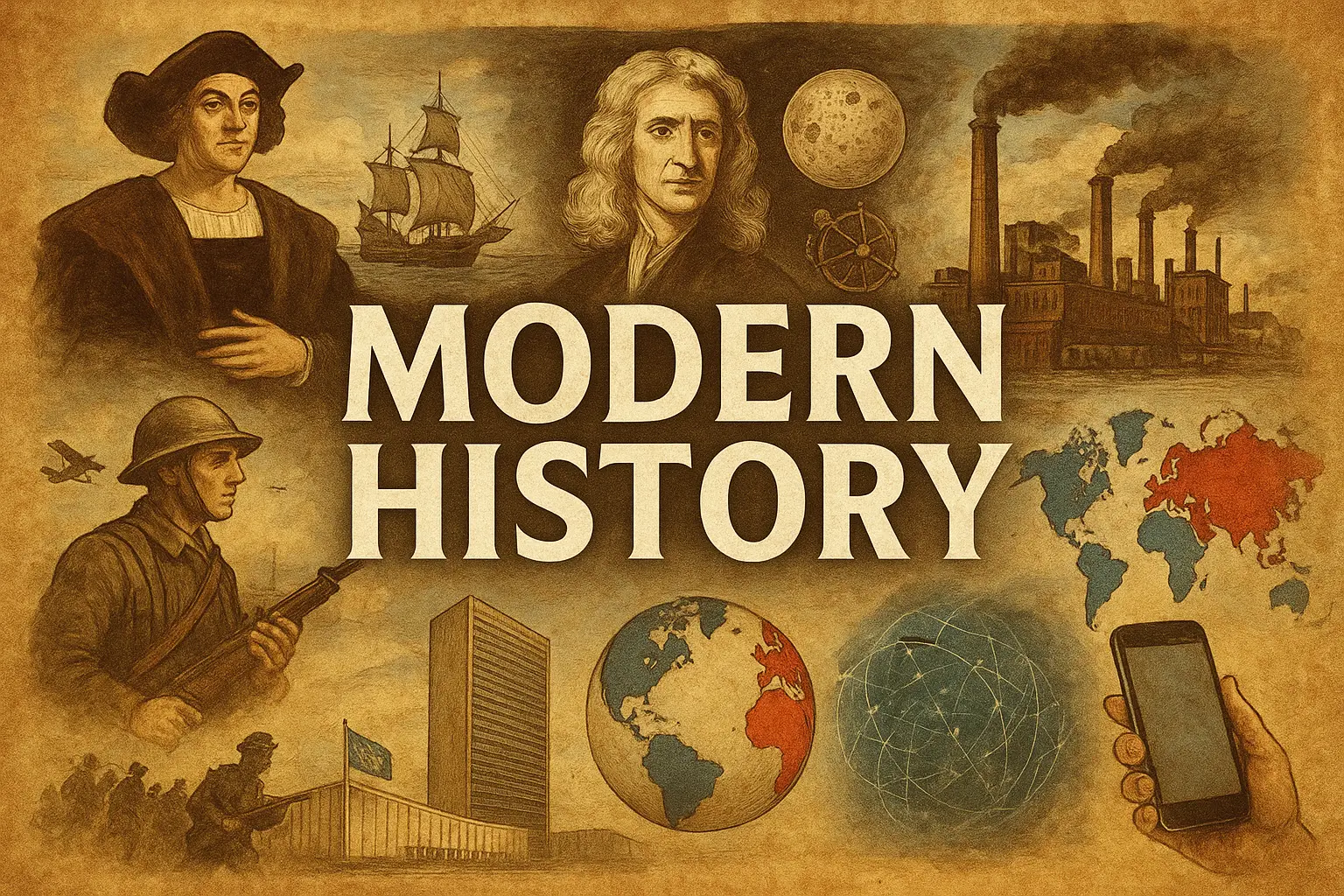
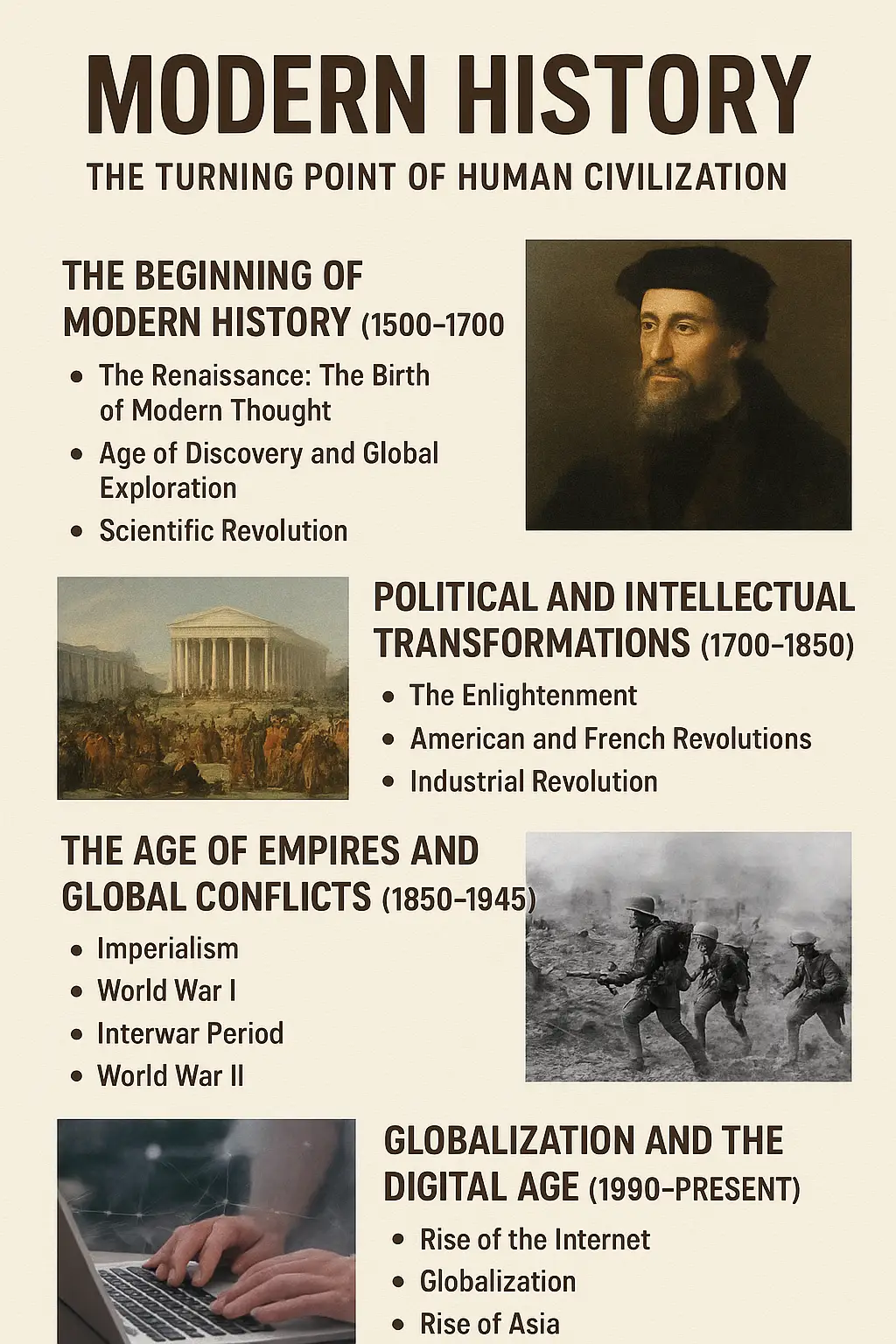
Modern history is the period that reshaped the world into what we see today. It begins around the late 15th century and continues to the present. This era includes major events such as the Renaissance, the Industrial Revolution, the rise and fall of empires, world wars, decolonization, and the digital revolution.
Modern history changed politics, science, economics, technology, and human society in unprecedented ways.
This article explores the major phases and turning points of modern history in a clear, human-written, and detailed manner.
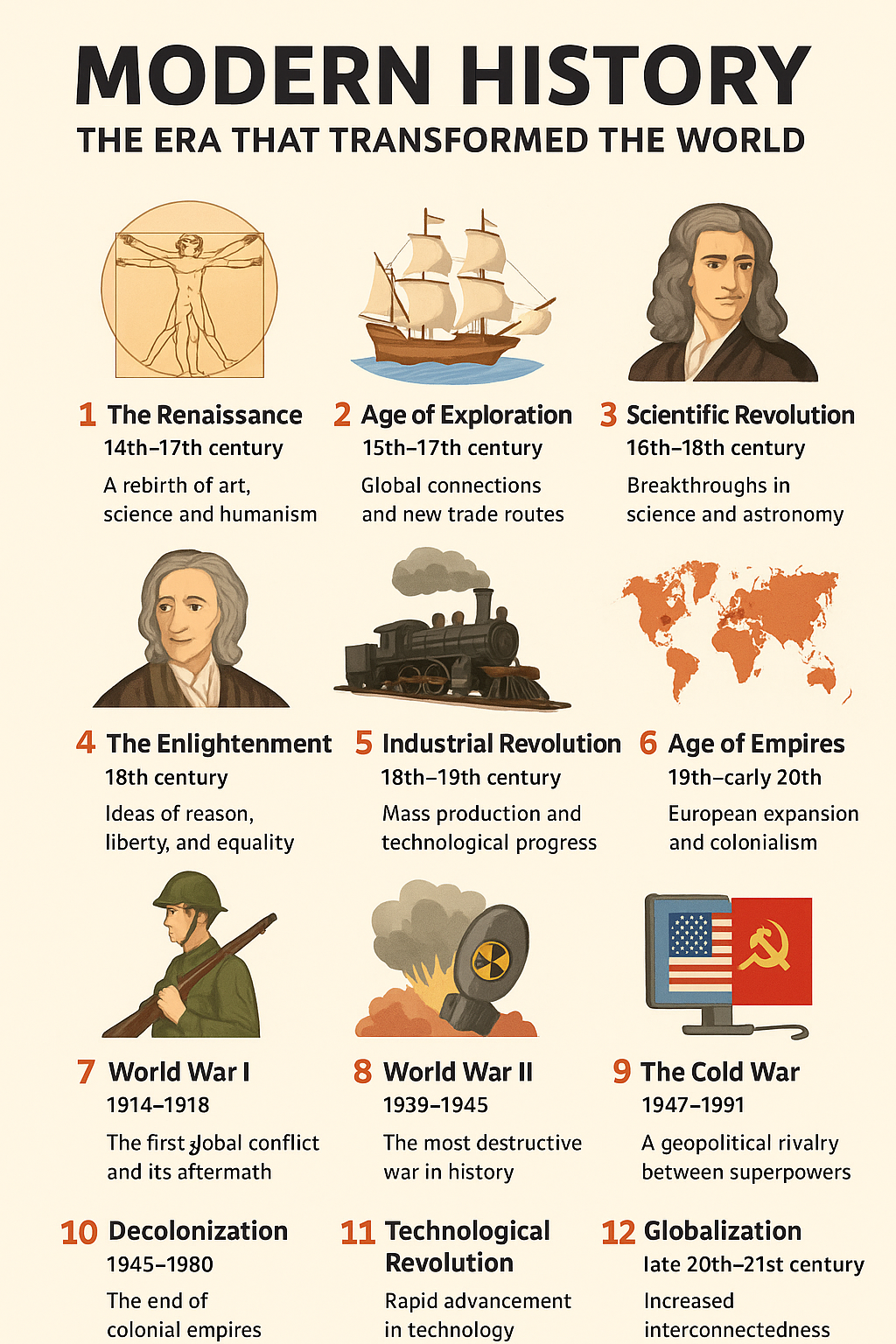
1. The Renaissance — The Birth of Modern Thought
The Renaissance (14th–17th century) was a turning point where Europe transitioned from the Middle Ages to a new era of creativity, learning, and discovery.
Key Features
- Revival of classical Greek and Roman knowledge
- Growth of art, literature, and architecture
- Scientific curiosity and innovation
- Humanism and rational thinking
Famous Figures
- Leonardo da Vinci
- Michelangelo
- William Shakespeare
- Galileo Galilei
The Renaissance laid the foundation for scientific breakthroughs and modern education.
2. Age of Exploration — Global Connections Begin
Between the 15th and 17th centuries, European explorers traveled across oceans in search of new lands and trade routes.
Major Explorers
- Christopher Columbus
- Vasco da Gama
- Ferdinand Magellan
Impact
- Discovery of the Americas
- Global trade networks
- Spread of cultures, languages, and religions
- Rise of European colonial empires
This era made the world more connected than ever before.
3. Scientific Revolution — The Rise of Modern Science
The 16th–18th centuries transformed human understanding of nature.
Key Advancements
- Heliocentric theory (Copernicus)
- Laws of motion and gravity (Newton)
- Modern astronomy
- Medicine and anatomy innovations
Science replaced superstition and prepared the world for technological progress.
4. The Enlightenment — Age of Reason and Political Change
The Enlightenment (18th century) promoted rationality, liberty, and human rights.
Important Ideas
- Freedom of speech
- Equality
- Separation of powers
- Democracy
- Social contract
Influential Thinkers
- John Locke
- Montesquieu
- Voltaire
- Rousseau
These ideas inspired revolutions and modern political systems.
5. Industrial Revolution — The Modern Economy is Born
The Industrial Revolution (18th–19th century) began in Britain and changed the world forever.
Technological Innovations
- Steam engine
- Textile machinery
- Railways
- Factories
- Electricity
Major Impacts
- Mass production
- Urbanization
- Faster transport
- Global trade expansion
- Rise of capitalism
This was one of the most transformative periods in human history.
6. Age of Empires and Colonial Expansion
European powers controlled large parts of Africa, Asia, and the Americas from the 18th to early 20th century.
Reasons
- Economic exploitation
- Access to raw materials
- Political and military dominance
- Missionary activities
Consequences
- Cultural blending
- Economic dependency
- Resistance and revolutions
- Shaping modern borders
Colonialism deeply influenced modern societies, especially in Asia and Africa.
7. World War I — The First Global Conflict (1914–1918)
WWI involved major powers divided into two alliances.
Causes
- Nationalism
- Militarism
- Alliances
- Assassination of Archduke Franz Ferdinand
Results
- Millions of casualties
- Fall of empires (Ottoman, Austro-Hungarian)
- Redrawing borders
- Foundation for WWII
The world entered a new era of political instability.
8. World War II — The Most Destructive War (1939–1945)
WWII was the largest and deadliest war in history.
Main Causes
- Treaty of Versailles failures
- Rise of fascism
- German expansion
- Japanese militarism
Major Events
- Holocaust
- Atomic bombings of Hiroshima & Nagasaki
- Allied vs. Axis powers
- Global resistance movements
Aftermath
- Formation of the United Nations
- Beginning of the Cold War
- Decolonization movement
- Technological and political shifts
WWII reshaped global power structures.
9. The Cold War — A Battle Without Fighting (1947–1991)
The Cold War was a geopolitical rivalry between the U.S. and the Soviet Union.
Key Features
- Nuclear arms race
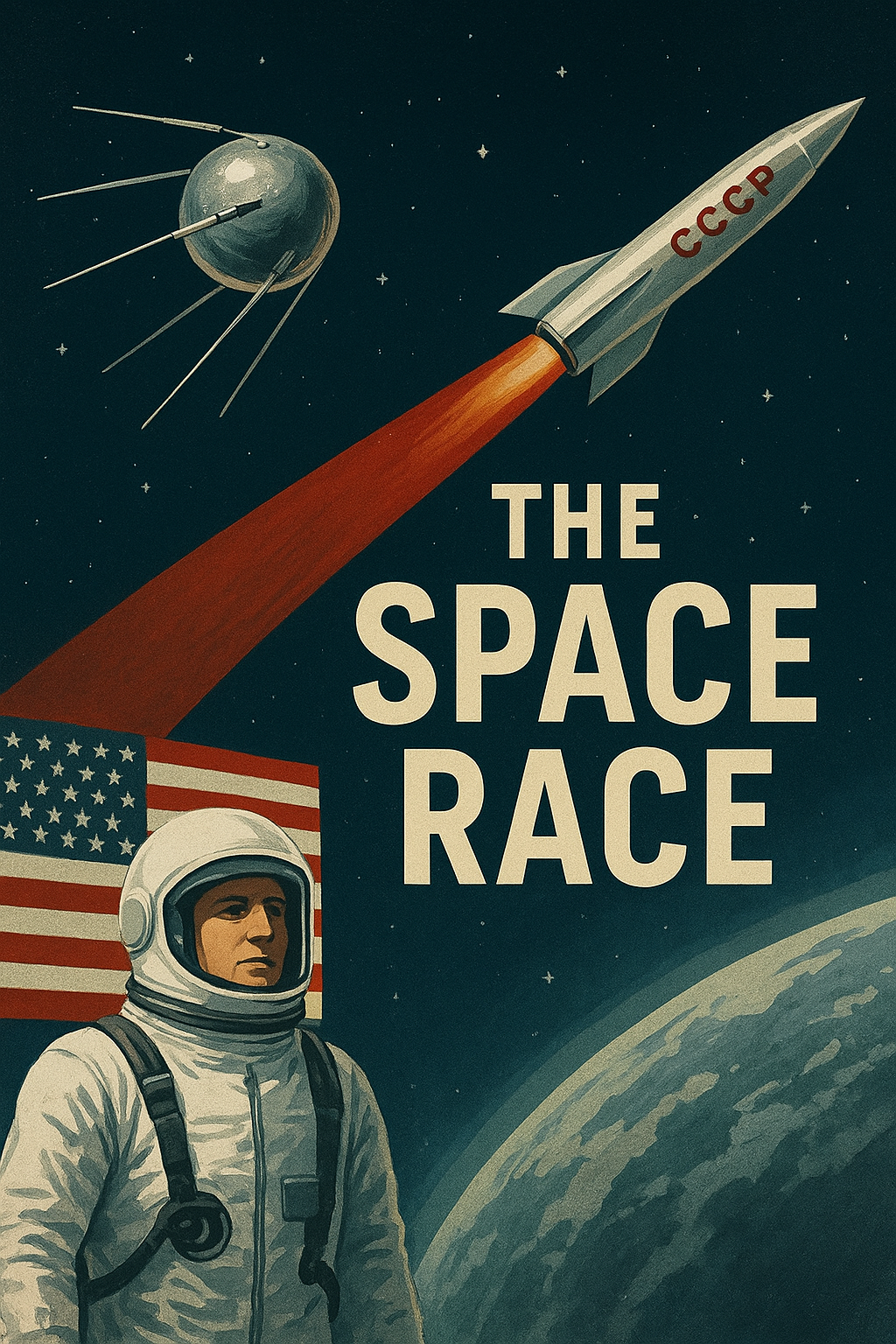
- Space race
- Ideological conflict (capitalism vs. communism)
- Proxy wars in Korea, Vietnam, Afghanistan
Outcome
- Fall of the Berlin Wall
- Collapse of the Soviet Union
- Unipolar world led by the U.S.
10. Decolonization — Freedom for Nations
From 1945–1980, Asian and African nations gained independence.
Examples
- India (1947)
- Pakistan (1947)
- African nations in the 1960s
- Middle Eastern shifts
Independence movements shaped modern international relations.
11. Technological Revolution — The Digital Age
Late 20th and early 21st centuries introduced radical technological growth.
Major Innovations
- Computers
- Internet
- Smartphones
- Artificial Intelligence
- Biotechnology
Impact
- Faster communication
- Global connectivity
- Digital economy
- Online education
- Social media era
Technology became the driving force of modern civilization.
12. Globalization — The Borderless World
Globalization increased the flow of:
- Goods
- Information
- People
- Cultures
Effects
- Global trade networks
- Multinational corporations
- Cultural blending
- International tourism
- Worldwide markets
The world became more interconnected than ever before.
Conclusion
Modern history is a powerful journey filled with revolutions, discoveries, conflicts, and innovations. From the Renaissance to the Digital Age, every phase pushed humanity into a more advanced era. It transformed science, politics, culture, and global relationships.
Understanding modern history helps us see how the past shapes today’s world—and prepares us for the future ahead.