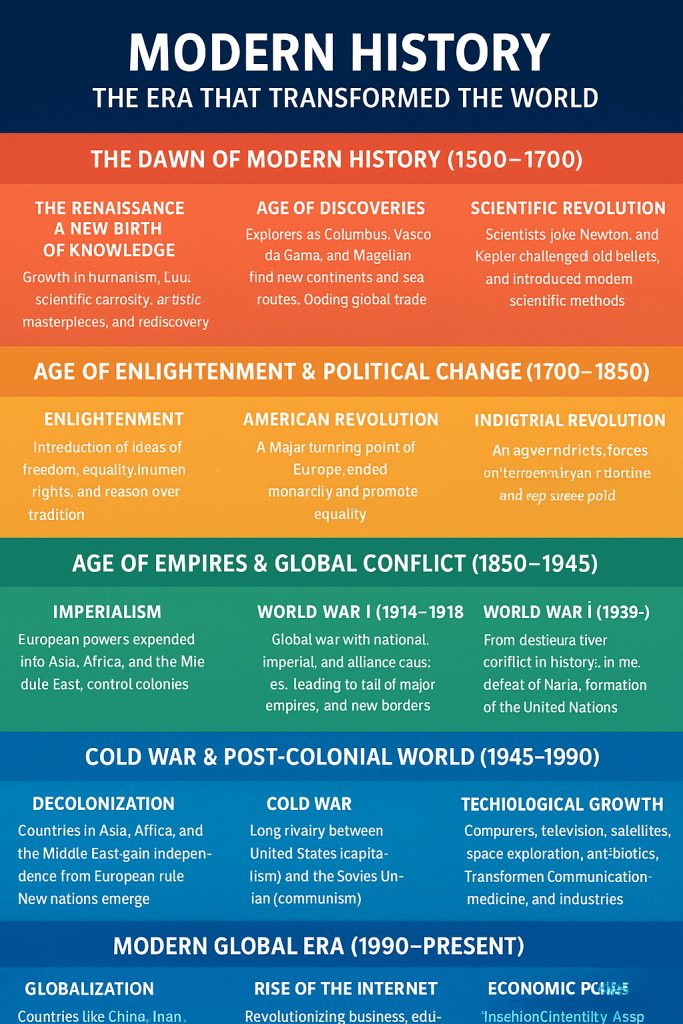
Introduction
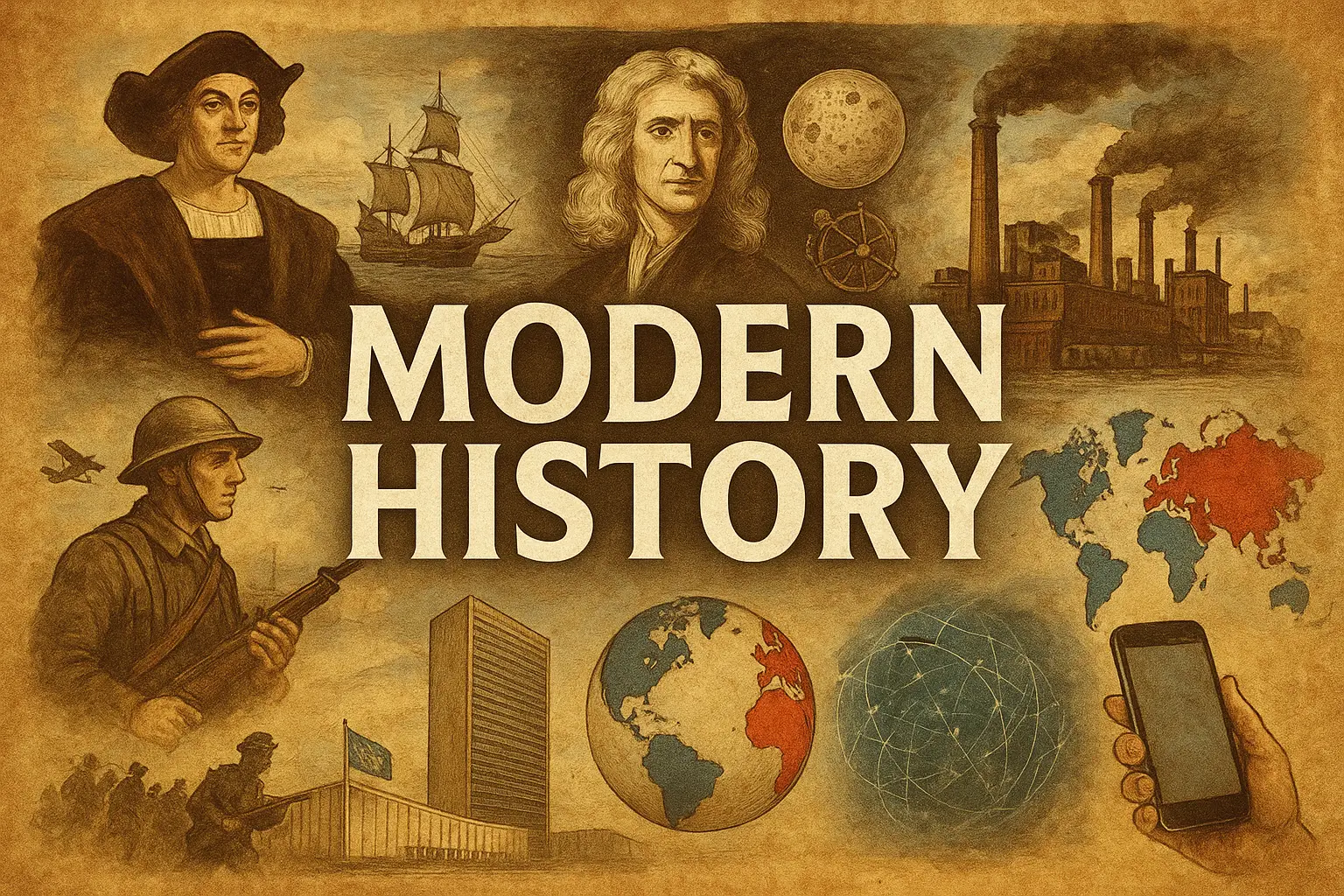
Modern History refers to the period from the late 15th century to the present day. It is the era in which science, technology, politics, economics, and societies changed rapidly. This period includes events like the Renaissance, Enlightenment, Industrial Revolution, world wars, decolonization, globalization, and the digital age.
Modern History shaped today’s world—how we live, how we communicate, how countries are governed, and how economies function.
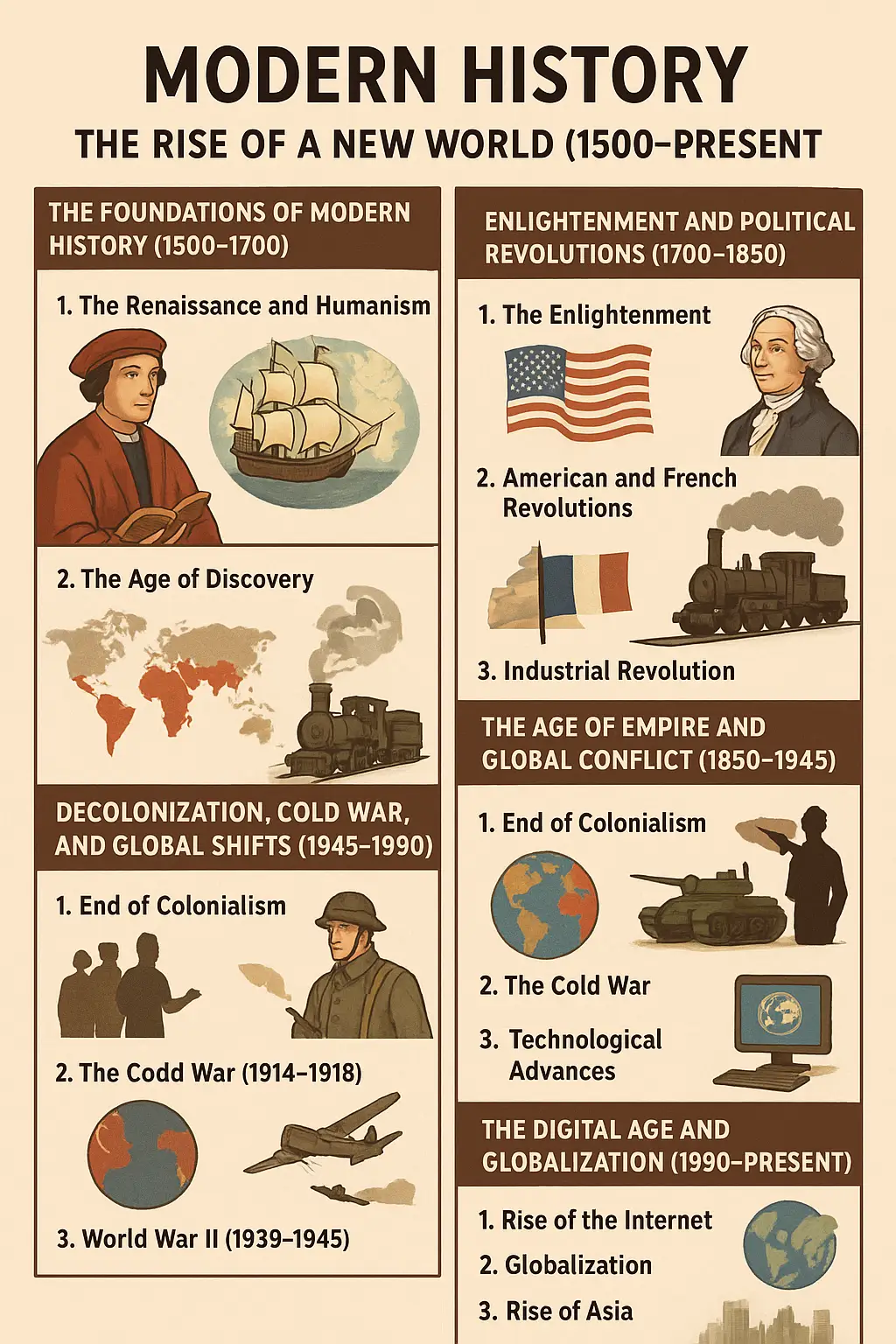
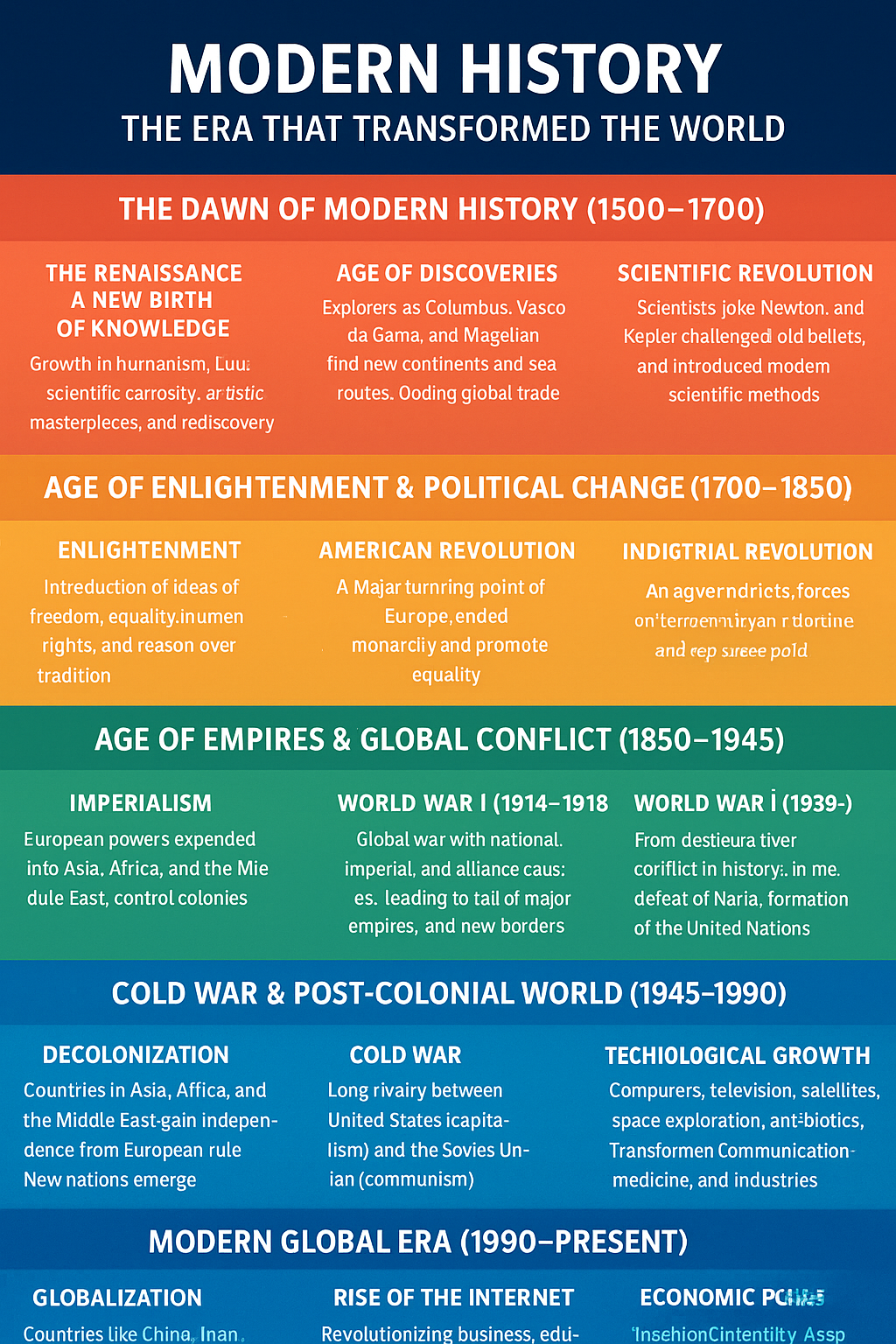
The Dawn of Modern History (1500–1700)
1. The Renaissance: A New Birth of Knowledge
The Renaissance began in Europe and transformed art, science, literature, and human thinking.
Key impacts:
- Growth of humanism
- Scientific curiosity
- Artistic masterpieces
- Rediscovery of Greek and Roman knowledge
Thinkers like Leonardo da Vinci and Michelangelo changed the way people understood creativity, while scientists like Copernicus challenged old beliefs about the universe.
2. Age of Discoveries
This period saw huge explorations across the world. Explorers such as Columbus, Vasco da Gama, and Magellan discovered new continents and sea routes.
Effects:
- Start of global trade
- Cultural exchange
- Beginning of colonization
- Spread of crops and technologies
3. Scientific Revolution
Modern science was born during this time.
Scientists like:
- Newton (gravity & physics)
- Galileo (astronomy)
- Kepler (planetary motion)
Their discoveries changed how humans understood nature, leading to scientific methods still used today.
Age of Enlightenment & Political Change (1700–1850)
1. Enlightenment
The Enlightenment introduced ideas of:
- Freedom
- Equality
- Human rights
- Reason over tradition
Thinkers like Rousseau, Voltaire, and Locke questioned monarchy and inspired modern democracy.
2. American Revolution (1776)
The first successful revolution based on democratic principles. It introduced:
- Written constitution
- Separation of powers
- Rights of citizens
3. French Revolution (1789)
A major turning point in Europe. It ended monarchy, promoted equality, and spread modern political ideas across the world.
4. Industrial Revolution
Starting in Britain, the Industrial Revolution changed everything.
New inventions:
- Steam engines
- Textile machines
- Railways
- Factories
People moved from villages to cities. Production increased, transportation became faster, and economies grew with mass production.
Age of Empires and Global Conflict (1850–1945)
1. Imperialism
European powers expanded into Asia, Africa, and the Middle East. They controlled colonies for resources and markets.
Results:
- Large trade networks
- Cultural exchanges
- Political tensions
2. World War I (1914–1918)
Causes included nationalism, militarism, and alliances.
Outcomes:
- Fall of major empires
- New borders
- Rise of political ideologies
3. Interwar Period
This period saw economic depression, political instability, and the rise of fascism in Europe.
4. World War II (1939–1945)
The most destructive conflict in history.
Consequences:
- Defeat of Nazis
- Formation of the UN
- Beginning of the Cold War
- Start of decolonization
- Huge technological progress
WWII reshaped global power.
Cold War & Post-Colonial World (1945–1990)
1. Decolonization
After WWII, many countries in Asia, Africa, and the Middle East gained independence. New nations formed and old empires collapsed.
2. Cold War
A long rivalry between:
- United States (capitalism)
- Soviet Union (communism)
Characteristics:
- Nuclear arms race
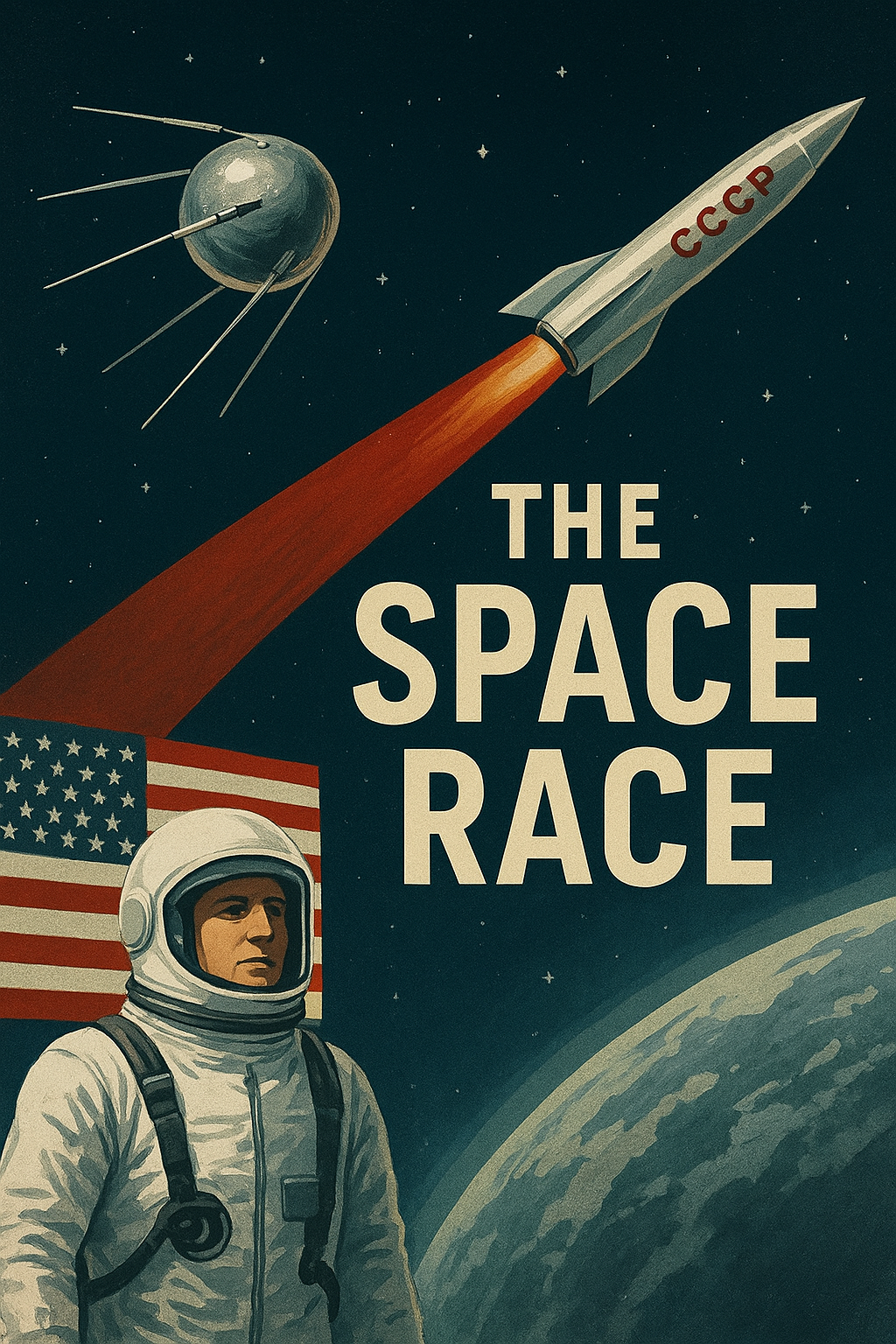
- Space race
- Proxy wars
- Political influence battles
It ended with the collapse of the Soviet Union in 1991.
3. Technological Growth
The second half of the 20th century saw:
- Computers
- Television
- Satellites
- Space exploration
- Antibiotics
Technology improved communication, medicine, and industries.
Modern Global Era (1990–Present)
1. Globalization
The world became more connected through:
- Trade
- Migration
- Digital communication
- International organizations
Goods, businesses, and ideas now travel across borders easily.
2. Rise of the Internet
The internet changed everything:
- Business
- Education
- Shopping
- Entertainment
- Social interaction
It created a digital economy and new industries.
3. Economic Power Shift
Countries like China, India, Japan, and South Korea became major global powers. Asia became the center of manufacturing and technology.
4. The Digital Revolution
New technologies include:
- Artificial Intelligence
- Smartphones
- Cloud computing
- Robotics
- Social media
- Cryptocurrency
These technologies changed work, communication, and daily life.
5. Modern Challenges
The world today faces:
- Climate change
- Global pandemics
- Cybersecurity threats
- Economic inequality
- Environmental crises
Countries now work together to find solutions.
Conclusion
Modern History is the story of how humanity transformed from traditional societies to advanced global civilizations. From the Renaissance to the digital age, every event added something new—knowledge, innovation, democracy, science, and technology. Understanding modern history helps us understand today’s world and prepare for the future.