Introduction
Throughout human history, civilizations have risen, flourished, and eventually vanished—often leaving behind traces of knowledge far more advanced than we once believed possible. From forgotten sciences and mysterious manuscripts to engineering feats that still puzzle experts today, lost knowledge represents one of the most fascinating windows into humanity’s forgotten brilliance.
Across the world, archaeologists, linguists, and historians continue to uncover fragments of wisdom that challenge modern assumptions. How did ancient societies develop such precise astronomical systems? What technologies allowed them to move massive stones? Why did some of their languages disappear forever?
This article explores the world’s most intriguing examples of lost ancient knowledge—real, historically documented, and still unsolved.
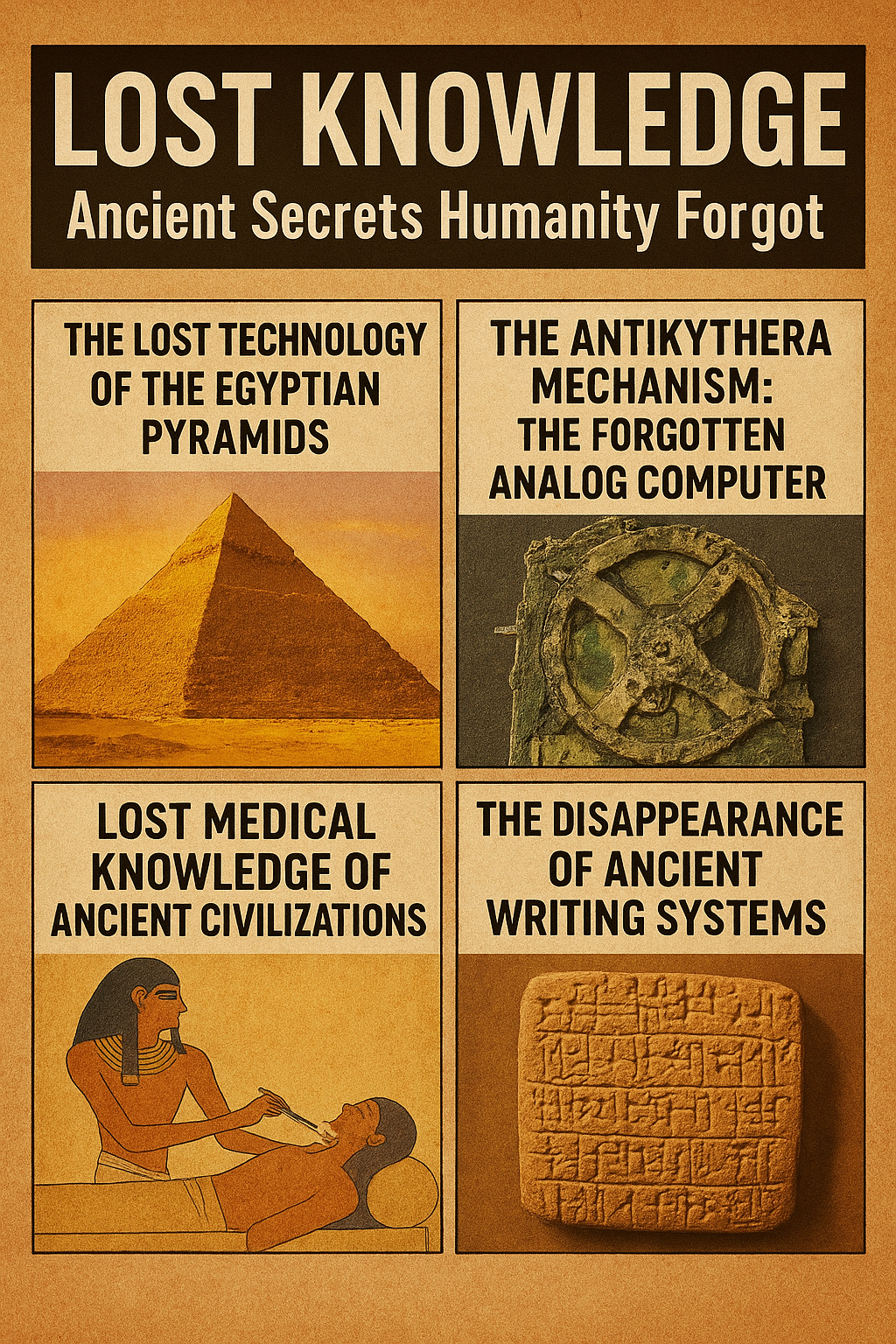
1. The Lost Technology of the Egyptian Pyramids
The Great Pyramid of Giza remains one of the greatest engineering puzzles ever created. Constructed around 2560 BCE, its alignment with the cardinal directions is so precise that modern compasses reveal only a tiny margin of error.
Experts still debate:
- How millions of limestone blocks weighing up to 80 tons were moved
- The methods used for near-perfect leveling
- Why the pyramid dimensions encode mathematical constants such as π and the golden ratio
Despite countless theories—ramps, pulleys, counterweights—no definitive explanation exists, making pyramid construction one of history’s most puzzling examples of lost engineering knowledge.
2. The Antikythera Mechanism: The Forgotten Analog Computer
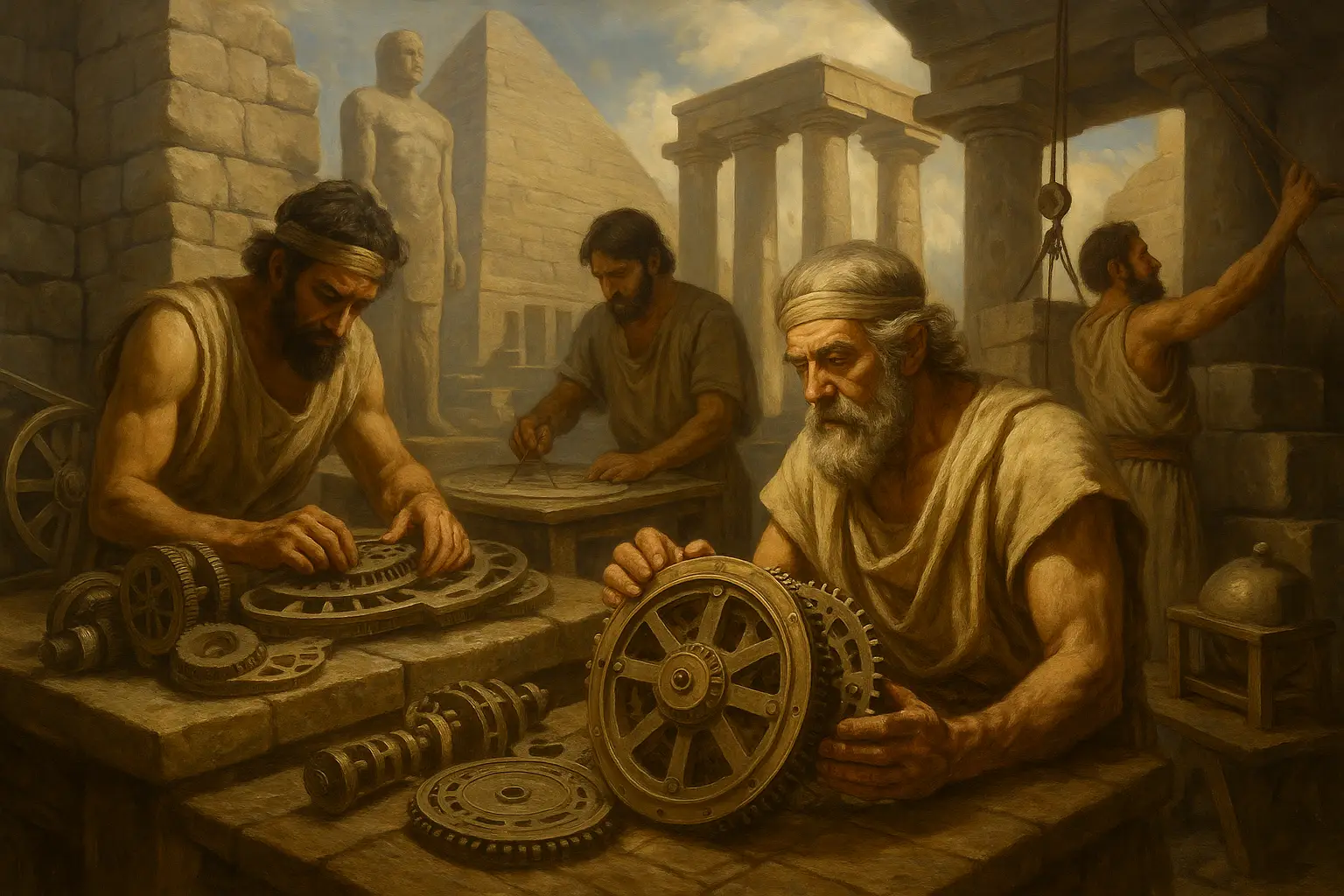
Discovered in a shipwreck off Greece, the Antikythera Mechanism is a 2,000-year-old device often called the world’s first computer. Made of intricate bronze gears, it could accurately track:
- Solar cycles
- Lunar phases
- Planetary positions
- Eclipses
Its complexity shocked researchers—nothing like it appeared again for at least 1,400 years. The knowledge to build such mechanical computers vanished with ancient Greek scientists, leaving modern experts astonished at what ancient engineers once achieved.
3. Lost Medical Knowledge of Ancient Civilizations
Ancient cultures possessed medical knowledge far ahead of their time.
Ayurveda and Surgical Techniques
India’s ancient medical texts, such as the Sushruta Samhita, describe surgical methods including:
- Rhinoplasty
- Cataract removal
- Suturing techniques
These advanced procedures existed over 2,500 years ago but were partially forgotten before being rediscovered in the modern era.
Egyptian Medicine
Mummies show signs of:
- Dental restoration
- Amputation techniques
- Fracture repairs
Yet much of the scientific understanding behind their medical practices remains unknown.
4. The Disappearance of Ancient Writing Systems
Hundreds of writing systems have been lost, taking entire libraries of human memory with them.
The Indus Script
Over 4,000 years old and still undeciphered, the Indus symbols may represent:
- Economic records
- Religious texts
- A complex language system
Without a bilingual “Rosetta Stone,” this civilization’s thoughts remain locked away.
Rongorongo of Easter Island
Carved into wooden tablets, Rongorongo remains unreadable. It might hold clues to:
- Migration
- Culture
- Rituals
The knowledge vanished with the collapse of Rapa Nui society.
5. The Forgotten Knowledge of Megalithic Builders
Across Europe, Latin America, and the Pacific, ancient people constructed massive stone structures using techniques we still struggle to replicate.
Examples include:
- Stonehenge (England)
- Sacsayhuamán (Peru) – stones cut so precisely that paper cannot fit between them
- Göbekli Tepe (Turkey) – 12,000 years old, predating agriculture
How prehistoric societies transported multi-ton stones without wheels or metal tools remains one of archaeology’s great mysteries.
6. Lost Maritime Navigation Techniques
Polynesian navigators traveled thousands of kilometers across the Pacific with:
- No maps
- No compasses
- No modern tools
They used:
- Star paths
- Ocean wave patterns
- Bird flight behavior
- Cloud reflections
Much of this knowledge was transmitted orally—and many navigation secrets disappeared before researchers could document them.
Conclusion
Lost knowledge reminds us that human history is not a straight path of progress. Civilizations have repeatedly achieved brilliant scientific, medical, linguistic, and engineering advancements—only for those systems to vanish due to war, collapse, or natural disasters.
Every archaeological discovery hints at a deeper truth:
Humanity once knew far more than we currently understand.
And as new discoveries emerge each year, we continue to piece together these missing fragments of ancient wisdom—changing our understanding of the past and reshaping our vision of the future.