Introduction
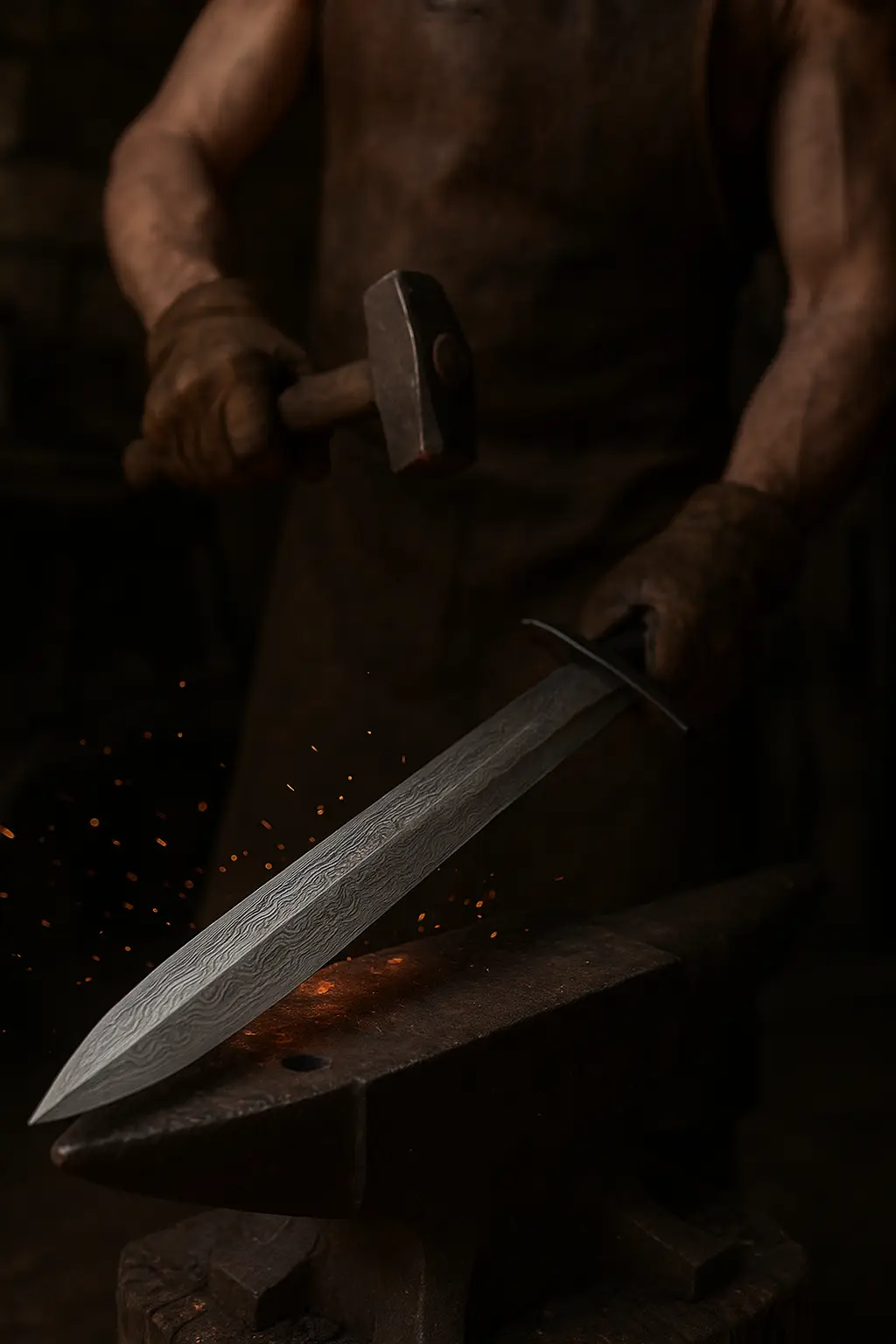
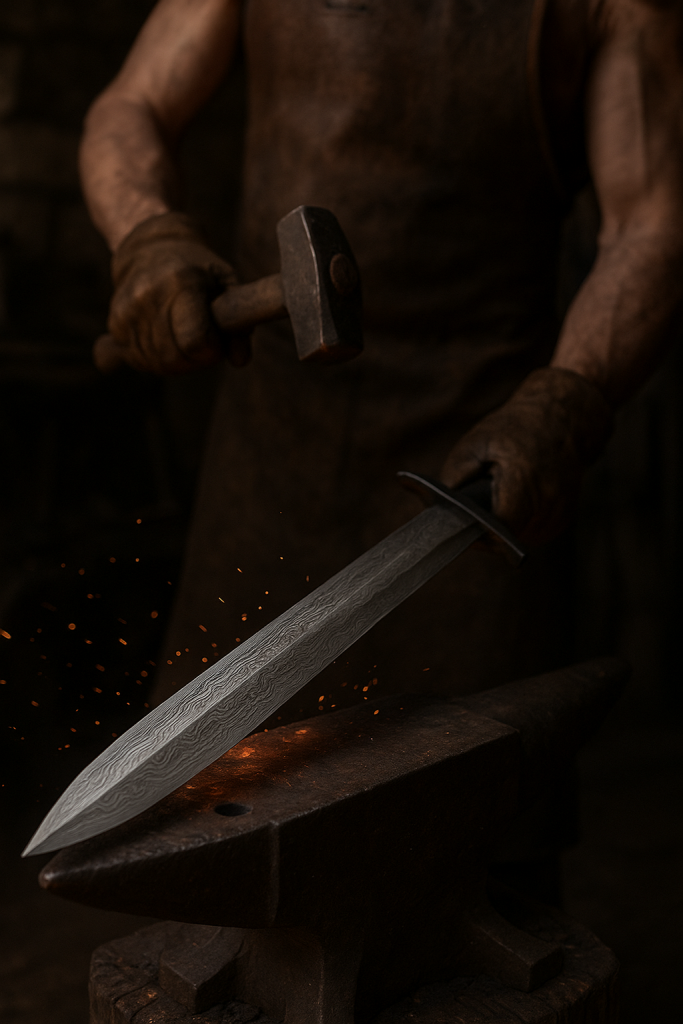
Among the many wonders of the ancient world, few inspire as much awe and mystery as Damascus steel — a legendary metal once used to forge swords so sharp they could slice through a falling silk scarf and so strong they could cut cleanly through other blades. These weapons, known for their wavy, water-like surface patterns, were prized across the Middle East, Europe, and Asia from the 3rd century CE through the Crusades.
Yet, despite centuries of fame, the precise method of making true Damascus steel was lost to history by the 18th century. Modern metallurgists have tried to replicate it using advanced tools and technology, but even today, the exact ancient process remains elusive — a haunting example of how human knowledge can vanish, leaving behind only legends and fragments of forgotten genius.
The Birth of a Legend
The origins of Damascus steel trace back to the Near East and South Asia, particularly to the use of a unique type of steel called wootz, produced in ancient India as early as 300 BCE. Wootz steel was exported to the Middle East, where skilled blacksmiths in Syria, especially around the city of Damascus, refined and forged it into weapons of remarkable quality.
These blades weren’t just tools of war — they were symbols of artistry, craftsmanship, and advanced metallurgy. Warriors, kings, and crusaders all sought them. Stories spread across Europe of swords that could cut through armor or stones, remaining razor-sharp after countless battles. Some even believed these weapons were infused with magic, though their real secret lay in their revolutionary microstructure — something modern science would only begin to understand thousands of years later.
The Lost Technique
Despite its fame, the method for creating true Damascus steel was never written down in full detail. Instead, it was passed orally from master to apprentice, shrouded in secrecy. By the 1700s, this knowledge had mysteriously disappeared.
When European blacksmiths tried to imitate Damascus blades, they could produce similar-looking swords but not ones with the same extraordinary properties. The patterned surface could be copied, but the inner strength — the mysterious molecular perfection — could not.
Historians and materials scientists now believe that the secret lay in nanostructures within the steel. Modern microscopy has revealed that ancient Damascus steel contained carbon nanotubes and carbide nanowires — features that give the metal a unique combination of hardness and flexibility. Yet how ancient smiths achieved such precision without modern equipment remains one of the great metallurgical mysteries of all time.
The Science Behind the Mystery
Ancient Damascus blades were made using wootz steel ingots, imported primarily from southern India and Sri Lanka. These ingots were made by melting iron with carbon-rich materials like charcoal inside sealed clay crucibles, creating a controlled environment where carbon atoms diffused into the metal.
When forged at specific temperatures, this carbon formed cementite bands (iron carbide crystals) within a softer iron matrix. The result was a blade that could hold an edge without becoming brittle — a near-perfect balance of strength and flexibility.
But the key was in the precise thermal and mechanical treatment. Too hot, and the carbon bands would dissolve. Too cold, and the metal would crack. This delicate balance required not just technical skill, but generations of experience passed down through families of blacksmiths. Once trade routes shifted, wars disrupted local production, and the last masters died, the chain of transmission broke, and the knowledge was lost.
A Material Far Ahead of Its Time
What makes the loss of Damascus steel so astonishing is that its creators unknowingly achieved nanotechnology long before the term existed. A 2006 study by the Technical University of Dresden found carbon nanotubes embedded in ancient Damascus samples — structures only rediscovered by modern scientists in the late 20th century.
This means ancient smiths were producing materials with atomic-level engineering — manipulating the arrangement of carbon atoms to create superior mechanical performance — using only charcoal furnaces and hammers. It’s a reminder that ancient “technology” often exceeded our expectations of what pre-industrial civilizations could achieve.
Why the Knowledge Disappeared
Several factors contributed to the disappearance of Damascus steel craftsmanship:
- Loss of Raw Materials: The wootz steel imported from India required very specific iron ore containing trace elements like vanadium, molybdenum, and tungsten. Over time, these ore sources were depleted or disrupted by trade collapse and colonization. Without the same raw material composition, reproducing the process became impossible.
- Colonial and Economic Changes: As the British Empire expanded into India in the 18th and 19th centuries, traditional industries were replaced by factory production. Local smelting and forging practices that once produced wootz were abandoned.
- Secrecy and Oral Tradition: Because the methods were guarded as trade secrets and rarely recorded in writing, the craft could not survive the death or displacement of its few remaining masters.
- Industrial Steel Revolution: By the 1800s, Europe’s Bessemer process introduced mass steelmaking. Damascus-style craftsmanship was seen as old-fashioned, even though modern steel initially could not match its quality.
Attempts to Rediscover Damascus Steel
For centuries, metallurgists and historians have tried to recreate true Damascus steel. In the 19th century, blacksmiths produced “Damascus pattern-welded” steel — layering different metals and folding them together to mimic the look of original blades. While visually similar, these reproductions lacked the same internal composition and strength.
Modern research in the late 20th and 21st centuries has made remarkable progress. Scientists using electron microscopy and spectroscopy have identified microscopic patterns and chemical compositions that could explain the unique mechanical properties. Some have come close to reproducing the carbon structures, but the exact sequence of forging, cooling, and carbon infusion remains uncertain.
In essence, we’ve come tantalizingly close — but the true Damascus recipe still eludes us.
Damascus Steel in History and Legend
Beyond its technical brilliance, Damascus steel left a deep cultural imprint. Medieval writers described swords that “cut through feathers in midair,” and crusaders returning from the Holy Land told tales of Muslim warriors whose blades could slice through European armor with ease.
In Persian poetry and Arabic chronicles, Damascus blades became metaphors for truth, purity, and divine craftsmanship. The sword of the Prophet Muhammad, Zulfiqar, is often depicted as a double-edged Damascus blade. Even in Japan, samurai swordsmiths admired Damascus steel, inspiring aspects of their own katana-making techniques centuries later.
Its legacy extended far beyond the battlefield — influencing metallurgy, art, and symbolism across civilizations.
The Lesson of Lost Knowledge
The story of Damascus steel reminds us that knowledge is fragile. Even the most advanced techniques can vanish in a single generation if not preserved, shared, or documented.
Human progress isn’t always linear. Civilizations rise, achieve wonders, and fall — and with them, unique insights can disappear. The rediscovery of lost arts like Damascus steel challenges our assumptions about technological superiority and shows how deeply the past still has lessons for the future.
Today, researchers studying ancient materials like Roman concrete, Greek fire, and Damascus steel are not just trying to copy old methods — they’re exploring how ancient wisdom can inspire sustainable, resilient technologies in the modern world.
Conclusion
The mystery of Damascus steel endures because it represents something larger than a lost craft — it embodies the idea that knowledge, once lost, can reshape history. The swordsmiths of ancient India and Syria mastered a process that fused art, chemistry, and physics at a level that modern engineers are still trying to fully understand.
Their work stands as a silent reminder: human creativity is timeless, but memory is not. Every lost technique, every forgotten formula, every vanished library — they are all warnings that progress depends not just on discovery, but on preservation.
The shimmering patterns of Damascus steel, like ripples on water, reflect not only the skill of its makers but also the fragility of civilization’s greatest treasure — knowledge itself.