Introduction
At the turn of the 20th century, a group of Greek sponge divers made an astonishing discovery off the small island of Antikythera, located between Crete and the Peloponnese. Amidst the wreckage of a 2,000-year-old Roman shipwreck, they found a corroded lump of bronze and wood — a seemingly insignificant object that would go on to challenge everything historians thought they knew about ancient technology.
After decades of study, scientists realized that this artifact — now known as the Antikythera Mechanism — was an incredibly complex mechanical device, capable of predicting astronomical events with extraordinary accuracy. Often called the world’s first analog computer, the mechanism remains one of history’s most remarkable and puzzling artifacts, sparking endless debate about who built it, what it was used for, and how such advanced knowledge existed more than a millennium before similar technology appeared again.
The Discovery Beneath the Waves
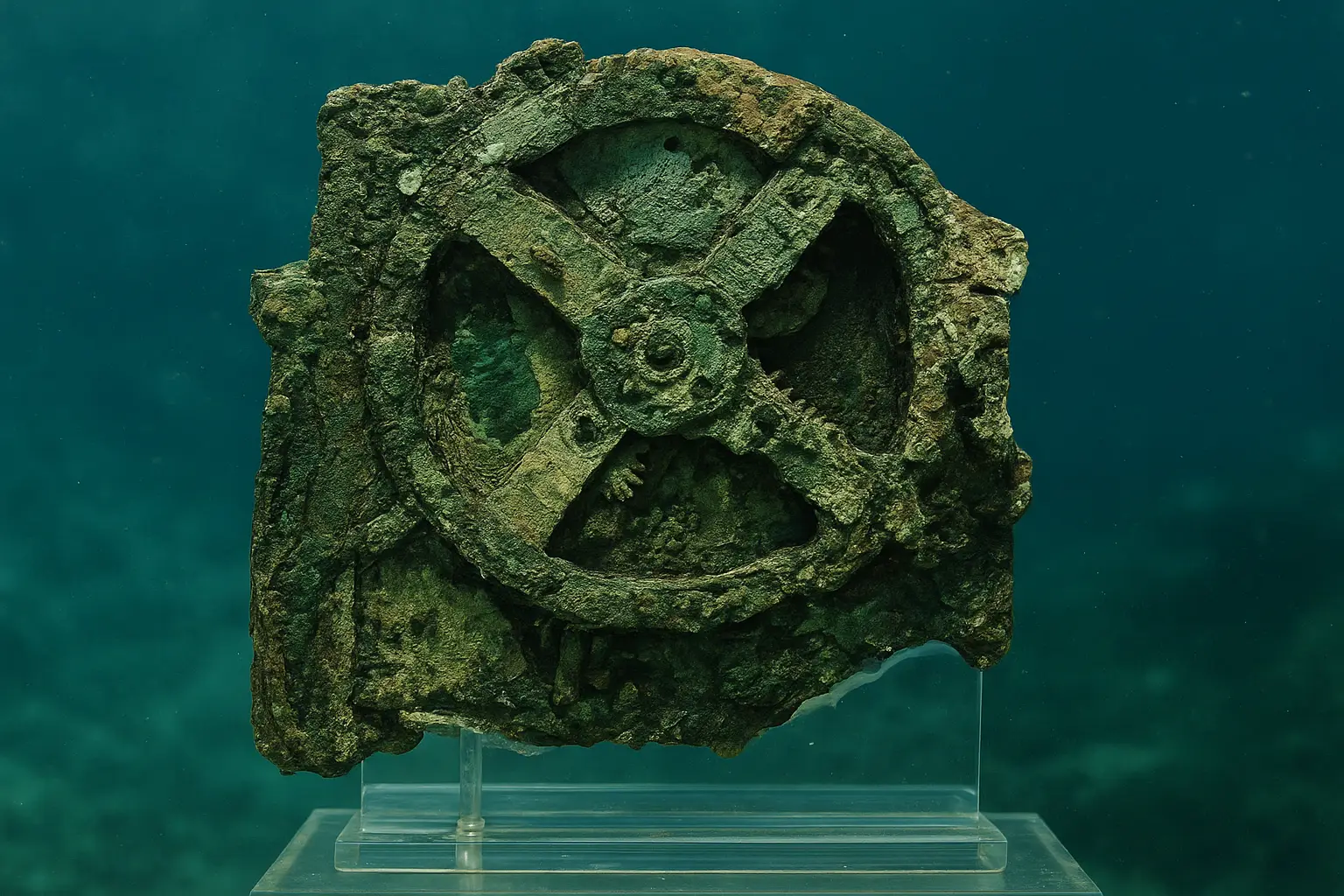
In 1900, Greek sponge divers led by Captain Dimitrios Kontos sought shelter near Antikythera after a storm. Diving into the depths, they discovered a shipwreck dating back to around 70–60 BCE. The site was littered with treasures — marble statues, pottery, coins, and jewelry — but among them lay a lump of corroded bronze that appeared unremarkable. It was only later, when it broke apart, that scientists noticed finely crafted bronze gears hidden inside.
At first, no one understood what it was. The gears seemed impossibly intricate for their age. Ancient Greece was known for its philosophers and mathematicians, but not for machines of this sophistication. It wasn’t until 1959, when physicist Derek J. de Solla Price began a detailed study, that the true complexity of the Antikythera Mechanism began to emerge.
Inside the Machine: A Technological Marvel
Using X-ray imaging and 3D scans, researchers have uncovered that the mechanism once contained more than 30 precisely cut bronze gears, housed in a wooden case about the size of a shoebox. These gears worked together to display the movements of the Sun, Moon, and possibly the planets, relative to the stars.
The front dial showed the Greek zodiac and calendar, while the back dials tracked lunar cycles and predicted solar and lunar eclipses. One dial even marked the timing of the Olympic Games — suggesting that the device was not only a scientific instrument but also a social and cultural one.
The craftsmanship was so advanced that many experts compare it to the work of 18th-century clockmakers, though it predates them by nearly 1,800 years.
The Genius Behind the Device
Who could have built something so far ahead of its time?
Historians believe the Antikythera Mechanism may have been created by a follower of Archimedes, the Greek mathematician and inventor from Syracuse, who lived in the 3rd century BCE. Ancient texts mention complex astronomical devices built by Archimedes and Hipparchus, another renowned astronomer.
Hipparchus, in particular, may have inspired the mechanism’s lunar calculations. His discovery of the Moon’s irregular orbit, known as the lunar anomaly, matches the mathematical models found within the gears. This suggests the mechanism was based on astronomical principles that were centuries ahead of their time.
Still, no records describe this specific device — and no other artifacts like it have ever been found.
How Advanced Was Ancient Knowledge?
The existence of the Antikythera Mechanism has forced scholars to rethink what ancient civilizations were capable of. Before its discovery, historians believed that complex gear systems didn’t appear until the development of medieval European clocks in the 14th century.
Yet, the mechanism demonstrates not only knowledge of mathematics and astronomy, but also mastery in precision engineering. The gear teeth were hand-cut with astonishing accuracy, and the mechanical synchronization of celestial cycles reveals a level of understanding that shouldn’t have existed in the ancient world.
It challenges the idea that technological progress follows a straight line. Instead, it suggests that ancient engineers achieved breakthroughs that were later lost — perhaps destroyed in wars, natural disasters, or through the decline of knowledge during the fall of empires.
Theories and Speculations
While much has been uncovered, the Antikythera Mechanism remains far from fully understood. Several theories attempt to explain its origin and purpose:
- Astronomical Calendar:
Many scholars believe the device was used to track celestial events — such as eclipses, solstices, and planetary alignments — for both scientific and religious purposes. - Navigational Tool:
Others suggest it might have aided sailors in navigation, allowing them to calculate positions based on astronomical data, although no clear evidence supports this. - Teaching Instrument:
Some experts propose it was used for education, demonstrating the cosmos to students of astronomy and philosophy. - Royal Gift or Curiosity:
Given its beauty and complexity, it may also have been a luxury object, commissioned by a wealthy patron fascinated by the stars. - A Lost Tradition of Ancient Engineering:
Perhaps most intriguing is the idea that the mechanism was not unique — that it was part of a lost technological tradition of mechanical astronomy that vanished from history.
Modern Investigations
In recent decades, new technologies have peeled back more of the mystery. The Antikythera Mechanism Research Project, using advanced CT scans and surface imaging, reconstructed the internal gears and inscriptions. They discovered Greek text that may have served as operating instructions — further confirming it was a scientific instrument rather than mere decoration.
In 2021, a team from University College London (UCL) proposed a digital model of the full mechanism, based on all surviving fragments and inscriptions. Their model suggests it displayed the motions of Mercury, Venus, Mars, Jupiter, and Saturn, in addition to the Sun and Moon.
If true, it would mean the device accurately represented the known universe of the ancient Greeks — a cosmic machine built over two thousand years ago.
The Questions That Remain
Despite these advances, many questions linger:
- Who commissioned the mechanism, and for what purpose?
- How was such precision achieved with the tools available in ancient Greece?
- Were there other devices like it that simply haven’t survived?
No definitive answers exist. Every discovery seems to open new layers of mystery.
Some speculate that the mechanism might represent the last surviving artifact from a forgotten age of ancient innovation — a fleeting moment when human genius reached a height only to be lost for centuries.
The Legacy of the Antikythera Mechanism
Today, the Antikythera Mechanism stands as a symbol of both brilliance and mystery. It challenges the boundaries of our historical understanding and invites us to question how much ancient knowledge has vanished over time.
It reminds us that history is not a simple progression from primitive to advanced. Instead, it is a fragile web of discoveries — one that can be lost just as easily as it is found.
The mechanism’s gears, once frozen in corrosion, now turn again in the minds of scientists, historians, and dreamers alike. It is a testament to the ingenuity of the human spirit — and to the mysteries that still lie hidden beneath the sands (and seas) of time.
Conclusion
The Antikythera Mechanism is more than an archaeological find; it is a question mark carved in bronze. It forces us to rethink what ancient civilizations knew about the cosmos, mathematics, and mechanics. Was it a singular masterpiece or the last survivor of a forgotten scientific tradition?
We may never know. Yet in that uncertainty lies its power. The device continues to remind humanity that history holds more secrets than answers — and that some of the greatest discoveries are not new inventions, but rediscoveries of knowledge long lost to the past.