Introduction
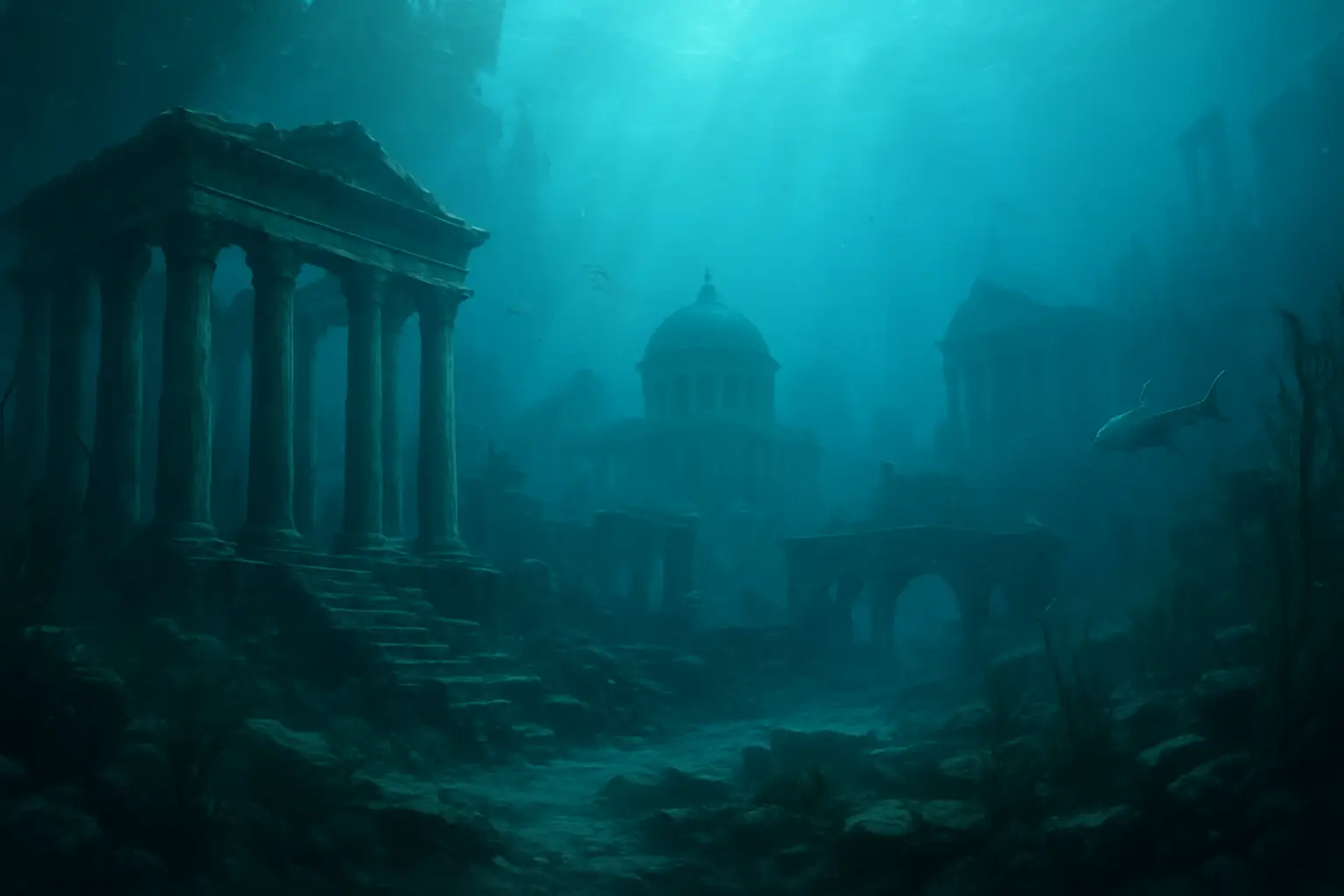
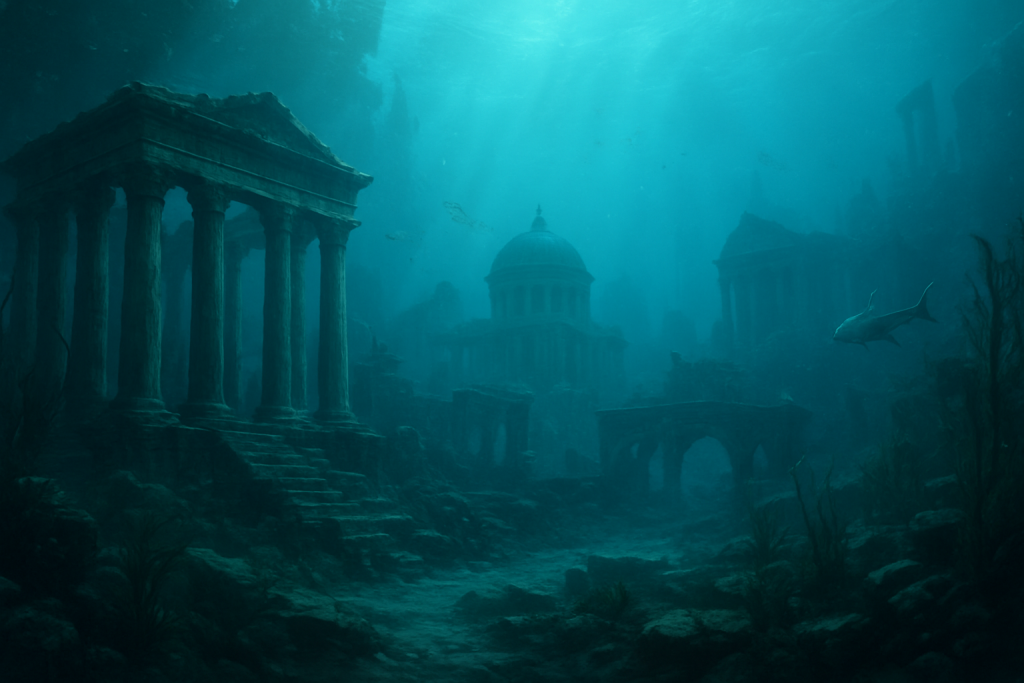
Few mysteries have captured the human imagination quite like the legend of Atlantis — the fabled island civilization said to have vanished beneath the sea thousands of years ago. For over two millennia, historians, archaeologists, and dreamers have debated whether Atlantis was real, symbolic, or simply a story meant to teach moral lessons.
First mentioned by the ancient Greek philosopher Plato in his dialogues Timaeus and Critias (circa 360 BCE), Atlantis was described as an advanced and powerful island nation that fell out of divine favor and sank “in a single day and night of misfortune.” Since then, countless explorers and researchers have searched for its remains — from the depths of the Atlantic Ocean to the deserts of North Africa.
This article explores the origins of the Atlantis story, the possible historical and geological realities behind it, and the modern efforts to locate the lost city that continues to fascinate the world.
The Origin of the Legend: Plato’s Account
The earliest and only direct source about Atlantis comes from Plato, the student of Socrates and teacher of Aristotle. In Timaeus and Critias, Plato describes Atlantis as a vast island located “beyond the Pillars of Heracles” — an ancient term for the Strait of Gibraltar, which separates Europe from Africa.
According to his writings, Atlantis was a mighty maritime empire that had once ruled parts of Europe and Africa around 9,000 years before his time (roughly 11,600 years ago). Its people were wealthy, technologically advanced, and governed by noble kings descended from the god Poseidon.
Plato described Atlantis as a near-utopian civilization — rich in natural resources, with grand palaces, circular canals, and fertile lands. However, as the Atlanteans grew powerful, they became greedy and corrupt. The gods, angered by their arrogance, punished them by causing earthquakes and floods that destroyed the entire island in a single cataclysmic event.
While Plato claimed this story was passed down from Egyptian priests to the Athenian statesman Solon, most scholars believe it was a philosophical allegory — a cautionary tale about human pride and moral decay. Yet, the level of detail Plato included has always made readers wonder: could there be some truth hidden beneath the legend?
Possible Locations of Atlantis
For centuries, scholars and explorers have tried to identify the location of Atlantis, proposing theories that span the globe. Below are some of the most discussed possibilities — each backed by varying degrees of evidence and speculation.
1. The Mediterranean Hypothesis
Some researchers believe Atlantis was not far from Greece at all, but located within the Mediterranean basin. One popular candidate is the island of Santorini (ancient Thera), part of modern Greece. Around 1600 BCE, the island’s volcano erupted violently, destroying much of the Minoan civilization — an advanced Bronze Age culture known for its art, trade, and architecture.
The eruption caused massive tsunamis and ash clouds that could have inspired stories of a city swallowed by the sea. The Minoans’ advanced maritime culture and sudden disappearance align strikingly with Plato’s description.
2. The Atlantic Ocean Theory
Because Plato explicitly wrote that Atlantis lay “beyond the Pillars of Heracles,” many believe the lost city was somewhere in the Atlantic Ocean. Early explorers like Christopher Columbus and Francis Bacon thought the Americas might be remnants of Atlantis.
In the 20th century, oceanographers discovered underwater plateaus such as the Azores Islands — volcanic islands located about 900 miles west of Portugal. Some researchers suggest that these islands could be the mountain peaks of a once-larger landmass that sank due to tectonic shifts. However, geological studies show no evidence of a submerged continent in the Atlantic during the time Plato described.
3. The Antarctica Hypothesis
A more controversial theory suggests that Atlantis could be buried under the ice of Antarctica. This idea, popularized by Charles Hapgood’s “earth crust displacement” theory, proposes that Antarctica was once located in a temperate zone before a sudden pole shift froze it over. Proponents argue that ancient maps, such as the Piri Reis map (1513), depict an ice-free Antarctica, hinting that an advanced civilization might have existed there before the cataclysm.
While intriguing, this theory lacks geological support, as Antarctica has been covered in ice for millions of years.
4. The Sahara and Eye of the Sahara
Recent attention has turned to the Richat Structure, also known as the Eye of the Sahara, located in Mauritania, West Africa. From above, it appears as a series of circular rings, remarkably similar to Plato’s description of Atlantis as a city of concentric circles surrounded by water.
Geological evidence shows the region was once lush and covered in rivers and lakes. Although the Eye of the Sahara is a natural formation, satellite imagery has reignited speculation that this might be the long-lost city’s remains.
Scientific Investigations and Archaeological Searches
Throughout modern history, the search for Atlantis has inspired both serious scientific efforts and wild pseudoarchaeological claims.
During the 20th century, marine archaeologists used sonar and deep-sea submersibles to explore the Atlantic Ocean floor. One of the most publicized claims came in the 1960s when divers near Bimini, in the Bahamas, discovered underwater rock formations known as the “Bimini Road.” Some believed these stones were the remains of ancient walls or roads built by Atlanteans. Later studies, however, showed they were natural beach rock formations fractured by geological processes.
Despite technological advances, no definitive ruins matching Plato’s detailed description have been found. However, the lack of evidence hasn’t diminished the mystery — it has only deepened humanity’s fascination.
The Minoan Connection
Of all the theories, the Minoan hypothesis remains one of the most credible in scholarly circles. The Minoan civilization, which flourished on Crete and nearby islands around 2700–1450 BCE, was among the most sophisticated cultures of the ancient world.
They built multi-story palaces, maintained a writing system (Linear A and Linear B), and traded across the Mediterranean. Around 1600 BCE, the Thera eruption devastated the region, producing massive tsunamis that likely destroyed coastal settlements.
The parallel between the destruction of Thera and Plato’s Atlantis — a wealthy maritime civilization annihilated in a sudden cataclysm — is striking. Some historians believe Plato may have drawn upon collective Greek memories of the Minoan disaster, passed down orally for centuries, to craft his philosophical allegory.
Atlantis in Culture and Myth
Beyond academia, Atlantis has become a powerful cultural symbol. It represents lost knowledge, forbidden technology, and the dream of an ideal society that perished due to hubris.
During the Renaissance, scholars rediscovered Plato’s works, sparking renewed interest in Atlantis as a real place. European explorers interpreted the legend as a historical account, fueling colonial quests for “lost worlds.”
In the 19th and 20th centuries, the story of Atlantis merged with pseudoarchaeology and mysticism. Writers like Ignatius Donnelly (in Atlantis: The Antediluvian World, 1882) argued that Atlantis was the mother civilization of all ancient cultures, influencing Egypt, Mesoamerica, and even prehistoric Europe.
Later, Atlantis became a staple of science fiction and fantasy — appearing in novels, films, and video games as an underwater city of advanced technology or alien heritage. The idea evolved beyond its origins, becoming a metaphor for humanity’s search for wisdom and its recurring self-destruction.
Modern Theories and Technology
In recent decades, modern technologies such as satellite mapping, ground-penetrating radar, and deep-sea scanning have allowed researchers to explore possible sites with unprecedented accuracy.
In 2018, archaeologists in southern Spain found submerged ruins near Cádiz, prompting speculation that Atlantis might have been a prehistoric settlement near the Strait of Gibraltar. Similarly, studies of ancient flood events during the Younger Dryas period (~12,000 years ago) suggest that massive coastal flooding could have erased early human settlements — events that might have inspired flood myths worldwide, including that of Atlantis.
Moreover, the rise of geoarchaeology — the study of geological processes affecting ancient human sites — has encouraged scientists to revisit old legends with modern evidence. While no Atlantis has been confirmed, the exploration itself continues to yield new discoveries about ancient civilizations and the fragility of human existence in the face of nature.
Symbolism and Legacy
Even if Atlantis never physically existed, its story endures because it speaks to universal truths. It represents the tension between progress and morality, between technological achievement and ethical decay.
Plato may have intended it as a philosophical warning — that even the greatest civilizations fall when they lose their moral compass. Yet, across time, people have reinterpreted it as a story of hope: that humanity once reached extraordinary heights and could do so again.
Atlantis also reminds us of how much of our planet’s history remains hidden. More than 80% of the ocean floor remains unexplored, and entire ancient cities have been discovered underwater in places like India, Japan, and Egypt. Each new find proves that myths can sometimes hold grains of truth.
Conclusion
The legend of Atlantis straddles the line between history and myth, between human imagination and forgotten truth. Whether it was a memory of the Minoans, a parable by Plato, or a story of a real lost world, its power endures because it touches something deeply human — our yearning for discovery, for connection with a lost golden age, and for understanding our own place in history.
Until conclusive evidence is found, Atlantis will remain a riddle — one that invites us to explore not only the depths of the sea but the depths of our own curiosity.
Perhaps that is the true legacy of Atlantis: not a city lost to the waves, but an idea that keeps human imagination afloat.