
Introduction
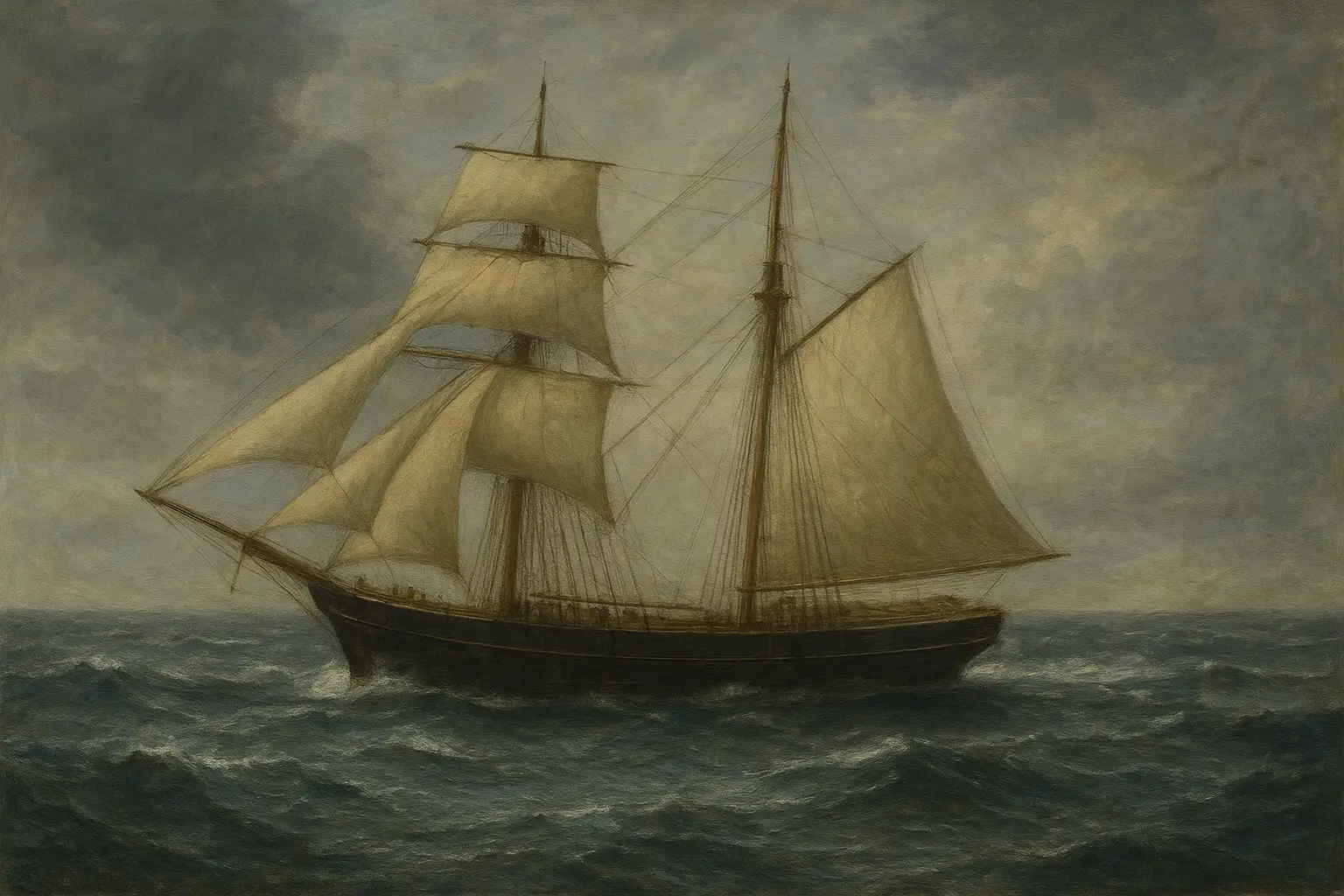
Few mysteries have haunted the sea quite like the story of the Mary Celeste — the so-called ghost ship found adrift in the Atlantic Ocean in 1872 with no one aboard, yet perfectly seaworthy.
When sailors of the Dei Gratia, another merchant vessel, spotted her drifting near the Azores Islands, they expected to find a wreck. Instead, they discovered a ship in near-perfect condition: the cargo untouched, food on the table, and the crew’s personal belongings neatly stored.
But the ten people who had been aboard — including the ship’s captain, his wife, and their two-year-old daughter — had vanished without a trace.
For over a century and a half, investigators, historians, and conspiracy theorists have wrestled with the question: What happened to the crew of the Mary Celeste?
1. The Voyage Begins
The Mary Celeste was a 282-ton brigantine, built in Nova Scotia in 1861 and originally named Amazon. After a series of ownership changes and mishaps (including running aground and colliding with another ship), she was refurbished and registered in New York in 1872 under her new captain, Benjamin Spooner Briggs — an experienced, devout, and respected seaman.
On November 7, 1872, Captain Briggs set sail from New York Harbor bound for Genoa, Italy, carrying 1,701 barrels of denatured alcohol. His crew of seven men were all skilled sailors, and he brought along his wife, Sarah, and their young daughter, Sophia.
The weather was favorable. The ship was well-provisioned for a long voyage. There was no reason to expect anything but a routine crossing of the Atlantic.
Yet less than a month later, the Mary Celeste was discovered sailing aimlessly, with no living soul on board.
2. The Discovery at Sea
On December 4, 1872, the British ship Dei Gratia, commanded by Captain David Morehouse, spotted a vessel drifting erratically about 400 miles east of the Azores.
When they approached, they saw the name Mary Celeste on the stern. Captain Morehouse knew Briggs personally — the two men had dined together in New York before their departures — and immediately sensed something was wrong.
A boarding party rowed over and climbed aboard. What they found was beyond strange:
- The sails were partly set but damaged.
- The lifeboat was missing.
- The ship’s logbook had been updated until November 25 — just nine days earlier.
- The cabin was orderly; beds were made, personal items neatly arranged.
- Food stores were abundant, and a meal appeared to have been recently prepared.
- The cargo of alcohol barrels was intact — save for nine that were empty.
- Crucially, the ship’s chronometer and sextant were missing — suggesting the crew had left intentionally.
Yet there was no sign of violence, struggle, or foul play.
The Dei Gratia crew divided up and sailed the Mary Celeste to Gibraltar, where an official inquiry began — one that would raise more questions than it answered.
3. The Investigation
The Gibraltar Court of Inquiry was led by Frederick Solly-Flood, the British attorney general for the territory. From the beginning, he suspected foul play — perhaps mutiny, or insurance fraud.
He interrogated the Dei Gratia crew, who were accused of plundering or even murdering the Mary Celeste’s sailors. But no evidence supported those claims. The cargo was almost completely intact, and there was no sign of a struggle.
Solly-Flood then proposed that the crew might have abandoned ship prematurely, fearing an explosion due to fumes from leaking alcohol barrels. Nine barrels were found empty — they had been made from a more porous type of wood, which could have allowed vapor to escape into the hold.
If the crew smelled alcohol and feared combustion, they might have launched the lifeboat to ride out a possible explosion. But if a storm or sudden gust of wind separated them from the ship, they could easily have been lost at sea.
This explanation — though incomplete — remains one of the most plausible.
4. The Theories: Fact, Fiction, and the Fantastic
The Mary Celeste has inspired a tide of theories — from the sensible to the supernatural.
A. The Alcohol Fume Explosion Theory
Many experts today support the idea that alcohol fumes escaping from the barrels caused a scare. A flash fire (without explosion) might have prompted Briggs to order an evacuation.
If the lifeboat was tied to the ship by a rope, it could have easily snapped, leaving the crew adrift in open sea while the Mary Celeste sailed on, unmanned.
This theory fits both the missing navigational instruments and the lack of violence.
B. Mutiny or Piracy
Some have speculated that the crew mutinied — killing the captain and his family, then abandoning ship. But there’s no evidence of blood, damage, or theft.
Others suggest the Dei Gratia crew staged the scene to claim the salvage reward. But again, no proof emerged, and both captains were known to be friends and men of integrity.
C. Natural Disaster
Could a waterspout or rogue wave have struck the Mary Celeste? Such an event could have drenched the decks and terrified the crew into thinking the ship was sinking.
Yet when found, the Mary Celeste was dry and stable.
D. The Paranormal Explanations
As with many sea mysteries, some theories venture beyond the rational.
Victorian tabloids published stories of sea monsters, ghosts, or even alien abduction (long before UFOs entered popular culture). Others claimed the ship was cursed — noting her troubled early history under the name Amazon, during which she had collided with other vessels and lost captains under strange circumstances.
Even Arthur Conan Doyle, creator of Sherlock Holmes, wrote a fictionalized account in 1884 titled “J. Habakuk Jephson’s Statement.” His story transformed the Mary Celeste into the “Marie Celeste” — a name that, ironically, became more famous than the real one.
Though Doyle’s tale was meant as fiction, many readers believed it true, cementing the ship’s legend in public imagination.
5. What the Science Says
Modern maritime researchers have revisited the evidence using simulations and experiments.
In 2006, a documentary for the Smithsonian Channel tested the alcohol-fume hypothesis by igniting butane gas in a scale model of the ship’s hold. The result was a brief but powerful flame — hot enough to cause panic, yet not to leave scorch marks or damage.
This supports the idea that Captain Briggs, known for his caution, might have ordered everyone into the lifeboat until the danger passed — a tragic decision if they couldn’t return.
6. Aftermath: The Fate of the Mary Celeste
After being salvaged and returned to service, the Mary Celeste continued sailing for another 12 years, though her reputation as a “cursed ship” followed her.
She changed hands several times and was eventually used in insurance fraud schemes by later owners. In 1885, her final captain deliberately ran her aground off Haiti, hoping to collect insurance money.
The plan failed, and the Mary Celeste was left to rot — a sad end for one of history’s most haunted ships.
7. Legacy of the Ghost Ship
The Mary Celeste has inspired books, documentaries, films, and songs. She remains one of the most enduring maritime mysteries, precisely because it’s both real and unsolved — a case with physical evidence, credible witnesses, and no definitive answer.
To this day, the Mary Celeste symbolizes the deep, cold indifference of the sea — and humanity’s endless fascination with the unknown.
Her story has become a mirror for our fears: of isolation, of vanishing without explanation, of losing control amid forces we cannot see.
Conclusion
The mystery of the Mary Celeste endures not because of ghosts or curses, but because it perfectly captures the tension between human reason and the vast unpredictability of nature.
Every theory — from leaking barrels to alien intervention — reflects our struggle to make sense of the senseless.
In truth, we may never know what happened to Captain Briggs, his family, and crew. The Atlantic, vast and unforgiving, swallowed their fate along with countless others.
But their ship’s lonely voyage across thousands of miles of ocean, sails still set, drifting silently under the wind, stands as one of the strangest and most haunting real events in history — a true ghost story of the sea.