Introduction
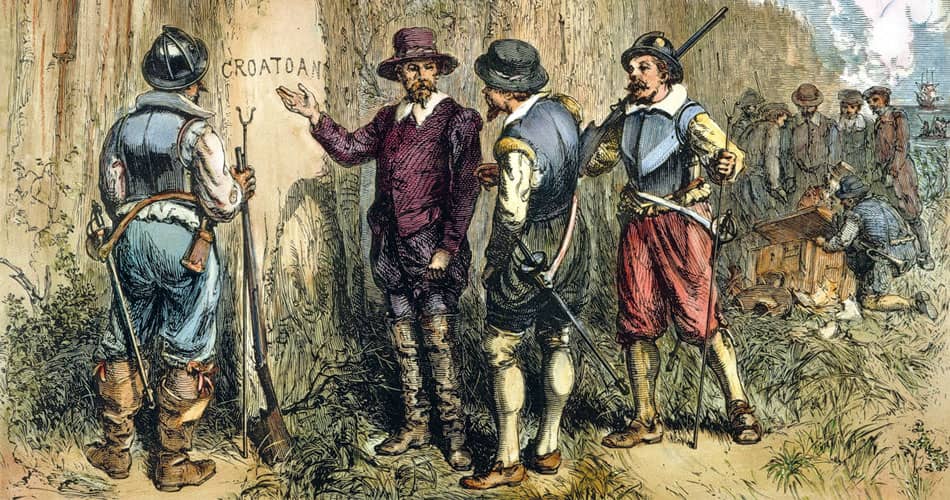
Few mysteries in history have haunted scholars, explorers, and storytellers quite like the disappearance of the Roanoke Colony. In the late 16th century, more than a hundred English settlers vanished without a trace from Roanoke Island, off the coast of modern-day North Carolina. When their governor, John White, returned from England after a three-year absence, he found the colony deserted — houses dismantled, supplies gone, and a single cryptic clue carved into a wooden post: “CROATOAN.”
For centuries, historians have debated what happened to those men, women, and children. Were they killed by hostile tribes? Did they starve and scatter? Or did they integrate peacefully with Native Americans, becoming lost in the folds of early American history?
Despite modern technology, archaeological digs, and DNA testing, the fate of the Roanoke settlers remains unsolved — a mystery suspended between fact and legend. This article explores the full story: from the colony’s founding and disappearance to the leading theories that continue to fascinate experts today.
1. The Dream of a New World
In the late 1500s, England was eager to compete with Spain’s growing empire in the Americas. Under Queen Elizabeth I, English explorers sought to establish a permanent foothold in the New World — both for trade and as a base to challenge Spanish ships.
Enter Sir Walter Raleigh, an ambitious courtier who was granted a royal charter in 1584 to “discover and occupy remote heathen and barbarous lands.” Raleigh sent several expeditions to explore the Atlantic coast, and his scouts identified Roanoke Island — located in the Outer Banks of present-day North Carolina — as an ideal site for settlement.
The first English expedition arrived in 1585, led by Sir Richard Grenville and Ralph Lane. They built a small fort but soon clashed with local tribes and ran short of supplies. After a year of hardship, they abandoned the settlement and returned to England. Still, Raleigh persisted. He organized another attempt two years later, determined to create a lasting English presence in North America.
2. The 1587 Colony: Hope and Hardship
The second Roanoke expedition, launched in 1587, was more ambitious — and more vulnerable. This time, it wasn’t a military outpost but a civilian colony. The leader was John White, an artist and mapmaker, appointed governor of the new settlement.
On July 22, 1587, about 115 colonists landed on Roanoke Island. Among them were families, women, and children — including White’s own daughter, Eleanor Dare, who soon gave birth to Virginia Dare, the first English child born in the Americas.
Initially, relations with local Native American tribes were mixed. Some, like the Croatoan people (who lived on nearby Hatteras Island), were friendly. Others were hostile, likely due to past conflicts with the earlier English expedition.
From the start, the settlers faced food shortages and disease. Desperate, the colonists urged John White to return to England for supplies. Though reluctant to leave his family behind, White agreed, departing for England in August 1587 — promising to return as soon as possible.
3. The Vanishing
White’s return, however, was delayed by events beyond his control. England was preparing for war with Spain, and all ships were commandeered to defend against the Spanish Armada. It wasn’t until August 1590 — three long years later — that John White finally returned to Roanoke.
When he arrived, he was met with a chilling silence. The colony was gone.
White found the settlement deserted, overgrown with weeds. The houses had been carefully dismantled, not destroyed — suggesting no violent attack had occurred. The colonists’ belongings were gone.
The only clue was a single word carved into a tree post: “CROATOAN.” On another tree, he found the letters “CRO.” White interpreted this as a sign that the colonists had relocated to Croatoan Island (modern-day Hatteras Island), where the friendly Croatoan tribe lived.
But before White could search there, a violent storm forced his ship to return to England. He never saw his family or the colonists again.
4. Theories of the Lost Colony
For over 400 years, the disappearance of the Roanoke colonists has inspired countless theories. While some are grounded in evidence, others border on legend. Let’s explore the main possibilities.
4.1. Integration with Native Tribes
The most plausible theory is that the colonists integrated with local Native American tribes, especially the Croatoans. This would explain why there were no signs of struggle or destruction.
Later English explorers reported encountering tribes with gray eyes and European features, and some Native oral histories mention ancestors who were “white” or spoke English words. Archaeological evidence from Hatteras Island also supports this theory: artifacts of European origin, such as a signet ring, gun parts, and slate writing tablets, have been found among Native settlements dating to the early 1600s.
Recent research by the First Colony Foundation and the Lost Colony DNA Project suggests that genetic and cultural intermixing between English settlers and Native tribes may indeed have occurred — though direct proof remains elusive.
4.2. Death by Starvation or Disease
Another possibility is that the colonists, cut off from England and struggling with limited supplies, succumbed to starvation or disease. The region was prone to drought, as confirmed by tree-ring data from the 1990s, which indicates that 1587–1589 was one of the worst drought periods in centuries.
If the colonists lacked food and were unable to secure help from local tribes, they may have perished gradually. Their remains, scattered and decomposed, might have vanished in the harsh coastal environment — explaining why no mass graves have been found.
4.3. Attack by Hostile Tribes
Some historians propose that the colonists were killed by hostile Native tribes, such as the Powhatan Confederacy, who may have viewed the English as threats. The leader Chief Powhatan reportedly told Captain John Smith (of Jamestown fame) that he had wiped out a group of English settlers living inland.
However, no physical evidence of such a massacre has ever been found at Roanoke, and Powhatan’s claim might have been an exaggeration meant to demonstrate his power to the English.
4.4. Spanish Raid
During this period, Spain considered England a rival colonial power. Spanish forces, based in Florida, frequently attacked English ships and settlements. Some have theorized that Spanish soldiers discovered Roanoke and destroyed it to eliminate an English foothold.
But Spanish records show no mention of such an attack, and there is no archaeological evidence of fire or violence at the Roanoke site.
4.5. The “Dare Stones” and Other Myths
In the 20th century, a series of engraved stones surfaced across North Carolina and Georgia, claiming to be messages from Eleanor Dare describing the colony’s fate. However, most scholars have since dismissed the “Dare Stones” as elaborate hoaxes created in the 1930s.
Other theories have grown even wilder — suggesting alien abductions, witchcraft, or secret relocation to Chesapeake Bay. While these ideas make for sensational stories, none hold up to scientific scrutiny.
5. Modern Archaeology and Ongoing Clues
The mystery of Roanoke continues to attract serious academic research. In recent decades, archaeologists have used satellite imaging, ground-penetrating radar, and DNA testing to search for traces of the lost colonists.
In 2012, researchers discovered a hidden symbol on an original map drawn by John White — a patch that concealed a small red and blue star marking an inland location near the Albemarle Sound. Excavations at that site, known as “Site X,” uncovered pottery fragments, gun flints, and other artifacts of late 16th-century English origin.
While not definitive proof, this suggests that at least some colonists may have moved inland, possibly splitting into smaller groups to survive.
The First Colony Foundation continues to excavate new areas, and the use of advanced genetic analysis may one day identify living descendants — potentially solving the mystery once and for all.
6. Why Roanoke Still Fascinates Us
The enduring allure of the Roanoke mystery lies not only in its unanswered questions but in what it represents: the fragility of human hope against the vast unknown.
Roanoke was the first English attempt to settle the New World — a bold and perilous dream of expansion. Its disappearance revealed how unprepared humanity was for such a venture, how nature and circumstance could erase a community entirely from the record.
In literature and popular culture, Roanoke has become a symbol of vanished ambition, inspiring novels, television series, and documentaries. It evokes the same eerie curiosity as other great unsolved enigmas — like the lost city of Atlantis or the fate of Amelia Earhart.
Ultimately, the mystery of Roanoke is not just about what happened to 115 colonists; it’s about how much of the human story still lies hidden, waiting to be rediscovered.
Conclusion
The Lost Colony of Roanoke stands as a haunting monument to the early age of exploration — a mystery that has survived over four centuries of speculation, science, and storytelling. Whether the settlers died, assimilated, or moved inland, their fate remains one of history’s most enduring enigmas.
But perhaps the greatest lesson Roanoke offers is this: even in an age of satellites and DNA databases, some mysteries resist resolution. They remind us of the limits of knowledge — and the boundless capacity of human imagination.
As the winds continue to sweep across the dunes of Roanoke Island, the ghost of that vanished colony still whispers one word into history: CROATOAN.