Introduction
For centuries, the Library of Alexandria has stood as a symbol of human brilliance—and human fragility. Built in the ancient Egyptian city of Alexandria, it was once the largest and most significant repository of knowledge in the world. Scholars from Greece, Egypt, Persia, India, and beyond gathered under its roof to study, translate, and preserve the intellectual heritage of civilizations.
And yet, this great storehouse of wisdom vanished. The details of how and when remain contested, but the loss of the Library of Alexandria—and the scientific, philosophical, and literary treasures it contained—represents one of the most profound tragedies of human history.
This is the story of what the library was, what it held, how it was lost, and what humanity truly lost when the flames consumed its shelves.
The Birth of a Dream
The Library of Alexandria was established in the early 3rd century BCE, during the reign of Ptolemy I Soter (a general of Alexander the Great who became ruler of Egypt after Alexander’s death). Alexandria, named after Alexander himself, had quickly become a thriving port city and a melting pot of cultures, languages, and ideas.
The Ptolemies sought to make it not only a center of trade but also the intellectual heart of the world. Ptolemy I and his son Ptolemy II Philadelphus envisioned a universal library—a place that would gather all knowledge ever written, from every known civilization.
To achieve this, royal agents were dispatched across the Mediterranean with a bold directive: acquire every scroll possible. Ships that docked in Alexandria were searched, and their books were copied—the originals often kept by the library, while the copies were returned. This relentless pursuit of knowledge gave rise to a collection estimated by ancient sources to have contained anywhere from 400,000 to 700,000 scrolls.
The Mouseion: A University Before Its Time
The Library was part of a larger complex known as the Mouseion (from which the word museum originates), dedicated to the Muses—the Greek goddesses of the arts and sciences. It wasn’t merely a library; it was a research institute, something remarkably close to a modern university.
The Mouseion provided scholars with funding, housing, dining halls, and gardens for study and debate. Thinkers like Euclid, the father of geometry, and Eratosthenes, who calculated the Earth’s circumference with astonishing accuracy, worked there. Herophilus made groundbreaking discoveries in anatomy and medicine, dissecting human bodies to study the nervous system. Callimachus of Cyrene, the library’s chief librarian, created the Pinakes, a 120-volume catalog system that served as an early model for modern bibliographies.
In short, Alexandria became the intellectual capital of the ancient world—a place where knowledge was revered as the highest pursuit of civilization.
The Knowledge It Held
Although none of the library’s original scrolls have survived, historical references, citations, and later works give clues to the kind of knowledge it held.
- Science and Mathematics:
- Euclid’s Elements was studied and copied extensively, forming the foundation of mathematics for two millennia.
- Archimedes’ theories on mechanics and buoyancy circulated there.
- Eratosthenes’ astronomical measurements and mapping techniques were ahead of their time.
- Medicine:
- Herophilus and his successor Erasistratus conducted the first recorded systematic dissections of human cadavers.
- They described the brain, nerves, and circulatory system with remarkable accuracy—knowledge that was later lost to Europe for nearly 1,500 years.
- Philosophy and Literature:
- The works of Plato, Aristotle, and other Greek philosophers were preserved and studied.
- Texts from Mesopotamia, Persia, and India were translated into Greek.
- The library even held early Buddhist and Hindu texts, showing how Alexandria served as a bridge between Eastern and Western thought.
- Technology and Engineering:
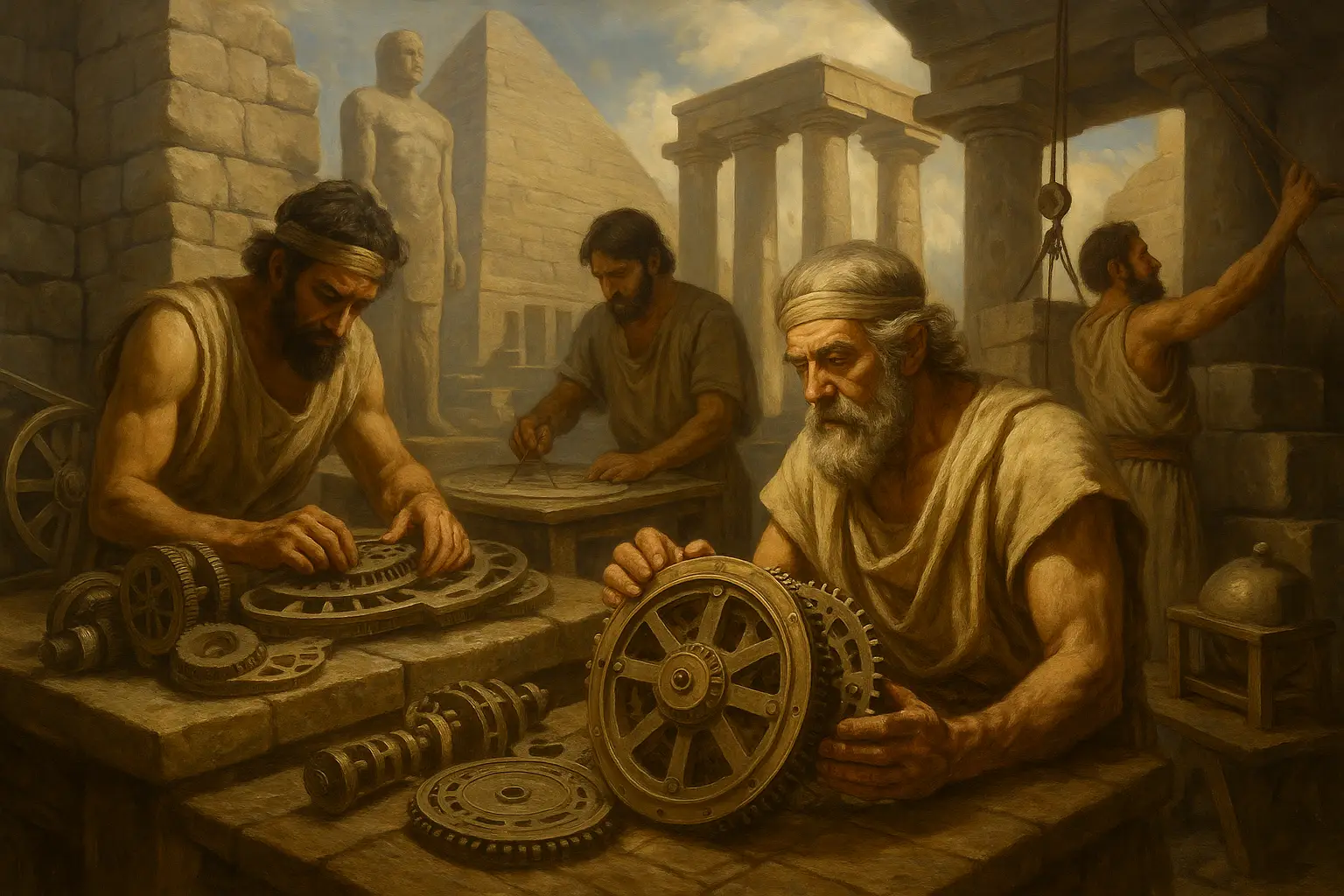
- Designs for automata, early steam engines (like the aeolipile), and mechanical devices were recorded.
- Alexandria was also home to the engineer Hero of Alexandria, who developed the first documented vending machine and a primitive steam turbine.
It’s difficult to overstate how advanced this collection was. The knowledge stored there could have advanced human progress by centuries—had it survived.
The Beginning of the End
The exact timeline of the library’s destruction remains a matter of historical debate. Instead of a single catastrophic event, evidence suggests it may have suffered multiple partial destructions over several centuries.
1. The Fire of Julius Caesar (48 BCE)
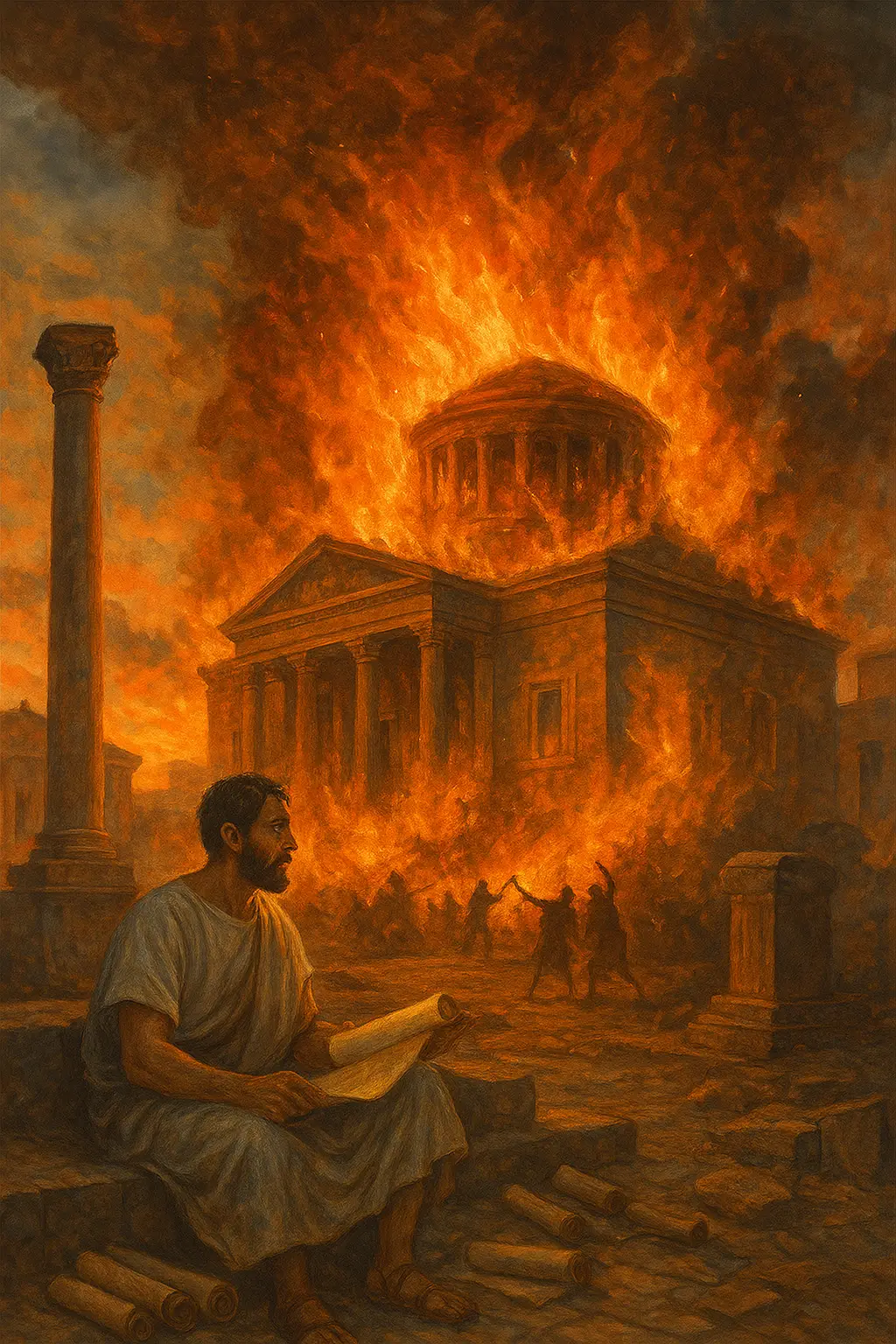
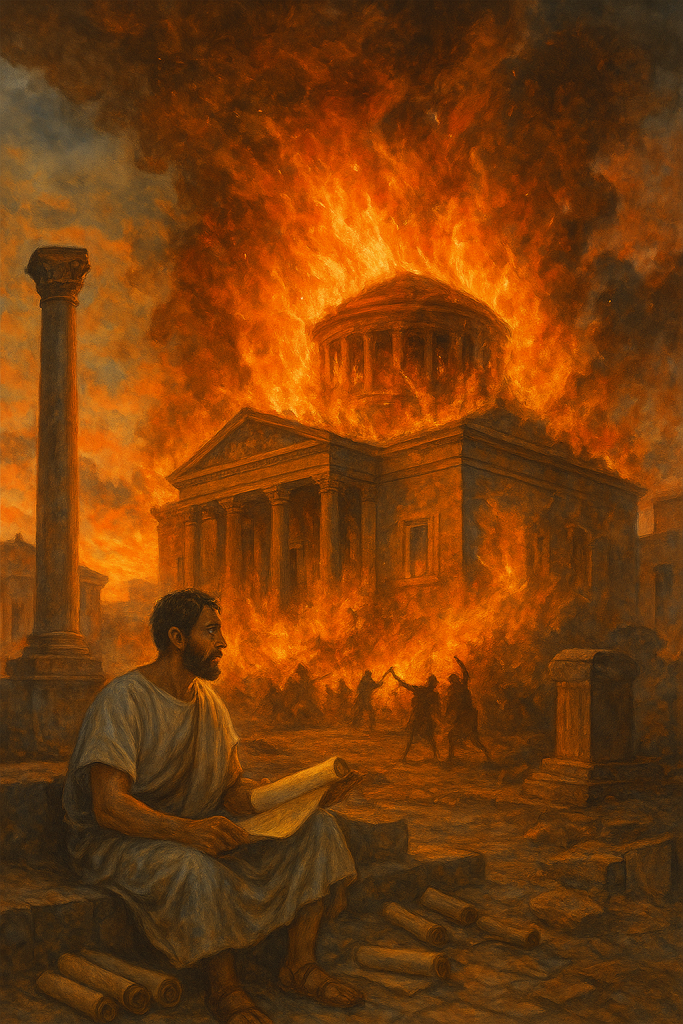
The first and most famous account of the library’s destruction comes from 48 BCE, when Julius Caesar’s forces became trapped in Alexandria during a civil war. To block enemy ships, Caesar ordered the harbor’s ships set on fire.
According to the historian Plutarch, the flames spread to the docks and nearby warehouses—possibly including the library itself. Ancient writers like Dio Cassius and Seneca mention that thousands of scrolls were lost in this fire.
However, some modern historians argue that this fire likely destroyed only a portion of the collection. The Mouseion itself may have survived, continuing to function for centuries afterward.
2. The Decline under Roman Rule
Following the Roman annexation of Egypt, Alexandria remained a center of learning, but the state’s focus shifted. Funding declined, scholars left, and the library’s influence waned. Still, sub-libraries and archives—like the Serapeum, a temple library associated with the main collection—remained active.
3. The Christian and Religious Conflicts (4th Century CE)
By the 4th century CE, Christianity had become the dominant religion of the Roman Empire. Many pagan temples and institutions were targeted as symbols of the old world. In 391 CE, under orders from Emperor Theodosius I, the Serapeum was destroyed by Christian mobs. This event is often seen as marking the final demise of the great library’s remnants.
4. The Arab Conquest (7th Century CE)
A later account, written centuries after the fact, attributes the final loss to the Arab conquest of Egypt in 642 CE. According to the story, Caliph Omar allegedly ordered that any books contradicting the Quran should be destroyed. However, most modern scholars consider this story apocryphal—it likely emerged much later and lacks contemporary evidence.
What Was Truly Lost
While historians debate how and when the library fell, there’s no question about what humanity lost. The destruction of the Library of Alexandria was not just the loss of books—it was the loss of ideas, experiments, and discoveries that could have changed the course of civilization.
For example:
- The medical work of Herophilus and Erasistratus, which detailed the nervous system, vanished until rediscovered during the Renaissance.
- Ancient engineering knowledge, including automata and mechanical computers, was forgotten for centuries.
- Entire schools of Greek philosophy and mathematics disappeared, leaving later civilizations to reinvent what had once been known.
Imagine if the continuity of scientific progress—from Alexandria to the Renaissance—had never been broken. The Industrial Revolution, space exploration, and digital technology might have arrived centuries earlier.
Echoes That Survived
Despite the destruction, fragments of Alexandria’s legacy lived on through scholars who fled the city and carried copies of texts to other regions.
The House of Wisdom in Baghdad (8th–13th centuries CE), for instance, was directly inspired by the Alexandrian model. Under the Abbasid Caliphs, scholars translated Greek and Egyptian works into Arabic, preserving key pieces of ancient knowledge. This included texts by Aristotle, Ptolemy, and Euclid—many of which had likely passed through Alexandria centuries before.
Later, during the European Renaissance, Arabic translations of these works were rendered back into Latin, fueling a revival of science and philosophy. Thus, while much was lost, Alexandria’s light never fully went out—it merely flickered across cultures and centuries.
The Modern Search for Alexandria’s Library
Archaeologists have long sought the remains of the ancient library. In the late 20th century, excavations beneath the modern city of Alexandria revealed what many believe to be part of the Mouseion complex, including lecture halls and research rooms.
In 2002, Egypt inaugurated the Bibliotheca Alexandrina, a vast, modern library built near the ancient site. With room for eight million books and a design inspired by a rising sun, the new library serves as both a memorial and a rebirth of the original’s vision—a place where knowledge is freely shared across nations and disciplines.
Why the Story Still Matters
The loss of the Library of Alexandria resonates today because it reminds us of the fragility of knowledge. In an age of digital archives and cloud storage, it’s easy to assume that information is safe forever. Yet, data loss, censorship, and cultural destruction continue to threaten the preservation of human thought.
The tragedy of Alexandria teaches a timeless lesson: knowledge must be protected, shared, and renewed, or it will vanish as it did before—consumed not only by fire but by indifference, neglect, and the passage of time.
Conclusion
The Library of Alexandria was more than a building filled with scrolls—it was the physical embodiment of humanity’s thirst for understanding. Its destruction stands as one of the greatest intellectual losses in history, a moment when centuries of learning turned to ash.
Yet, its spirit endures in every library, university, and digital archive that continues its mission. The dream of Alexandria—that all knowledge should be gathered, preserved, and made accessible to every mind—remains alive.
As we build new technologies and global networks, we do so standing on the shoulders of those who once walked its halls, copying scrolls by hand in the flickering light of oil lamps. The Library of Alexandria may be lost, but its idea—knowledge as a universal treasure—still guides us toward a wiser world.