Introduction
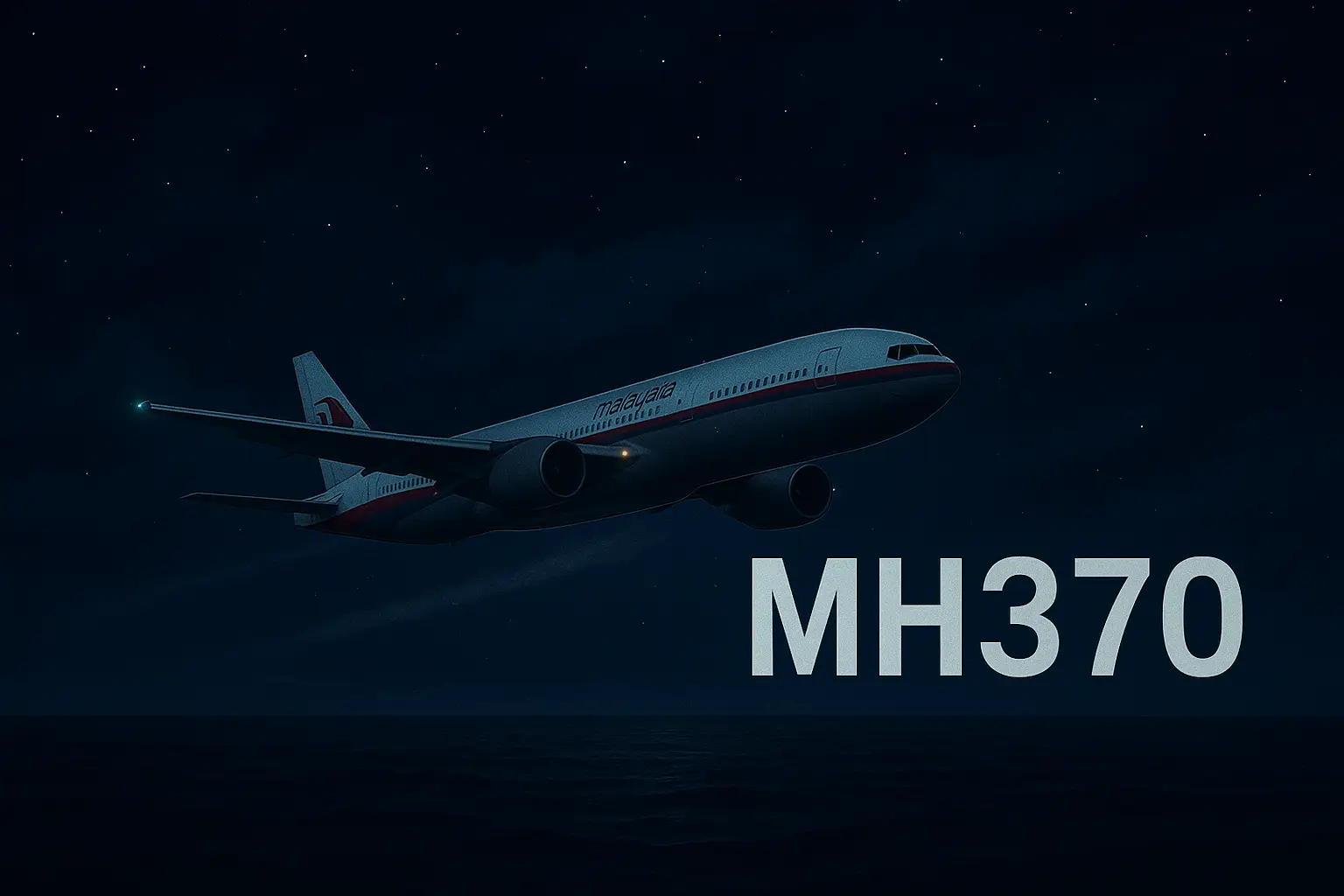
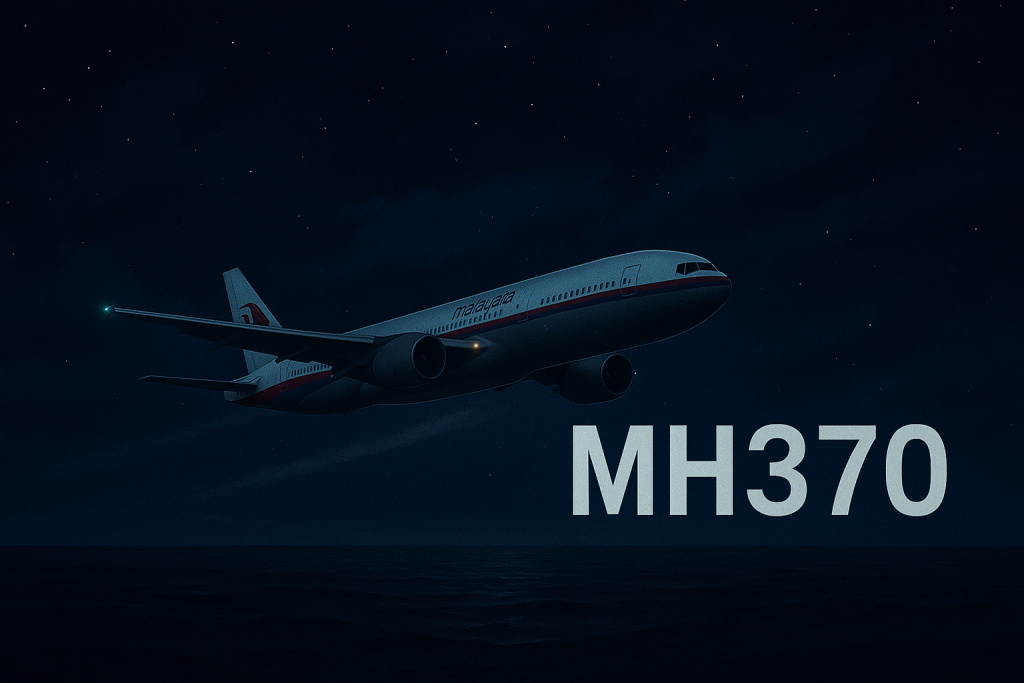
In an age of satellite tracking, advanced radar systems, and instantaneous digital communication, the disappearance of Malaysia Airlines Flight MH370 remains one of the most perplexing mysteries of the 21st century. On March 8, 2014, a Boeing 777 carrying 239 passengers and crew vanished while en route from Kuala Lumpur, Malaysia, to Beijing, China. Despite an unprecedented international search effort spanning years and millions of square kilometers of ocean, no definitive explanation for what happened has ever been found.
This is the story of what is known, what remains uncertain, and why the world still struggles to explain how a massive aircraft could disappear without a trace in the modern era.
The Flight and Its Disappearance
Flight MH370 took off from Kuala Lumpur International Airport at 12:41 a.m. local time, bound for Beijing. On board were 227 passengers and 12 crew members representing 15 different nationalities. The aircraft—a Boeing 777-200ER—was among the most reliable commercial planes in operation, with an excellent safety record.
At 1:19 a.m., the last voice communication was heard from the cockpit. It was a calm and routine farewell: “Good night, Malaysian Three Seven Zero.” Moments later, as the plane crossed from Malaysian to Vietnamese airspace, its transponder—a device that broadcasts its position to air traffic control—was switched off. Within minutes, MH370 vanished from civilian radar.
The disappearance sparked immediate confusion. For the first few hours, controllers assumed a communications failure. But when the plane failed to appear on any radar screens and could not be contacted, an emergency was declared. The search began in the South China Sea, where the aircraft was expected to be, but evidence soon suggested it had gone in a completely different direction.
The Inmarsat Data: The Only Trail Left
Days after the disappearance, engineers at Inmarsat, a British satellite communications company, made a remarkable discovery. Though the plane’s transponder had been turned off, its satellite communication system had continued to “ping” Inmarsat’s satellite network every hour for nearly seven hours after it vanished from radar.
By analyzing these “handshakes” between the aircraft and the satellite, investigators determined two possible flight paths known as “arcs.” One stretched north toward Central Asia, while the other curved south into the remote southern Indian Ocean. Based on additional data—mainly Doppler shift analysis—the southern route was considered more likely.
This led to one of the largest search operations in aviation history, covering roughly 120,000 square kilometers of ocean floor. The operation involved multiple nations, including Australia, Malaysia, and China, with the Australian Transport Safety Bureau (ATSB) leading much of the search.
Despite years of effort and the most sophisticated sonar equipment available, the main wreckage of MH370 was never found.
The Discovery of Debris
The first tangible evidence of MH370 emerged in July 2015—more than a year after the disappearance—when a piece of the aircraft’s wing, known as a flaperon, washed ashore on Réunion Island, a French territory east of Madagascar.
Subsequently, more debris consistent with Boeing 777 parts was found along the western coasts of the Indian Ocean, including Mozambique, Tanzania, and South Africa. These fragments were confirmed by Boeing and independent experts to have come from MH370, validating that the aircraft did indeed crash somewhere in the southern Indian Ocean.
However, while these discoveries confirmed the plane’s general endpoint, they revealed little about how or why it ended up there. The flight data recorder (black box) and cockpit voice recorder—critical to understanding any crash—have never been recovered.
Theories and Speculation
With so few facts and so much uncertainty, numerous theories have emerged. Some are grounded in aviation logic, while others veer into the realm of speculation.
1. Pilot Suicide or Deliberate Diversion
One of the most widely discussed theories involves Captain Zaharie Ahmad Shah, the 53-year-old pilot with over 18,000 flight hours. Investigators found that his home flight simulator contained a route similar to the one MH370 appeared to have taken. This led some to believe he might have deliberately diverted and crashed the plane in a remote area.
However, this theory remains controversial. The official Malaysian report found no evidence of mental instability or motive. Zaharie’s family and colleagues strongly rejected the idea, describing him as a stable, professional, and caring person.
2. A Sudden Catastrophic Failure
Another theory suggests that a rapid depressurization or fire incapacitated both pilots and passengers, leaving the aircraft to fly on autopilot until it ran out of fuel and crashed. This is plausible, given that similar “ghost flights” have occurred in aviation history. But such a failure should have triggered automatic emergency signals, none of which were received from MH370.
3. Hijacking or Interference
Some have speculated that MH370 was hijacked, either by passengers, terrorists, or external actors. Yet no credible organization has ever claimed responsibility, and no passengers had links to extremist groups. Another variation suggests that an onboard struggle or accidental interference with systems might have led to the aircraft’s course deviation.
4. U.S. or Military Involvement
A small but persistent fringe theory suggests the plane may have been shot down—accidentally or deliberately—by a military force conducting secret operations in the area. Proponents point to the lack of wreckage as evidence of a cover-up. However, no credible proof supports this theory, and international radar logs do not show any military engagement with MH370.
The Search Efforts and Their Legacy
The search for MH370 became the most expensive in aviation history, costing more than $200 million and spanning nearly four years. The initial search, led by Australia, used sonar-equipped vessels and underwater drones to map large portions of the Indian Ocean floor—an area as vast as the size of Pennsylvania and deeper than Mount Everest is tall.
In 2018, a U.S.-based company, Ocean Infinity, conducted an additional search using advanced autonomous underwater vehicles. Although this mission also failed to locate the wreckage, it expanded human knowledge of the Indian Ocean’s seafloor and improved future search capabilities.
The official investigation, led by Malaysia and assisted by international partners, concluded in 2018 with a 495-page report. The report stated that the cause of the disappearance could not be determined, though it did highlight multiple failures in air traffic control coordination and safety procedures.
The Human Cost
Beyond the technical mystery lies the enduring human tragedy. The 239 people aboard MH370 included families, business travelers, artists, and students from 15 nations. Many of their relatives have spent years searching for answers, clinging to hope before confronting the painful reality of uncertainty.
Support groups formed across the globe, advocating for continued searches and greater transparency. To this day, families in Malaysia, China, and Australia hold memorials every March to remember the victims. For them, MH370 is not just a historical mystery—it is a deeply personal wound that time has not healed.
Why MH370 Still Matters
The disappearance of MH370 exposed vulnerabilities in modern aviation tracking systems. How could a massive commercial jet simply vanish without continuous location data? In the aftermath, the International Civil Aviation Organization (ICAO) introduced new standards requiring airlines to report aircraft positions every 15 minutes, with more advanced satellite tracking becoming mandatory by 2025.
It also reminded the world of the ocean’s vastness. Despite our technological advances, the planet still holds regions—especially the deep sea—where our knowledge remains minimal. The Indian Ocean, one of the least explored bodies of water on Earth, proved how nature’s immensity can still outmatch human tools.
Continuing the Search for Truth
Even though official searches have ceased, independent researchers continue to analyze satellite data, ocean drift models, and wreckage patterns. In 2023, Ocean Infinity expressed renewed interest in resuming the search using upgraded technology. The company proposed a “no find, no fee” arrangement, meaning they would only be paid if the wreckage was located—a sign of both their confidence and commitment.
Meanwhile, scientists continue to study recovered debris for clues about the plane’s final moments. Detailed analysis of damage patterns and barnacle growth on wreckage pieces has helped narrow down possible impact zones, though not yet precisely enough to locate the fuselage.
Conclusion
The mystery of Malaysia Airlines Flight MH370 remains one of the most haunting enigmas of the modern age. It challenges our assumptions about safety, technology, and control in an interconnected world. For all our advancements, the ocean still holds its secrets, and human understanding remains incomplete.
What happened to MH370 may one day be known—perhaps when new technology, a lucky discovery, or another breakthrough reveals the truth. Until then, the mystery endures, symbolizing both the fragility of human life and the limits of human knowledge.
The disappearance of Flight MH370 is not just the story of a missing plane—it is a reminder of our unending quest to find meaning and truth, even when the evidence fades into the deep blue silence of the sea.