Introduction
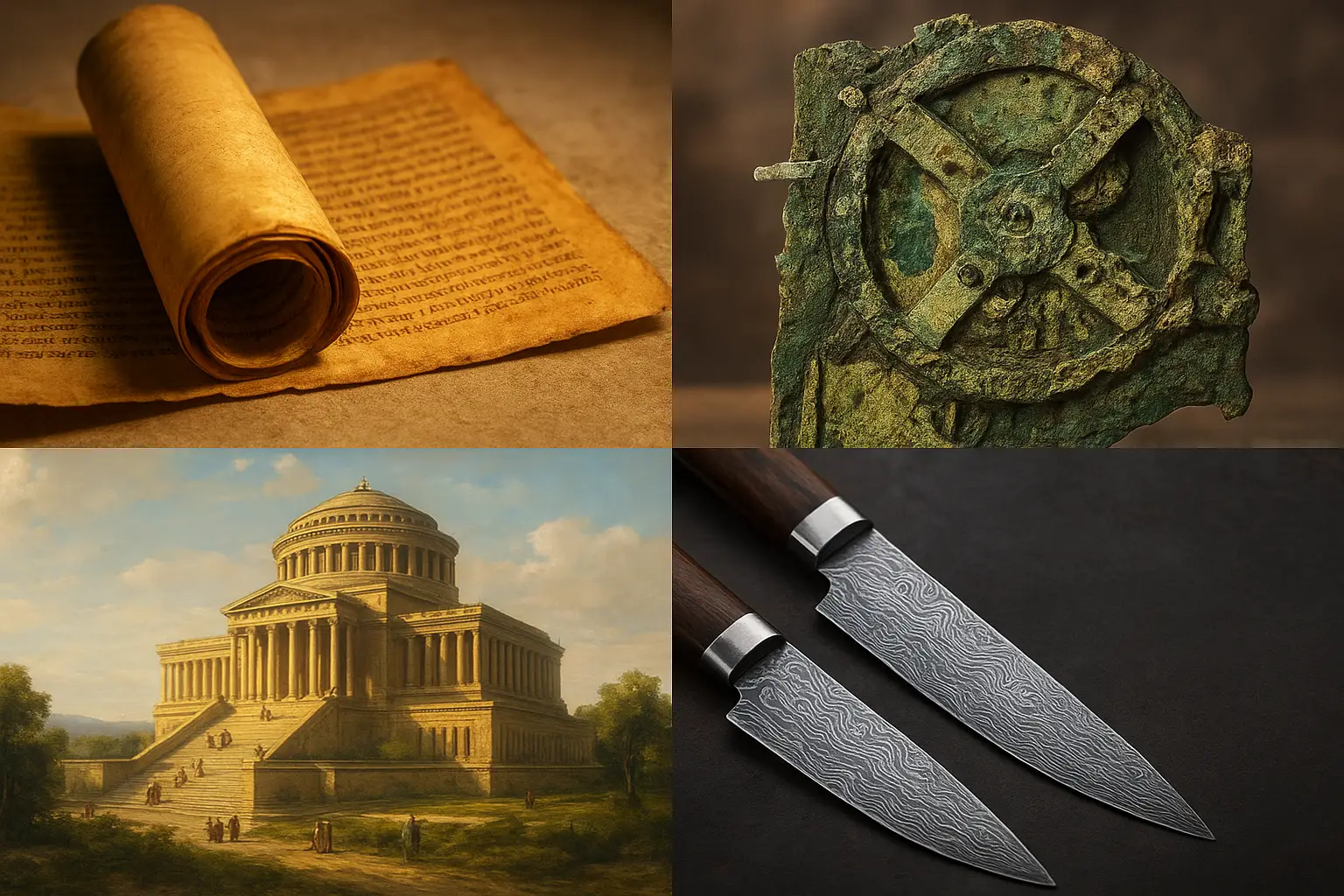
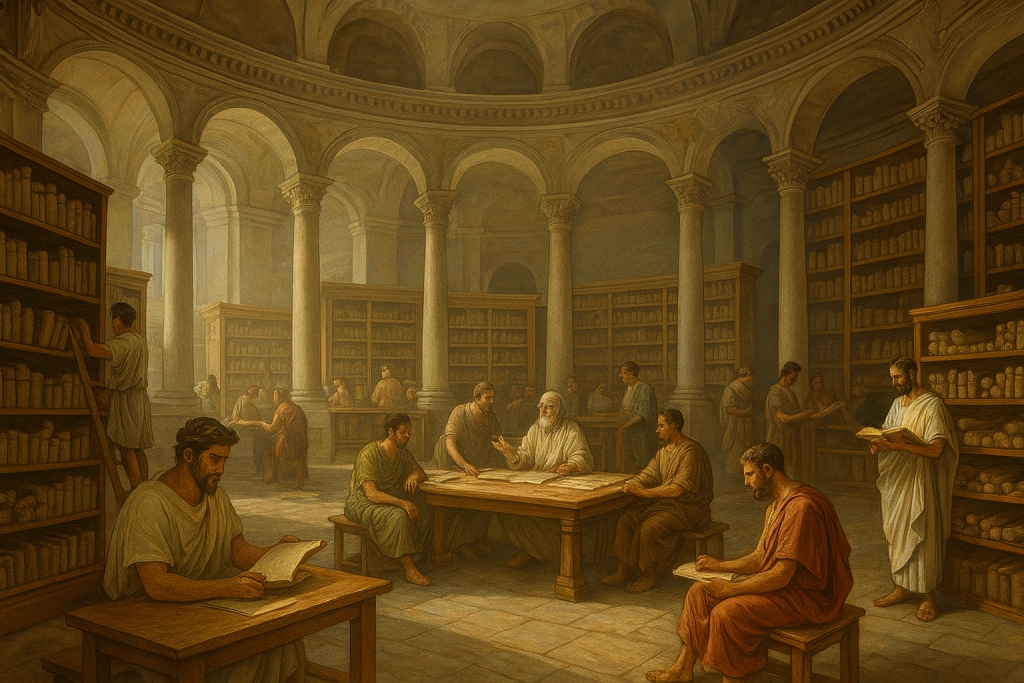
Few tragedies in human history evoke such a deep sense of loss as the destruction of the Library of Alexandria — the ancient world’s greatest repository of knowledge. Founded over 2,300 years ago in the Egyptian city of Alexandria, this vast collection of scrolls and scholarly works represented the intellectual heart of the ancient Mediterranean.
It was more than just a library — it was the world’s first research institution, a beacon of human curiosity and ambition. Scholars from Greece, Egypt, Persia, India, and beyond gathered there to study, debate, and expand the boundaries of science, philosophy, mathematics, and literature.
But sometime between the 1st century BCE and the 4th century CE, this grand monument to learning was lost to flames, neglect, and war. Its disappearance remains one of the most profound symbols of lost knowledge — a reminder of how fragile the pursuit of wisdom can be in the face of politics, ideology, and human conflict.
The Birth of a Dream: Alexandria, the City of Learning
The story begins in 331 BCE, when Alexander the Great founded the city of Alexandria on Egypt’s northern coast. After his death, his general Ptolemy I Soter took control of Egypt and established the Ptolemaic dynasty.
Ptolemy and his successors sought to make Alexandria not only the political capital of Egypt but also the intellectual capital of the world. To achieve this, they envisioned a library that would collect all the knowledge of humankind.
This ambitious dream led to the founding of the Library of Alexandria and the Mouseion (from which the modern word “museum” is derived) — a research institute dedicated to the Muses, the Greek goddesses of the arts and sciences.
Together, these institutions became the beating heart of ancient scholarship, attracting the brightest minds from every corner of the known world.
The Collection: A Universe of Scrolls
The Library’s goal was nothing less than to gather every book ever written. According to ancient accounts, its collection may have held between 400,000 and 700,000 scrolls, though exact numbers remain uncertain.
These scrolls contained works on:
- Mathematics and geometry (Euclid, Archimedes)
- Astronomy and geography (Eratosthenes, Hipparchus)
- Medicine and anatomy (Herophilus, Erasistratus)
- Philosophy and logic (Aristotle, Plato, Zeno)
- Poetry and history (Homer, Herodotus, Sophocles)
To expand its holdings, Ptolemaic officials employed aggressive acquisition tactics. Ships arriving at Alexandria’s port were searched for manuscripts, which were copied by scribes. The originals were kept for the Library, while the copies were returned to their owners.
This systematic effort transformed Alexandria into the greatest center of learning in antiquity, surpassing even Athens.
The Scholars of Alexandria
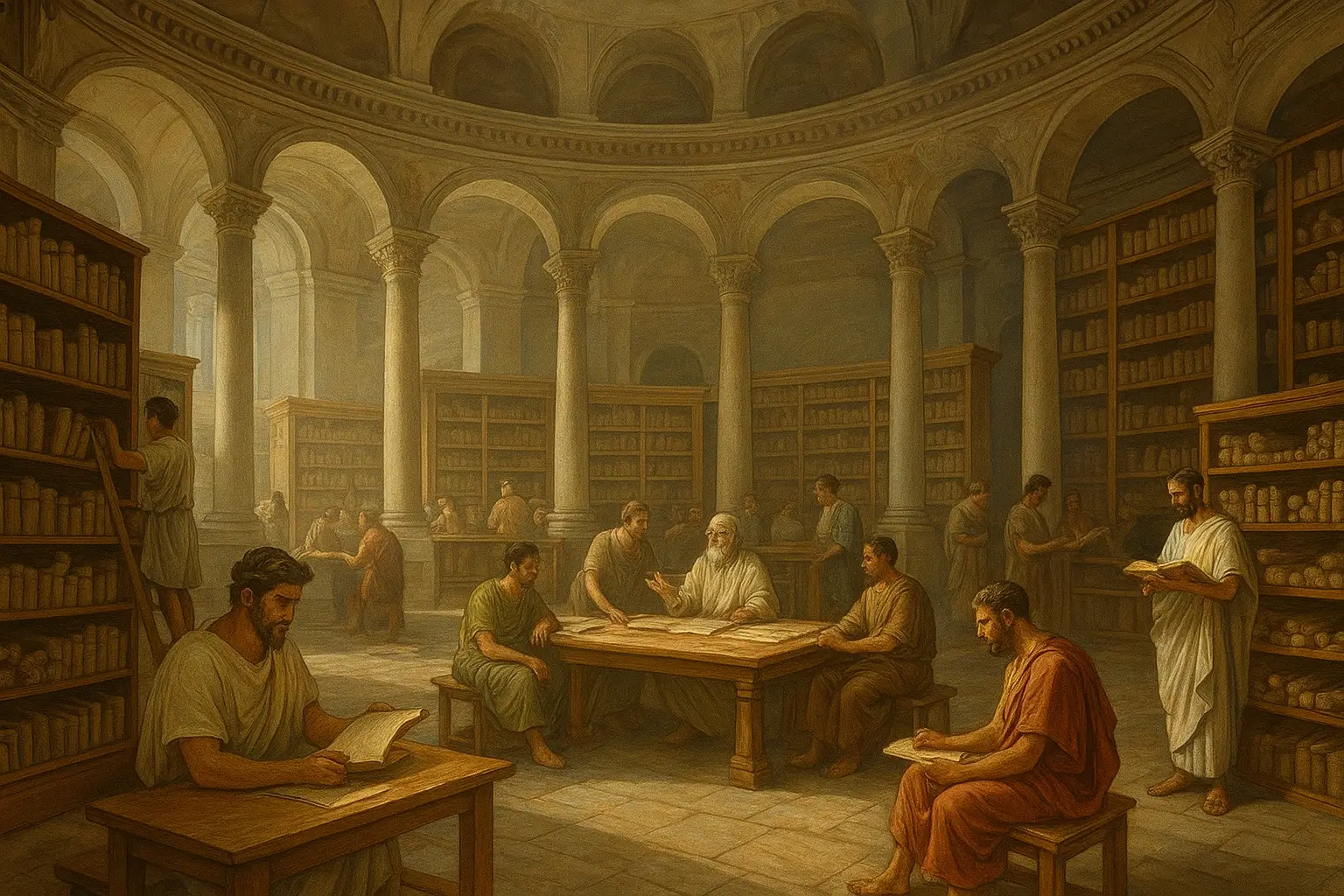
At its peak, the Library and the Mouseion housed hundreds of resident scholars who were provided with lodging, salaries, and meals — a kind of ancient academic fellowship.
Among them were some of history’s greatest intellectuals:
1. Euclid (c. 300 BCE)
The mathematician behind The Elements, Euclid formalized the principles of geometry. His work remained the foundation of mathematical education for over 2,000 years.
2. Eratosthenes (c. 276–194 BCE)
A polymath who served as chief librarian, Eratosthenes calculated the circumference of the Earth with remarkable accuracy using shadows and geometry — an achievement unmatched until the modern age.
3. Herophilus and Erasistratus
These two physicians conducted groundbreaking studies in human anatomy, reportedly dissecting cadavers to understand the body’s inner workings — a radical act in their time.
4. Aristarchus of Samos
Centuries before Copernicus, Aristarchus proposed that the Earth revolved around the Sun, not the other way around — a heliocentric model long forgotten until the Renaissance revived it.
5. Hypatia of Alexandria (c. 370–415 CE)
A brilliant philosopher and mathematician, Hypatia symbolizes the final generation of Alexandrian scholarship. Her murder by a mob marked the tragic end of classical learning in the city.
These scholars didn’t just preserve ancient knowledge — they created it. The Library was a living laboratory of discovery, where mathematics met philosophy and science met art.
How the Library Worked
Unlike modern libraries, the Library of Alexandria was both a university and a research hub. Its scribes and scholars worked tirelessly to translate, copy, and catalog scrolls from different cultures — including Egyptian, Babylonian, Indian, and Persian texts.
The Library used an early form of cataloguing system, possibly created by Callimachus, one of its head librarians. His work, the Pinakes, was a 120-scroll bibliographic index listing authors and subjects — perhaps the world’s first attempt at library organization.
The institution also maintained observatories, botanical gardens, laboratories, and lecture halls, fostering interdisciplinary collaboration centuries before modern academia would adopt such models.
The Mystery of Its Destruction
Despite its grandeur, the Library of Alexandria was not destined to endure. Its destruction remains shrouded in uncertainty, with multiple events over several centuries contributing to its decline.
Historians generally believe that the Library did not vanish in a single catastrophic fire, but rather died slowly, suffering repeated damage and neglect.
1. The Fire of Julius Caesar (48 BCE)
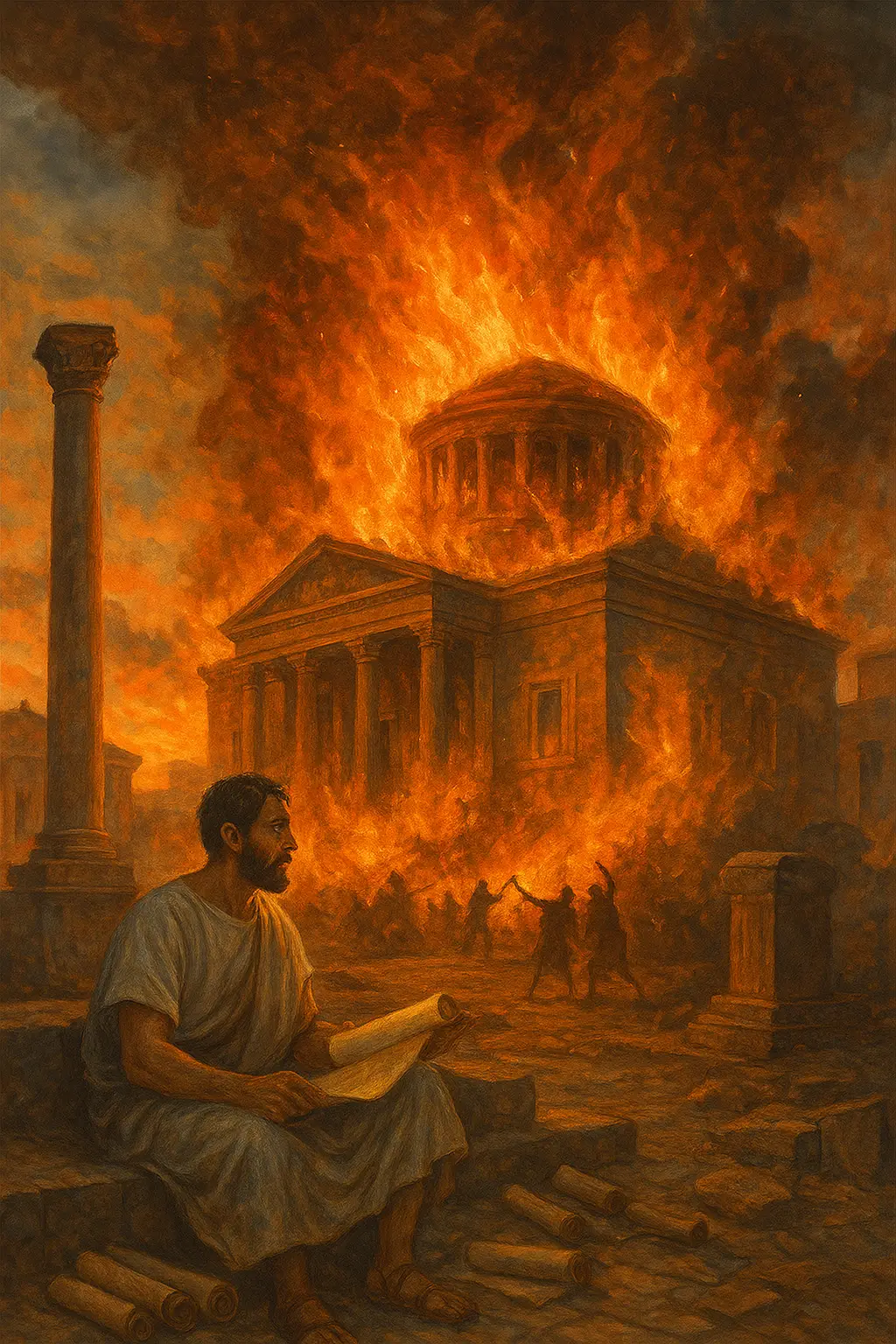
The first major blow came during Julius Caesar’s civil war in Egypt. When his fleet caught fire in Alexandria’s harbor, the flames spread to parts of the city — and possibly the Library’s scrolls.
Ancient sources like Plutarch claim that “a great number of books were destroyed.” Some historians believe this fire consumed the main library, while a secondary collection may have survived elsewhere.
2. The Attack of Aurelian (270–275 CE)
Centuries later, the Roman Emperor Aurelian fought to recapture Alexandria from Queen Zenobia of Palmyra. During the siege, parts of the Bruchion district, where the Library was located, were destroyed — likely erasing much of what remained.
3. The Christian Purges (391 CE)
As Christianity rose to dominance in the Roman Empire, pagan temples and institutions were targeted. The Serapeum, a temple housing what may have been the Library’s annex, was destroyed by order of Emperor Theodosius I.
By this point, any remnants of the Library’s collection were likely lost.
4. The Death of Hypatia (415 CE)
The final symbolic end came with the murder of Hypatia, the last great scholar of Alexandria. Accused of heresy, she was killed by a mob of Christian zealots. With her death, the flame of Greek scientific learning in Alexandria was extinguished forever.
What Was Lost
The destruction of the Library was not merely a loss of scrolls — it was a loss of civilizational memory.
Among the works believed to have been housed there were:
- The complete tragedies of Sophocles and Euripides (most now lost)
- Historical records from Egypt, Babylon, and Persia
- Ancient treatises on astronomy, medicine, and mathematics
- Works by philosophers whose ideas are known only through later fragments
Historians estimate that up to 90% of classical Greek literature has vanished. The Library’s destruction may have delayed scientific progress by centuries, erasing discoveries that might have accelerated the development of physics, medicine, and astronomy.
The Legacy of Alexandria
Despite its disappearance, the Library of Alexandria left an indelible mark on human civilization.
1. The Birth of the Academic Tradition
The Library’s model — a centralized institution for collecting, preserving, and producing knowledge — influenced the creation of later universities and research centers, from Baghdad’s House of Wisdom (8th century CE) to the European Renaissance universities.
2. Preservation Through Translation
Much of what survived of Greek and Egyptian scholarship did so because Arab scholars in the Islamic Golden Age preserved and translated classical texts. In a way, the spirit of Alexandria lived on in Baghdad, Cordoba, and Cairo, where learning flourished once more.
3. A Symbol of Knowledge Itself
Today, the name “Library of Alexandria” has become synonymous with the pursuit of universal knowledge. Its memory inspires modern projects like the Bibliotheca Alexandrina, inaugurated in 2002 on the same site — a modern tribute to the world’s first great library.
Lessons from a Lost Legacy
The fall of the Library of Alexandria teaches several timeless lessons.
1. Knowledge Is Fragile
Centuries of learning can vanish in an instant — through war, ideology, or neglect. The Library’s loss reminds us how easily human progress can be reversed when knowledge is not protected.
2. Curiosity Is Civilization’s Greatest Gift
What made the Library remarkable wasn’t its size, but its spirit — a belief that all knowledge, regardless of origin, deserved preservation and study. It was the first truly global intellectual project.
3. Destruction Breeds Rebirth
Ironically, the Library’s demise helped spark the global awareness of how precious knowledge is. It inspired future civilizations to preserve, translate, and rebuild what was lost.
Conclusion
The Library of Alexandria stands as both a monument to human genius and a warning of human folly. It embodied the highest ideals of intellectual pursuit — curiosity, openness, and unity — yet it fell victim to the very forces of ignorance and conflict that knowledge seeks to overcome.
In its ashes, the world lost not just books, but a part of humanity’s collective soul. Yet the dream it represented — the dream of gathering all knowledge and sharing it with the world — still endures.
Every modern library, research center, and digital archive is, in spirit, a descendant of Alexandria. Its legacy whispers to us through the centuries: that knowledge must be preserved, protected, and shared, for in it lies the true light of civilization.