Introduction
Long before the rise of Egypt’s pyramids or Mesopotamia’s ziggurats, a highly advanced civilization flourished quietly along the banks of the Indus River in what is now Pakistan and northwestern India. This was the Indus Valley Civilization (IVC) — one of the world’s earliest urban cultures, existing from approximately 3300 BCE to 1300 BCE.
Despite being one of the three great cradles of civilization, alongside Mesopotamia and Ancient Egypt, the Indus Valley people remain one of history’s most mysterious societies. Their script is still undeciphered, their government unknown, and even their downfall remains an unsolved puzzle.
Yet through their meticulously planned cities, sophisticated drainage systems, and peaceful coexistence, the Indus Valley Civilization stands as a testament to humanity’s early genius in organization, technology, and urban planning.
The Birth of a Civilization
The Indus Valley Civilization took root in the fertile plains of the Indus River Basin, which stretches across modern Pakistan, India, and parts of Afghanistan. The region benefited from annual monsoon floods, which enriched the soil and supported agricultural abundance.
Archaeologists divide the Indus Valley timeline into three main phases:
- Early Harappan (c. 3300–2600 BCE) – characterized by the growth of farming communities.
- Mature Harappan (c. 2600–1900 BCE) – the peak of urban development.
- Late Harappan (c. 1900–1300 BCE) – the gradual decline of urban centers.
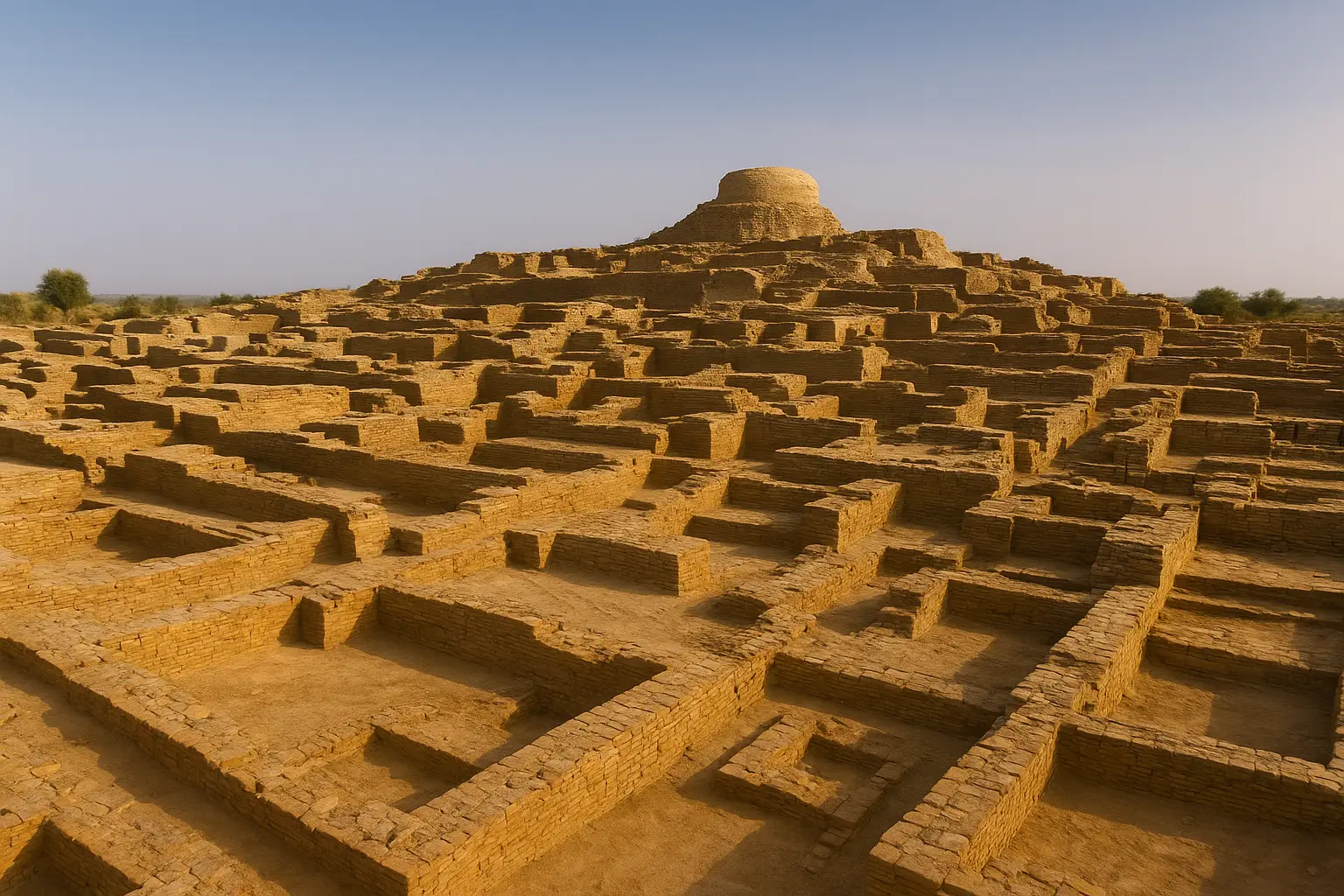
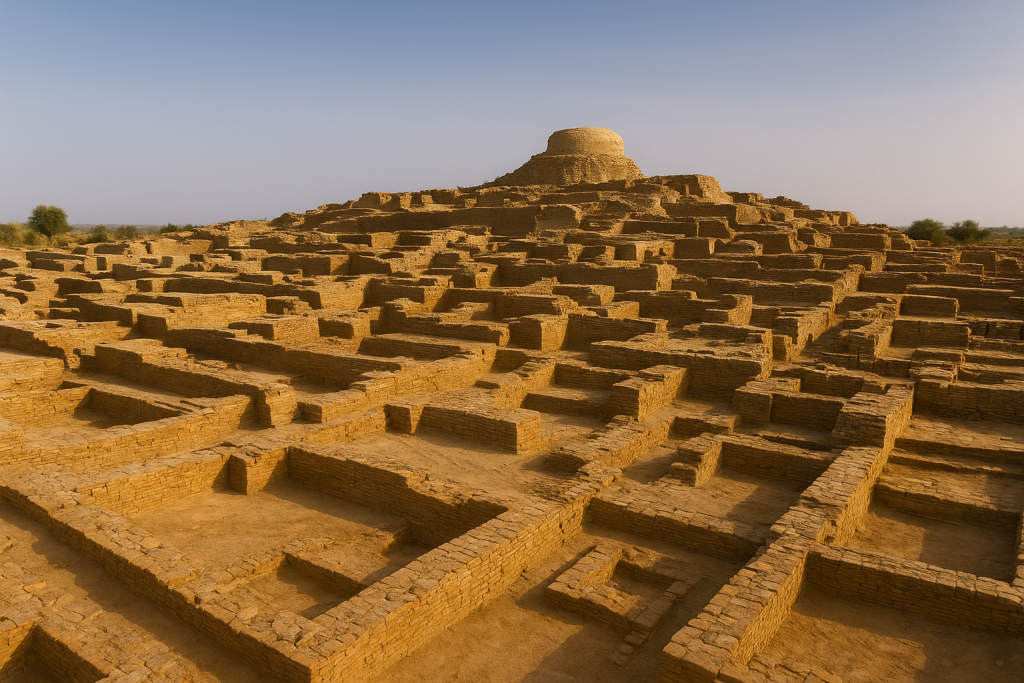
The civilization’s name derives from its two major sites — Harappa and Mohenjo-Daro — discovered in the early 20th century during British excavations. Since then, more than 1,500 settlements have been identified across the region, forming a vast cultural network.
Urban Planning and Architecture: A City Ahead of Its Time
The cities of the Indus Valley are remarkable for their level of urban planning, something far ahead of their contemporaries in Mesopotamia or Egypt.
1. Grid-Like City Design
Mohenjo-Daro and Harappa were laid out in precise grid patterns, with streets intersecting at right angles — a feature reminiscent of modern city design.
Each city was divided into two main parts:
- The Citadel, a raised area that likely housed administrative or religious structures.
- The Lower Town, where the majority of citizens lived.
2. Advanced Drainage and Sanitation
Perhaps the civilization’s most impressive feature was its drainage system.
Every house had access to running water and a private bathing area connected to covered brick drains that ran beneath the streets. These drains had removable bricks for cleaning — evidence of regular maintenance and civic responsibility.
No other ancient civilization achieved such sanitation sophistication until millennia later.
3. Standardized Building Materials
Buildings were constructed using uniform baked bricks, indicating centralized planning and standardization. This level of organization points to a powerful administrative system that enforced common measurements and design principles across vast distances.
Life in the Indus Valley
1. Economy and Trade
The Indus people were primarily agrarian, cultivating wheat, barley, sesame, and peas. They also domesticated cattle, buffalo, and goats.
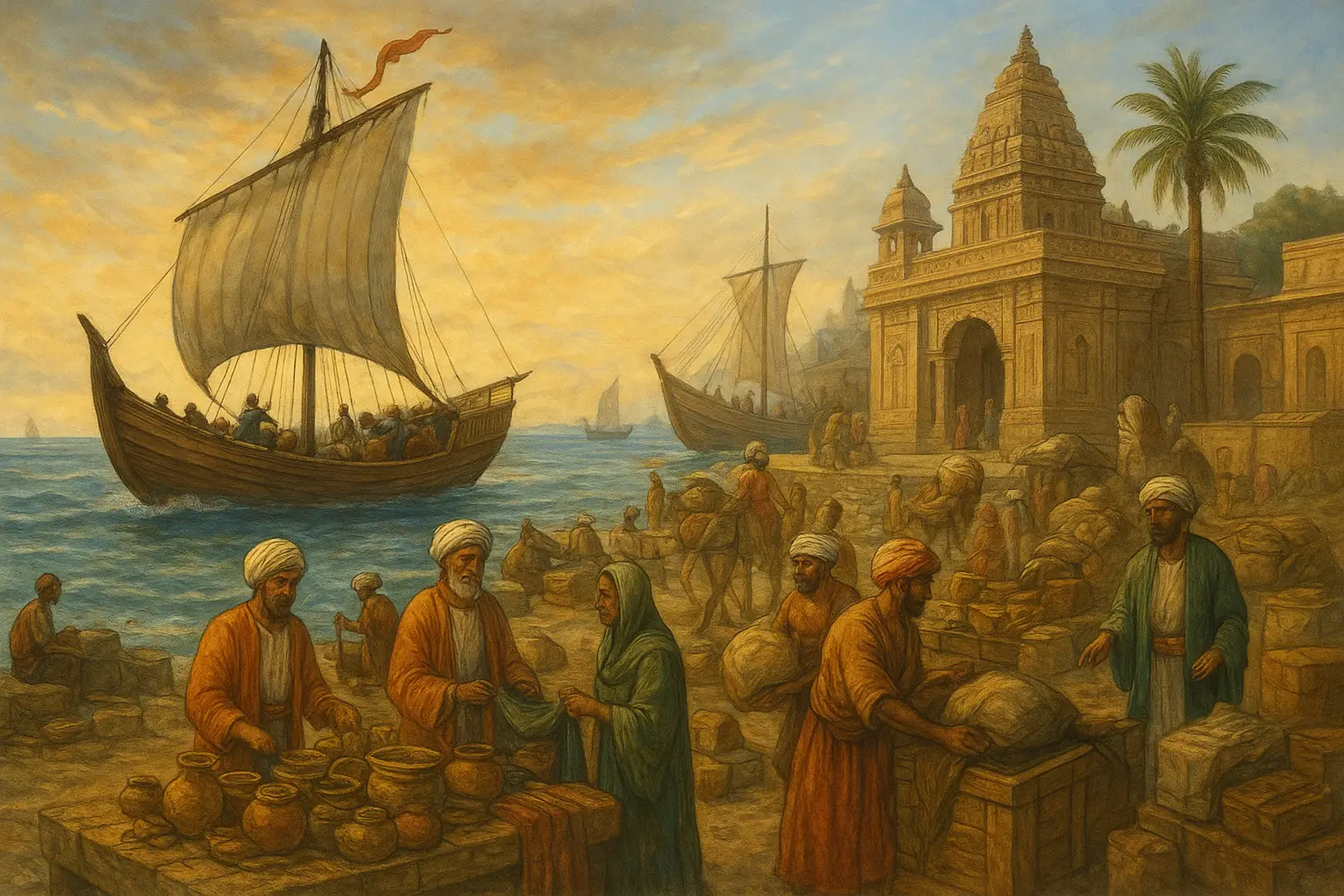
Beyond agriculture, they were skilled craftsmen and traders. Artifacts reveal extensive trade networks reaching as far as Mesopotamia, where Indus seals have been found in ancient Sumerian cities like Ur and Kish.
Goods such as cotton textiles, beads, ivory, and lapis lazuli were exchanged for silver, tin, and wool. The port city of Lothal (in modern Gujarat, India) had a sophisticated dockyard, suggesting the Indus people were among the earliest maritime traders in history.
2. Social Organization
Surprisingly, archaeologists have found no evidence of kings, palaces, or large temples in Indus sites. This absence of grand monuments suggests that their society may have been egalitarian, possibly governed by local councils rather than monarchs.
The uniformity of urban design across thousands of kilometers also implies a shared cultural or administrative system, possibly one based on collective governance rather than divine rule.
3. Art and Craftsmanship
The Indus people excelled in pottery, jewelry, metallurgy, and sculpture.
Bronze figurines, such as the famous “Dancing Girl of Mohenjo-Daro”, display remarkable artistry and attention to detail.
Seals engraved with animals — bulls, elephants, unicorn-like creatures — were used for trade and identification, featuring the mysterious Indus script, still undeciphered to this day.
The Enigmatic Indus Script
One of the greatest mysteries of the Indus Valley Civilization is its writing system. Thousands of artifacts bear short inscriptions made up of symbols — believed to represent words or sounds — but despite decades of study, no one has yet succeeded in deciphering them.
The problem lies in the brevity of the texts; most inscriptions contain only 5 to 10 characters, leaving too little context for linguistic analysis. Without a bilingual reference (like the Rosetta Stone for Egyptian hieroglyphs), the language remains silent.
If the script were ever deciphered, it could revolutionize our understanding of the Indus people — revealing how they governed, what they believed, and why their civilization ultimately declined.
Religion and Beliefs
The Indus people left no grand temples or clear written records of their religion, but artifacts offer clues to their spiritual life.
Seals and figurines suggest worship of fertility deities and nature-related symbols.
A well-known seal shows a horned figure seated in a meditative pose surrounded by animals — possibly an early form of Shiva (Pashupati), hinting at continuity between Indus beliefs and later Hindu traditions.
The prevalence of female figurines, interpreted as “mother goddesses,” points to fertility worship. Water, purification, and ritual bathing also seemed important, as evidenced by the Great Bath of Mohenjo-Daro — a massive public water tank likely used for religious ceremonies.
Peaceful Society and Governance
Unlike other ancient civilizations, the Indus people left behind no evidence of warfare — no weapons of mass destruction, fortresses, or military art. This has led scholars to believe they maintained a peaceful and cooperative society, possibly relying on trade and mutual benefit rather than conquest.
Such peace might have been maintained through collective civic systems and shared economic prosperity. Their focus on urban hygiene, equality, and trade suggests a society deeply rooted in order and practicality.
Science and Technology
The Indus Valley Civilization made remarkable advances in mathematics, engineering, and measurement.
Artifacts like rulers and weighing stones show an understanding of standardized units, with remarkable accuracy even by modern standards.
They also practiced drainage engineering, hydraulic management, and urban design principles that would not be matched until the Roman Empire — nearly two millennia later.
Their mastery of metallurgy is evident in bronze tools and ornaments. They were among the earliest to produce high-quality copper and bronze alloys, used for both tools and decoration.
The Decline: The Great Mystery
Around 1900 BCE, the great cities of Harappa and Mohenjo-Daro began to decline.
By 1300 BCE, the once-thriving civilization had largely vanished. The reasons for this collapse remain uncertain and continue to intrigue archaeologists.
Several theories exist:
- Environmental Changes – Shifts in the course of the Indus River and prolonged droughts may have disrupted agriculture and trade.
- Resource Depletion – Overuse of land and deforestation could have led to ecological stress.
- Invasion or Migration – Some historians once believed that Indo-Aryan tribes invaded the region, but there is little archaeological evidence for a violent conquest.
- Gradual Decline – It is now believed that a combination of environmental stress and economic shifts caused urban centers to slowly depopulate, as people moved eastward toward the Ganges Plain.
Whatever the reason, the end of the Indus Valley Civilization remains one of history’s most profound enigmas — a peaceful society fading into obscurity, leaving only bricks and seals to tell its story.
Legacy of the Indus Valley Civilization
Though long forgotten, the Indus people left behind an enduring legacy that shaped South Asian culture and identity.
- Urban design principles, such as grid-based layouts and sanitation systems, influenced later Indian cities.
- The concept of civic planning inspired by communal welfare — rather than monumental architecture — became a hallmark of Indian civilization.
- The continuity of cultural symbols, such as the sacred bull, bathing rituals, and fertility worship, can still be traced in modern Hindu traditions.
Modern research using satellite imaging, genetic studies, and climate modeling continues to reveal more about the Indus world. Far from being a lost civilization, it stands as a cornerstone in the story of human advancement.
Conclusion
The Indus Valley Civilization was a marvel of organization, intellect, and harmony — a society that achieved greatness not through conquest, but through cooperation and innovation.
Its people mastered urban planning, built advanced sanitation systems, and sustained peaceful coexistence for centuries. Yet their story remains partly hidden, their language undeciphered, their downfall unexplained.
In the silence of their ruins, one hears not the echoes of war but the rhythm of progress — the hum of potters, the songs of traders, the steps of citizens walking through clean streets planned by engineers who lived 5,000 years ago.
The Indus Valley Civilization reminds us that true greatness lies not in empire or conquest, but in the quiet brilliance of order, peace, and shared humanity.