Introduction
On the evening of November 9, 1989, an ordinary day in divided Berlin turned into one of the most transformative moments in modern history. After nearly three decades of separation, the Berlin Wall, that towering symbol of the Cold War, was opened — not through a planned political act, but through a combination of confusion, public pressure, and historical inevitability.
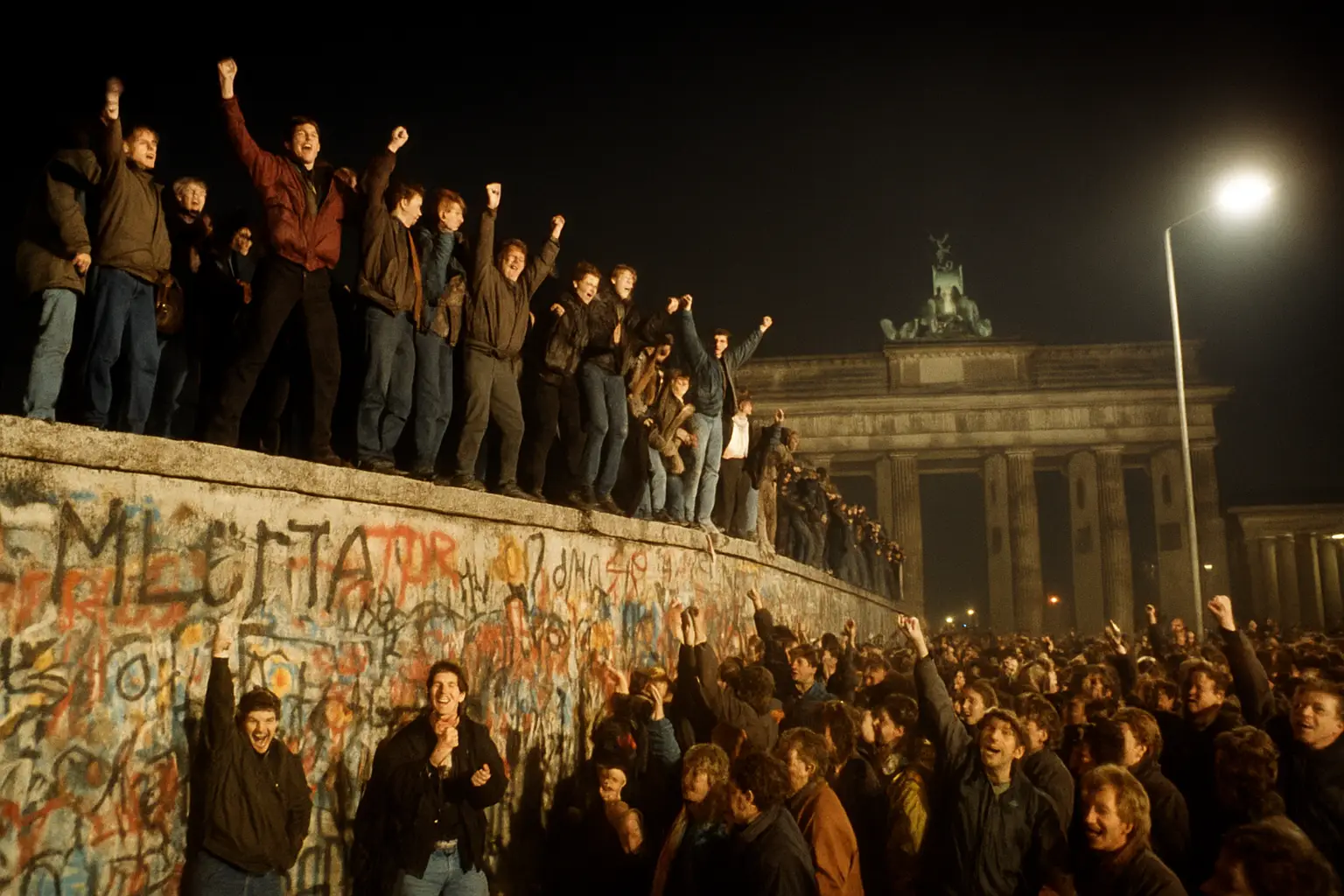
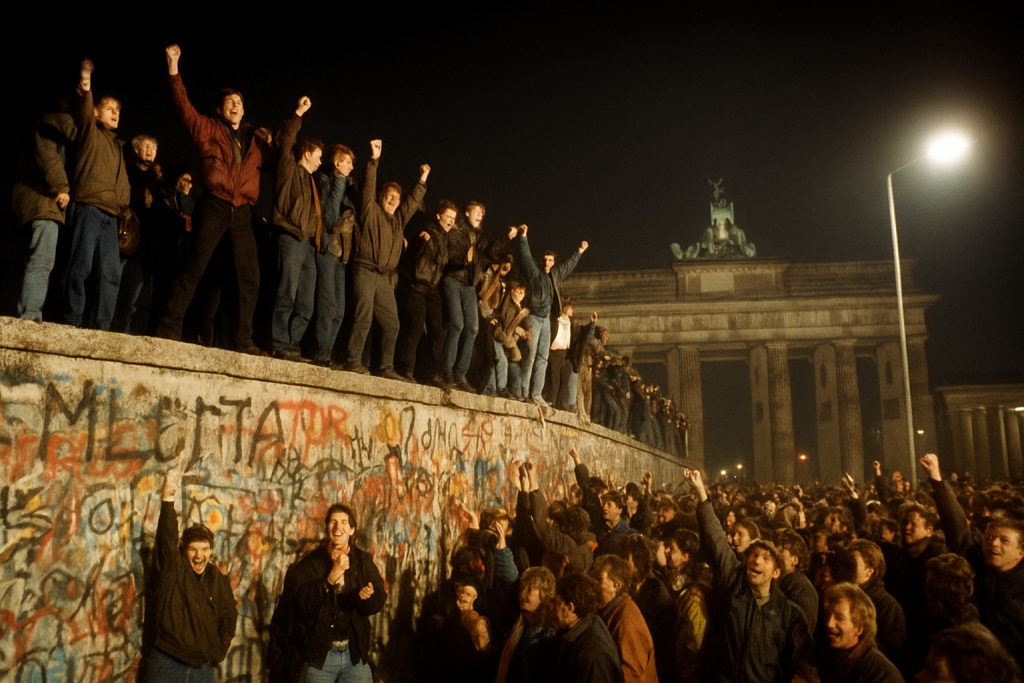
Within hours, Berliners from both East and West climbed the wall, hugged, cried, and began to tear down the concrete barrier that had divided families, friends, and a nation. This event did not merely change Germany — it reshaped the world order, signaling the imminent collapse of the Soviet Union, the end of the Cold War, and the dawn of a new global era.
This article explores the origins of the Berlin Wall, its impact on Germany and the world, the dramatic events of its fall, and its lasting legacy in shaping the modern geopolitical landscape.
The Origins of Division: Post–World War II Germany
At the end of World War II in 1945, Germany lay in ruins — both physically and politically. The Allied powers (the United States, the United Kingdom, France, and the Soviet Union) divided the country into four occupation zones, with the same division applied to its capital, Berlin, even though the city itself lay deep within the Soviet-controlled zone of East Germany.
Initially, this arrangement was meant to be temporary, but ideological differences soon hardened into an unbridgeable divide. The Western Allies aimed to rebuild Germany as a democratic and capitalist state, while the Soviet Union sought to establish a socialist government aligned with Moscow’s communist model.
By 1949, two separate German states were born:
- The Federal Republic of Germany (FRG), or West Germany, backed by the Western Allies.
- The German Democratic Republic (GDR), or East Germany, under Soviet control.
Berlin, though located within East Germany, remained split into East and West sectors. This division became the front line of the Cold War — a physical and ideological fault line separating the communist East from the capitalist West.
The Wall Rises: 1961
Throughout the 1950s, East Germans increasingly fled to the West, seeking freedom and better economic opportunities. West Berlin, with its open borders, became the escape hatch — a place where over 2.5 million East Germans defected to the West between 1949 and 1961.
The East German government, under Walter Ulbricht and with Soviet approval, decided to put an end to the mass exodus. On August 13, 1961, East German troops and workers suddenly began building a barrier through the heart of Berlin — first barbed wire, then concrete.
Families were separated overnight. Streets were cut in half. Commuters who had crossed freely between sectors found themselves trapped. The Berlin Wall — or as the East called it, the “Anti-Fascist Protection Rampart” — stretched nearly 155 kilometers (96 miles) around West Berlin, fortified with guard towers, minefields, and patrol dogs.
Over the next decades, it would become one of the most heavily guarded borders in the world.
Between 1961 and 1989, at least 140 people were killed attempting to cross the Wall, though estimates vary. Among the most famous was Peter Fechter, an 18-year-old shot while trying to escape in 1962. His death, witnessed by journalists and Western onlookers, became a global symbol of the Wall’s cruelty.
Life Behind the Wall
Life in East Germany (GDR) was characterized by state control, surveillance, and a planned economy under the Socialist Unity Party (SED). The feared Stasi, East Germany’s secret police, maintained one of the most extensive domestic spy networks in history — by some estimates, one in every six East Germans was either an informant or under surveillance.
While the GDR government emphasized social welfare, employment, and education, it also suppressed dissent and limited freedom of expression and movement. People could not travel freely, own certain goods, or criticize the state without consequence.
In contrast, West Germany experienced an economic boom known as the “Wirtschaftswunder” (economic miracle), fueled by American aid through the Marshall Plan. West Berlin became a vibrant, modern city — a showcase of Western prosperity that stood in stark contrast to the gray austerity of the East.
The Wall, therefore, was not just a barrier of concrete — it was a symbolic and psychological divide between two competing visions of the modern world.
Winds of Change: The 1980s
By the 1980s, the political landscape was shifting. The Soviet Union, under Mikhail Gorbachev, introduced glasnost (openness) and perestroika (restructuring) — reforms aimed at modernizing socialism and reducing Cold War tensions. These changes encouraged movements for freedom across Eastern Europe.
In Poland, the Solidarity trade union led by Lech Wałęsa challenged communist control and inspired similar movements in neighboring states. East Germans began demanding reform, emboldened by the sight of other Eastern Bloc nations loosening their regimes.
Meanwhile, East Germany’s economy was stagnating. Citizens grew restless as they compared their lives to the more prosperous West. The SED leadership, under Erich Honecker, refused to adopt reforms, creating friction even within the Eastern Bloc.
As the decade progressed, the number of East Germans seeking to flee surged again — this time through Hungary and Czechoslovakia, where border restrictions were weakening. By mid-1989, thousands were leaving East Germany every week. The Wall, though still standing, was losing its power.
The Night the Wall Fell
The dramatic fall of the Berlin Wall on November 9, 1989, was both spontaneous and accidental.
In early November, faced with mounting protests and emigration, the East German government decided to relax travel restrictions. A new policy allowing limited private travel was drafted, but its implementation date had not been clearly communicated to officials.
At a live press conference that evening, Günter Schabowski, a senior East German spokesperson, was asked when the new travel rules would take effect. Shuffling through his notes, he famously replied:
“As far as I know, effective immediately, without delay.”
Within minutes, West German television broadcast the announcement. East Berliners, hearing the news, rushed to the Wall’s checkpoints demanding to cross. Confused border guards, receiving no clear orders, eventually opened the gates.
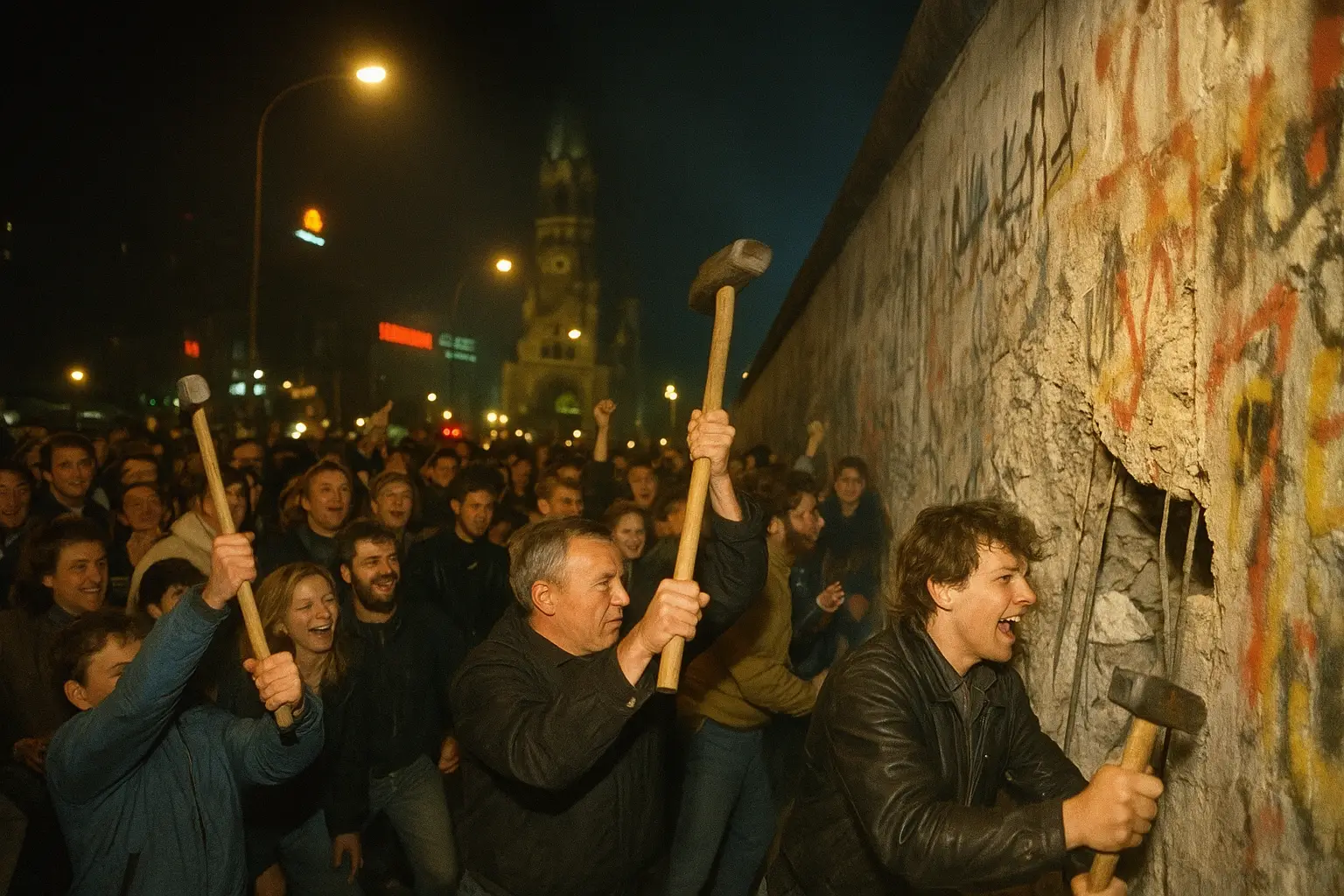
Crowds surged through. People climbed the Wall, cheered, and began to chip away at it with hammers and chisels. Strangers embraced across the divide, and spontaneous celebrations erupted through the night.
By dawn, Berlin was one city again.
The Aftermath: A World Transformed
The fall of the Berlin Wall set off a chain reaction across Eastern Europe. Within weeks, communist regimes in Czechoslovakia, Hungary, and Bulgaria began to crumble. By the end of 1991, the Soviet Union itself had dissolved, marking the definitive end of the Cold War.
In Germany, the process of reunification began almost immediately. On October 3, 1990, East and West Germany officially became one nation again — the Federal Republic of Germany.
Chancellor Helmut Kohl led the complex process of integrating the two societies, economies, and political systems. The challenges were enormous: East Germany’s infrastructure was outdated, its industries inefficient, and its citizens struggling to adapt to the realities of a market economy.
Yet, over time, Germany emerged as a unified democracy and a leading power in Europe — both economically and politically. Berlin, once a divided city, became a symbol of reconciliation and resilience.
Global Significance
The fall of the Berlin Wall carried significance far beyond Germany. It symbolized the collapse of Soviet influence over Eastern Europe and the victory of democratic ideals over authoritarian control.
It also reshaped international relations:
- The NATO alliance expanded eastward, incorporating many former Warsaw Pact nations.
- The European Union grew as countries formerly behind the Iron Curtain sought integration with the West.
- The United States, having led the Western bloc during the Cold War, emerged as the world’s sole superpower for the next two decades.
At the same time, the fall of the Wall raised new questions about globalization, inequality, and the challenges of transitioning societies — issues still relevant today.
Cultural and Symbolic Legacy
The Berlin Wall’s legacy endures not just in politics, but in memory and art. Sections of the Wall now stand in museums around the world — in Washington, Seoul, London, and New York — as reminders of the dangers of division and the power of freedom.
Berlin itself has preserved parts of the Wall as memorials, such as the East Side Gallery, where artists from around the world have turned remnants of concrete into canvases of hope and unity.
Phrases like “tearing down walls” and “breaking barriers” now carry deep symbolic weight, used to describe moments of liberation and transformation everywhere.
As former U.S. President Ronald Reagan said in his famous 1987 speech at the Brandenburg Gate:
“Mr. Gorbachev, tear down this wall!”
Two years later, those words became reality.
Conclusion
The fall of the Berlin Wall stands as one of the most defining events of modern history — not merely because a physical barrier was destroyed, but because it represented the triumph of human will, unity, and freedom over fear and division.
It ended an era dominated by nuclear tension and ideological rivalry, and opened a new chapter of global cooperation and democratic aspiration.
Yet, the story of the Wall also serves as a cautionary reminder. New walls — both literal and metaphorical — continue to divide nations and people today. The Berlin Wall’s lesson endures: that separation born of fear and control cannot last forever, and that the desire for freedom is one of humanity’s most unstoppable forces.
On that cold November night in 1989, when Berliners danced atop the Wall and the world watched in awe, history witnessed not just the end of a conflict, but the rebirth of hope — proof that even the most unyielding structures can crumble when people dare to cross them.