Introduction
On the morning of June 30, 1908, a remote region of Siberia witnessed one of the most powerful explosions in recorded history. Known today as the Tunguska Event, the blast flattened over 80 million trees across an area larger than 2,000 square kilometers, sending shockwaves that circled the Earth twice. Yet, despite its magnitude, no impact crater was ever found. This strange and still partly unexplained event has intrigued scientists, historians, and mystery seekers for over a century. What exactly happened in the skies over Tunguska?
This article explores the details of that day, the investigations that followed, the leading scientific theories, and the enduring mysteries that keep the Tunguska Event one of history’s most fascinating natural enigmas.
The Morning of the Explosion
The Tunguska region lies near the Podkamennaya Tunguska River in central Siberia — an extremely isolated area of swamps, forests, and tundra. Around 7:15 a.m. local time, local Evenki reindeer herders and Russian settlers saw a blinding blue-white fireball streaking across the sky, followed by an immense explosion that lit up the horizon.
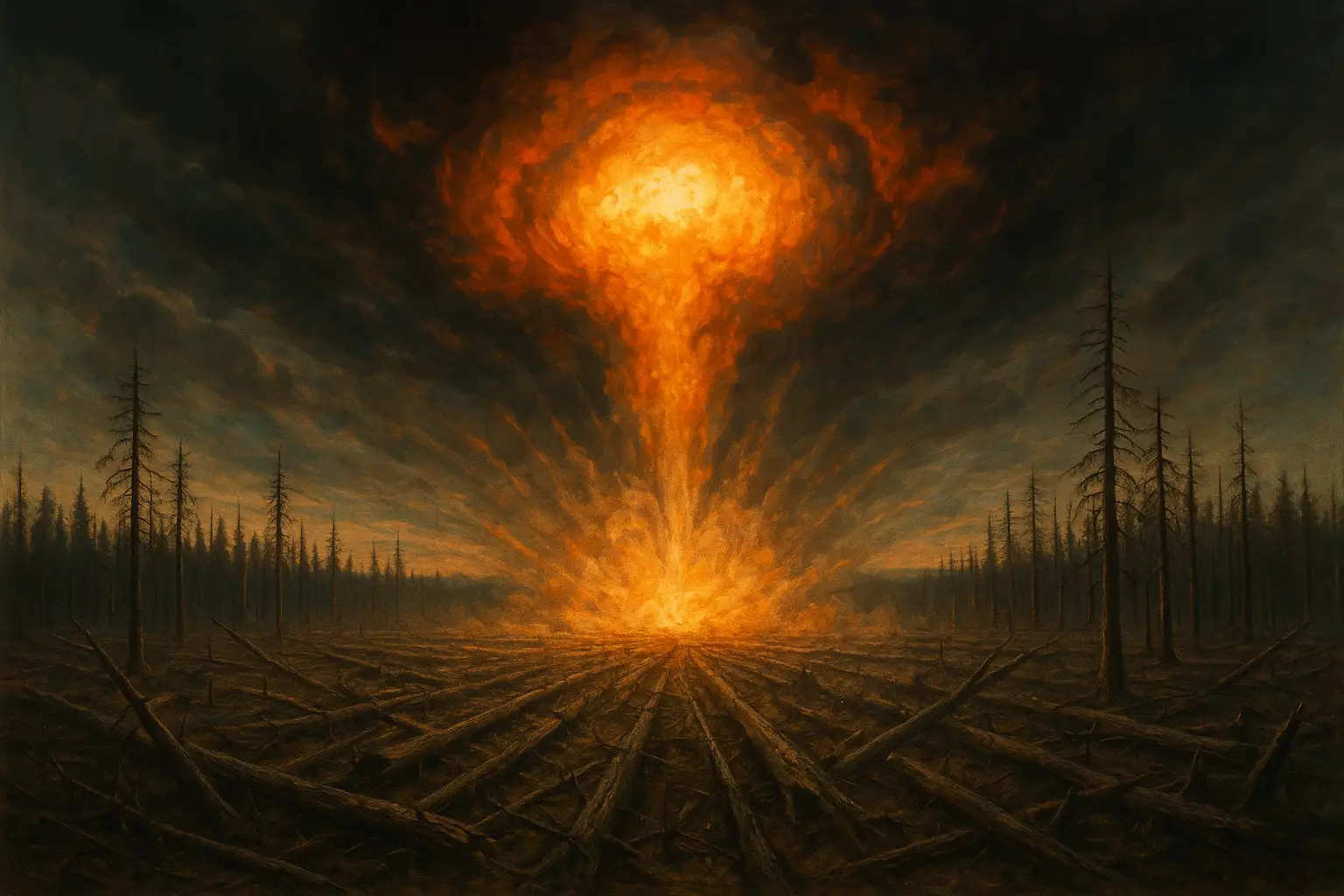
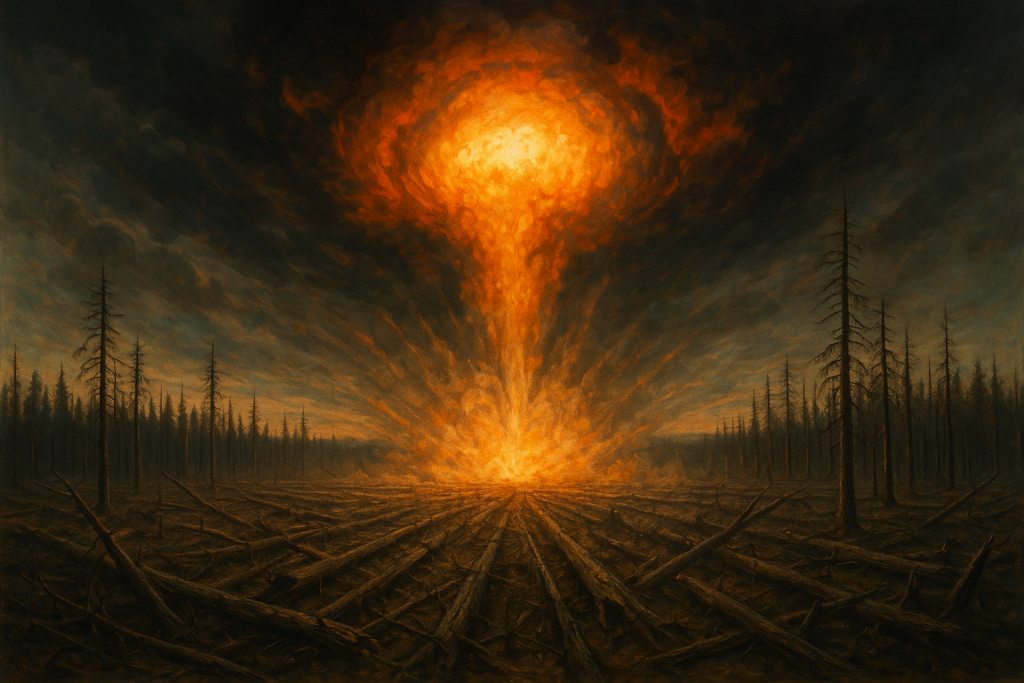
Eyewitnesses described a “pillar of fire” rising above the forest and a “deafening thunder” that shook the ground. A shockwave from the explosion knocked people off their feet, shattered windows, and ignited forest fires dozens of kilometers away.
In some accounts recorded later by Russian scientists, residents said the sky “split in two,” and the air became unbearably hot, as if the sun had come down to Earth. One local man, Semen Semenov, described it vividly:
“Suddenly in the north sky…the whole sky seemed to be covered with fire. I felt a great heat, as if my shirt was on fire. I wanted to tear it off and throw it down, but at that moment there was a bang in the sky and a strong push threw me off the porch. After that, such noise came, as if stones were falling from the sky, or guns were firing.”
The explosion was later estimated to have been 1,000 times more powerful than the atomic bomb dropped on Hiroshima.
The Aftermath
Despite the immense destruction, no official scientific expedition visited the site for almost 20 years — partly due to the remoteness of the area and the political upheaval in Russia following the Revolution of 1917.
When Leonid Kulik, a mineralogist at the St. Petersburg Museum, finally led an expedition in 1927, he expected to find a massive crater or meteorite fragments. Instead, he found something stranger: a vast area of trees lying flat, all pointing outward from a central point, as if a giant explosion had occurred in the air above them.
At the very center of the devastation zone, trees were still standing upright but stripped of branches and bark — a haunting image reminiscent of a blast wave coming from above. There was no crater, no meteorite debris, and no evidence of volcanic activity or man-made explosion.
The phenomenon was unlike anything scientists had ever encountered.
Scientific Investigations and Theories
Since the 1920s, scientists have proposed numerous explanations for what caused the Tunguska Event. The main theories fall into a few key categories.
1. The Meteor or Comet Hypothesis
The most widely accepted explanation is that the Tunguska explosion was caused by a cosmic body — either a stony asteroid or an icy comet — entering Earth’s atmosphere at high speed. According to modern estimates, it was likely 50 to 80 meters (160–260 feet) in diameter and traveling at about 27,000 km/h (17,000 mph).
Instead of hitting the ground, it exploded in mid-air at an altitude of about 5–10 kilometers (3–6 miles), releasing energy equivalent to 10–15 megatons of TNT. This type of explosion is known as an airburst.
Computer simulations conducted in recent years, including studies by NASA’s Jet Propulsion Laboratory, support this explanation. The intense heat and pressure from the airburst would have instantly vaporized the object, leaving no crater and scattering microscopic particles over a wide area — which explains the lack of large debris.
Tiny silicate and nickel particles, consistent with extraterrestrial origin, have indeed been found in soil and tree resin samples from the Tunguska region.
2. The Cometary Ice Theory
Another version, proposed by Soviet scientist Vladimir Vernadsky and others, suggested that the object was a comet made primarily of ice. Because comets contain volatile materials such as water and carbon dioxide, an icy nucleus would have completely vaporized upon atmospheric entry, explaining why no solid remains were discovered.
This idea gained support from the pattern of devastation and from eyewitness reports of “a glowing trail” that persisted for hours — possibly from water vapor and ice crystals spreading through the atmosphere.
3. Alternative Theories
While the cosmic explanation remains dominant, several alternative hypotheses have been proposed over the years, including:
- Volcanic or geothermal explosions, though there’s no evidence of volcanic activity in the region.
- A natural gas explosion caused by the release of methane from underground sources, similar to what might occur in the Siberian permafrost.
- The more speculative and famous idea: an alien spacecraft explosion or extraterrestrial experiment gone wrong — first proposed in the 1940s by science fiction writers and later explored in UFO literature.
While entertaining, these fringe theories lack scientific evidence and are generally dismissed by researchers.
The Search for Evidence
Throughout the 20th century, multiple expeditions returned to the Tunguska site to gather more data. In the 1950s and 1960s, aerial surveys revealed that the trees formed a butterfly-shaped pattern, consistent with a blast traveling from east to west — matching the direction of eyewitness reports.
Later analyses of tree rings showed abnormal growth patterns, likely due to radiation or soil changes caused by the explosion. Some researchers initially interpreted this as evidence of a nuclear-like event, but later studies confirmed that the radiation levels were consistent with natural cosmic sources.
In 2007, a team of Italian scientists led by Luca Gasperini claimed to have identified a possible impact crater at Lake Cheko, about 8 kilometers from the explosion’s epicenter. Sonar readings showed an unusual cone-shaped depression at the lake’s bottom.
However, further analysis revealed that the lake likely predated the 1908 event, making it unlikely to be the actual impact site. The mystery, therefore, persisted.
Modern Analysis and Comparisons
In recent years, advances in satellite imaging, computer modeling, and space science have allowed scientists to better understand Tunguska-like events.
In 2013, the Chelyabinsk meteor exploded over Russia with a yield of around 500 kilotons, injuring over 1,500 people and damaging thousands of buildings. The Chelyabinsk explosion was caused by a 19-meter-wide asteroid that disintegrated in the atmosphere — a smaller but well-documented parallel to the Tunguska blast.
The Chelyabinsk event confirmed that asteroid airbursts are real and can cause significant damage without leaving a crater. It also validated models that scientists had developed to explain Tunguska.
Today, most experts believe the Tunguska Event was indeed caused by a stony asteroid or comet fragment that exploded before impact — an extraordinarily rare natural event that occurs roughly once every few centuries.
Lingering Mysteries
Even with modern consensus, Tunguska retains an aura of mystery. Some key questions remain unresolved:
- Why did no large fragments of the object survive, unlike other known meteorite falls?
- What explains certain unusual light phenomena observed across Europe and Asia for days afterward, where people reported bright, glowing skies at night?
- Could multiple smaller fragments or atmospheric effects have contributed to the strange optical patterns and seismic disturbances?
These lingering questions ensure that Tunguska continues to inspire both scientific and imaginative exploration.
Cultural Impact and Legacy
The Tunguska Event left an indelible mark not only on science but also on culture and fiction. It inspired countless books, documentaries, and speculative theories — from early Soviet science fiction to modern films and video games.
Writers such as Arthur C. Clarke and Carl Sagan referenced Tunguska as a warning about the cosmic dangers Earth faces. Clarke even suggested in 2001: A Space Odyssey that the event might have been the accidental detonation of an alien probe — a nod to humanity’s smallness in the vast universe.
In the scientific community, Tunguska served as a wake-up call to the reality of asteroid impacts. It directly influenced later efforts to track near-Earth objects (NEOs) and develop early-warning systems to detect potential threats. The event remains a key case study for planetary defense programs today.
Conclusion
Over a century after it occurred, the Tunguska Event remains one of the most dramatic natural explosions ever witnessed on Earth. Its sheer power — unleashed in a remote Siberian wilderness — reminds us of the fragile balance between our planet and the cosmic environment around it.
While modern science has answered many of the questions once shrouded in mystery, the absence of a crater and the strange aftermath continue to captivate imaginations. The Tunguska explosion stands as both a scientific puzzle and a cosmic warning — a reminder that the universe is full of forces far beyond human control or expectation.
From eyewitness accounts of fire in the sky to the silent forests that still bear its scars, Tunguska remains a symbol of nature’s awe-inspiring and unpredictable power — one of history’s strangest and most extraordinary events.