Introduction
History is not merely a record of what humanity has achieved — it is also a story of what we have lost. Civilizations have risen and fallen, leaving behind fragments of their brilliance: shattered tablets, eroded scrolls, and silent monuments. Within those remnants lies an uncomfortable truth — vast amounts of human knowledge have vanished forever.
From advanced engineering techniques to forgotten medicines and mysterious writing systems, much of ancient wisdom disappeared through wars, natural disasters, or deliberate destruction. Yet, even in their absence, these lost discoveries continue to inspire scientists and historians, reminding us that progress is rarely a straight path.
Let’s explore some of the greatest examples of lost knowledge — moments where human ingenuity reached extraordinary heights, only to be buried by time.
1. The Burning of the Great Library of Alexandria
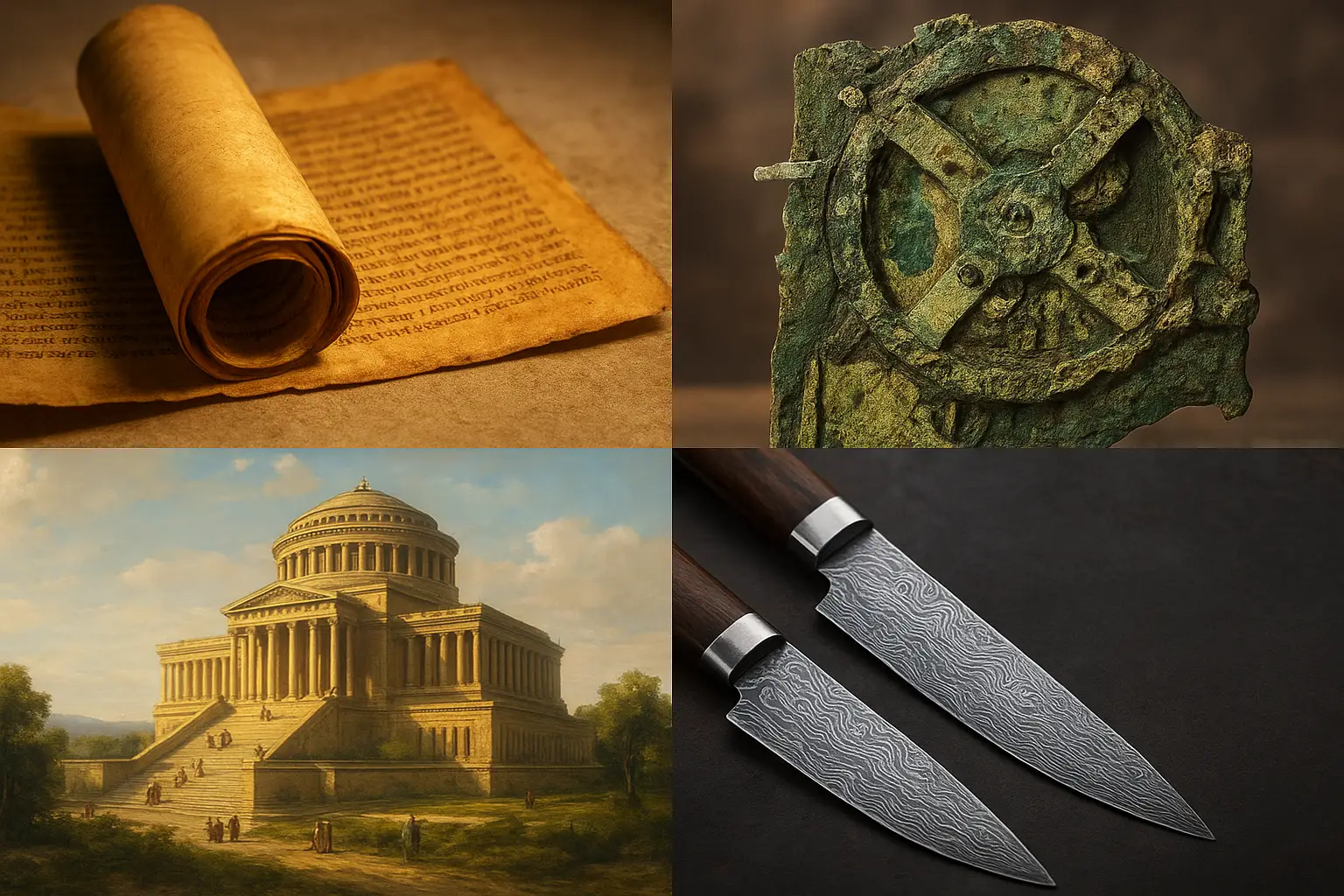
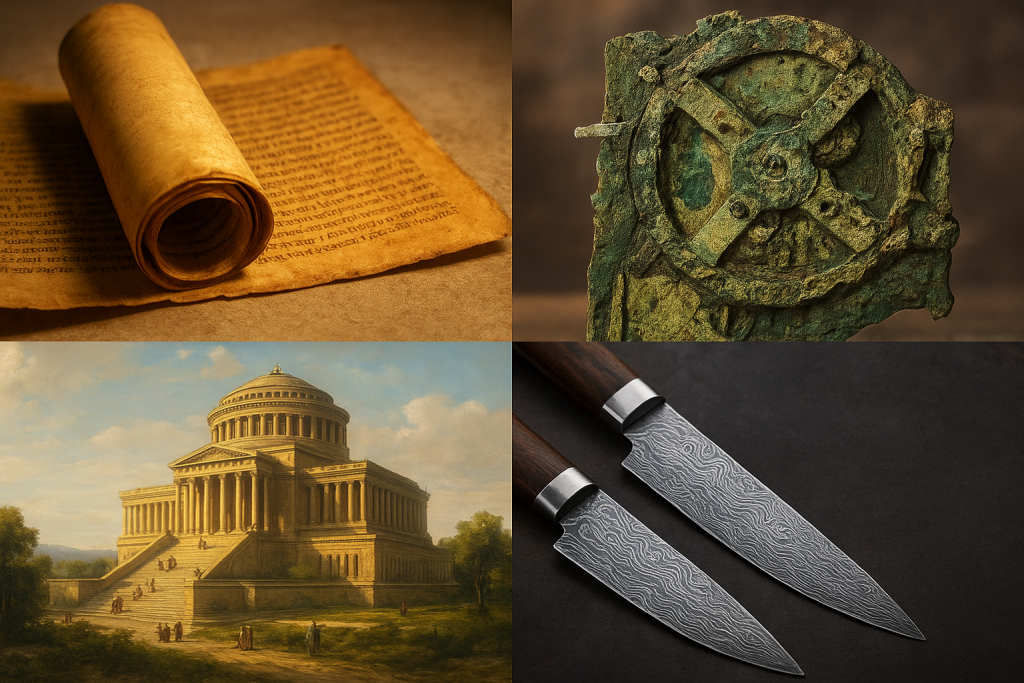
No discussion of lost knowledge can begin without the legendary Library of Alexandria, founded around the 3rd century BCE in Egypt under the rule of Ptolemy I Soter. It was more than a building — it was the intellectual heart of the ancient world. Scholars from Greece, Egypt, India, and Persia gathered there to study mathematics, astronomy, philosophy, and medicine.
Ancient sources suggest that the library may have contained hundreds of thousands of scrolls, representing centuries of collective knowledge. But between the 1st century BCE and the 4th century CE, the library suffered multiple disasters: a fire set during Julius Caesar’s invasion (48 BCE), later decrees by Roman emperors hostile to pagan learning, and further destruction during religious conflicts.
No one knows exactly how much was lost — works by Aristarchus, Eratosthenes, and early medical researchers likely perished. The loss of Alexandria’s library became a symbol of how fragile knowledge can be when power and ideology collide.
2. Roman Concrete: The Secret of Enduring Architecture
Many of Rome’s ancient structures — from the Pantheon to the aqueducts — have stood for more than 2,000 years. The secret lies in Roman concrete (opus caementicium), a building material that modern scientists still struggle to replicate fully.
While modern concrete typically deteriorates within a century, Roman concrete appears to grow stronger with time. In 2017, researchers from MIT and the University of Utah discovered that the secret ingredient was volcanic ash from the Bay of Naples region, particularly pozzolana. When mixed with lime and seawater, it triggered chemical reactions that allowed cracks to “self-heal.”
After the fall of the Roman Empire, the technique was lost for over a millennium. Builders in the Middle Ages and Renaissance reverted to weaker lime-based mortars. Only recently have researchers rediscovered and tested the ancient formula — a rare case where archaeology and materials science work hand in hand to revive lost wisdom.
3. Greek Fire: The Byzantine Empire’s Secret Weapon
During the height of the Byzantine Empire (7th–12th centuries CE), the Eastern Romans wielded a terrifying weapon known as Greek Fire — a flammable liquid that could burn even on water. It was used in naval battles to defend Constantinople from Arab sieges and was said to cause “fire that clung to flesh.”
Despite centuries of speculation, the formula for Greek Fire remains unknown. Some historians suggest it contained naphtha, quicklime, sulfur, and pine resin, while others argue for petroleum-based mixtures pressurized through bronze tubes.
The Byzantines guarded the secret so closely that even their allies never learned its composition. When the empire fell in 1453, the knowledge vanished with it — a lost technology that may have altered the course of warfare for centuries.
4. Damascus Steel: The Forgotten Metallurgy of Blades
Between the 9th and 18th centuries, swordsmiths in the Middle East crafted weapons of near-mythic quality using Damascus steel — a metal renowned for its sharpness, flexibility, and distinctive wavy patterns. European crusaders were astonished at how these blades could cut through their own swords without losing an edge.
The secret of Damascus steel lay in the use of wootz steel, imported from southern India. Its unique carbon structure produced nanotubes and carbides that gave it extraordinary strength. By the 18th century, however, the knowledge of producing wootz steel had disappeared — possibly due to trade disruptions and loss of key raw materials.
Modern metallurgists have recreated similar alloys, but the precise traditional method — including the exact temperature and impurity control — remains unknown. The rediscovery of Damascus steel’s original process would represent one of metallurgy’s greatest achievements.
5. The Antikythera Mechanism: A Lost Science of the Stars
Discovered in 1901 among the wreckage of a ship off Antikythera Island, Greece, the Antikythera Mechanism is often called the world’s first analog computer. Dated to around 100 BCE, this bronze device used complex gear systems to track planetary movements, predict eclipses, and even mark the dates of athletic games such as the Olympics.
Its level of mechanical sophistication was unmatched for more than a thousand years. According to research published by University College London (UCL) in 2021, the mechanism contained at least 30 interlocking gears — some smaller than a fingernail — and encoded astronomical theories derived from Hipparchus and Archimedes.
After the Roman era, the knowledge of such gear-based mechanisms disappeared until the development of clockwork in medieval Europe. The Antikythera Mechanism serves as a haunting reminder that ancient science may have reached heights far beyond what we once imagined.
6. The Mayan Hieroglyphs: Rediscovering a Lost Language
When Spanish conquistadors arrived in the Americas in the 16th century, they encountered the remnants of the Maya civilization, whose monuments were covered in intricate hieroglyphs. Tragically, many of the Maya’s codices were burned by missionaries, erasing much of their recorded history.
For centuries, scholars could not read the symbols — believing they were purely decorative. It wasn’t until the mid-20th century that linguists such as Tatiana Proskouriakoff and Yuri Knorosov proved that the glyphs represented a full written language combining phonetic and logographic signs.
Today, more than 90% of known glyphs have been deciphered, revealing new insights into Mayan astronomy, politics, and daily life. Yet dozens of codices remain missing, and large parts of Mayan knowledge — especially in medicine and mathematics — are still lost forever.
7. Ancient Medical Wisdom: The Healing Arts of Egypt and Greece
Ancient medical systems were far more sophisticated than once thought. In Egypt, papyri such as the Ebers Papyrus (c. 1550 BCE) describe hundreds of treatments, surgical techniques, and herbal remedies. Similarly, Greek physicians like Hippocrates and Galen built on earlier Egyptian and Mesopotamian traditions.
Yet much of their combined knowledge was destroyed during periods of war and religious upheaval. Medieval copies survived, but entire treatises — including those detailing surgical instruments, anesthetic compounds, and herbal pharmacology — were lost.
Modern medicine has, in some cases, rediscovered similar treatments independently. For example, willow bark, once used by ancient healers to relieve pain, contains salicin — the basis of modern aspirin. The fragments that remain hint at an even deeper understanding of natural science once possessed by ancient civilizations.
8. The Knowledge of the Builders: Lost Engineering Techniques
How ancient people built monumental structures such as the Pyramids of Giza, Stonehenge, or Machu Picchu continues to intrigue modern engineers. Although many theories exist — involving sledges, levers, ramps, and counterweights — no definitive written records survive explaining their exact construction methods.
For instance, the precision of the Great Pyramid’s alignment to true north is within a fraction of a degree, an achievement that would be challenging even with modern instruments. Similarly, the Inca builders of Machu Picchu cut and fitted massive stones so perfectly that even a knife blade cannot pass between them — without the use of mortar.
These accomplishments testify to highly developed mathematical and engineering knowledge that has been largely forgotten or destroyed over time.
9. The Lost Knowledge of Sound and Vibration
Across ancient sites — from Chichen Itzá in Mexico to Newgrange in Ireland — archaeologists have discovered evidence that ancient peoples understood acoustic engineering. The “Temple of Kukulcán” at Chichen Itzá produces an echo that mimics the call of a sacred bird when one claps at its base. In Egypt, some chambers in the Great Pyramid seem to amplify low-frequency vibrations.
Whether these effects were deliberate or coincidental remains debated, but the precision suggests an understanding of sound resonance and spatial acoustics that surpasses what we once assumed about early architecture. Much of that knowledge, especially regarding the symbolic and ritual use of sound, has been lost to history.
Conclusion
The story of lost knowledge is not one of despair — it is a call to curiosity. Every vanished manuscript, every forgotten formula, reminds us that progress is not guaranteed. Civilizations can achieve extraordinary heights and still lose their wisdom through conflict, neglect, or time.
Yet history also shows that rediscovery is possible. Modern science has resurrected Roman concrete, begun to decode Mayan scripts, and rebuilt ancient machines once thought impossible. In doing so, we glimpse not only the brilliance of our ancestors but also our own potential for renewal.
The quest to recover lost knowledge is, ultimately, a journey into ourselves — proof that humanity’s greatest treasure is not what we know, but our relentless desire to know more.