Introduction
In the frozen heart of the Russian Ural Mountains, nine experienced hikers set out in January 1959 on what was supposed to be a challenging but routine expedition. They never returned alive. When search teams eventually found their campsite weeks later, they discovered a scene that defied logic and terrified investigators: a torn tent, barefoot hikers fleeing into the snow, and bodies scattered across the landscape — some with severe, unexplained injuries.
This tragedy, later known as the Dyatlov Pass Incident, remains one of the most haunting mysteries of the 20th century. Over six decades later, despite dozens of investigations, government reports, and modern scientific theories, no single explanation has ever satisfied all the questions surrounding what happened on that lonely mountainside.
The Expedition Begins
The group consisted of nine students and graduates from the Ural Polytechnic Institute in Sverdlovsk (now Yekaterinburg). The expedition leader, Igor Dyatlov, was an experienced 23-year-old engineering student with several successful winter treks behind him.
The rest of the group included:
- Zinaida Kolmogorova
- Yuri Doroshenko
- Lyudmila Dubinina
- Alexander Kolevatov
- Rustem Slobodin
- Nikolai Thibeaux-Brignolles
- Yuri Krivonischenko
- Semyon Zolotaryov
All were healthy, fit, and trained in survival under extreme cold. Their goal was to reach the remote Otorten Mountain, a journey rated as “Category III” — the most difficult.
On January 23, 1959, they departed by train, then by truck and ski, gradually making their way into the northern Urals. Their diary entries and photographs — which were later recovered — show a cheerful, organized group enjoying the adventure. They sang songs, joked, and recorded every day with precision.
But on February 1, everything went terribly wrong.
The Camp on the Slope
The hikers set up camp on the slope of Kholat Syakhl, a Mansi name meaning “Mountain of the Dead.” Weather conditions were harsh, with temperatures dropping below -25°C and strong winds sweeping across the mountain. For reasons still unclear, they pitched their tent on the open slope rather than descending into the forested valley below, where conditions would have been safer and more sheltered.
Dyatlov’s meticulous nature suggests there was a reason — possibly a desire to practice setting camp in extreme conditions or to stay on course. Whatever the motive, it would be the last decision they ever made.
The Discovery
When the group failed to send their scheduled telegram confirming their safe arrival by February 12, no one initially panicked. Delays were common in winter expeditions. But by February 20, with still no word, a massive search effort was launched involving students, volunteers, and military personnel.
On February 26, rescuers finally found the campsite — and what they saw shocked them.
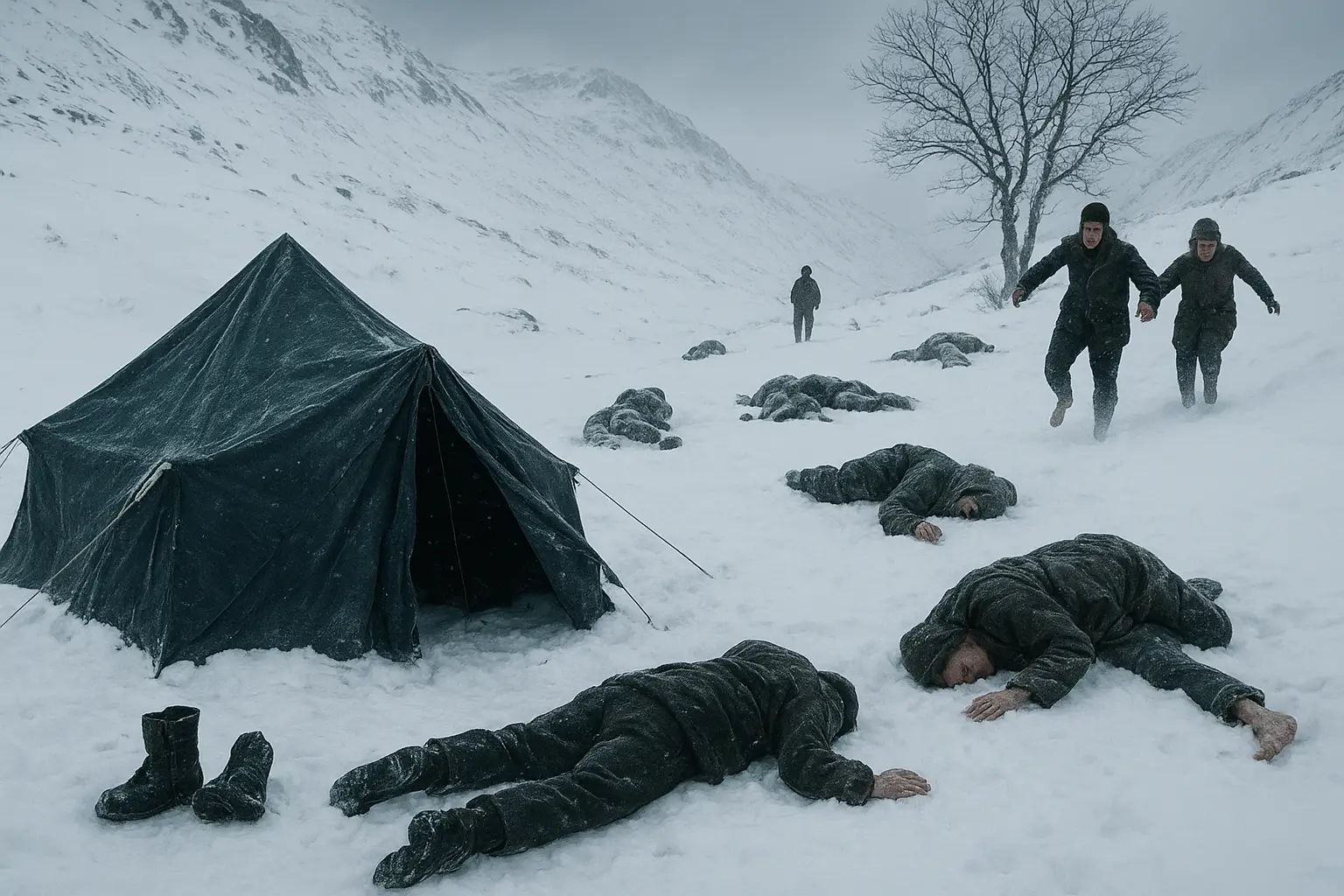
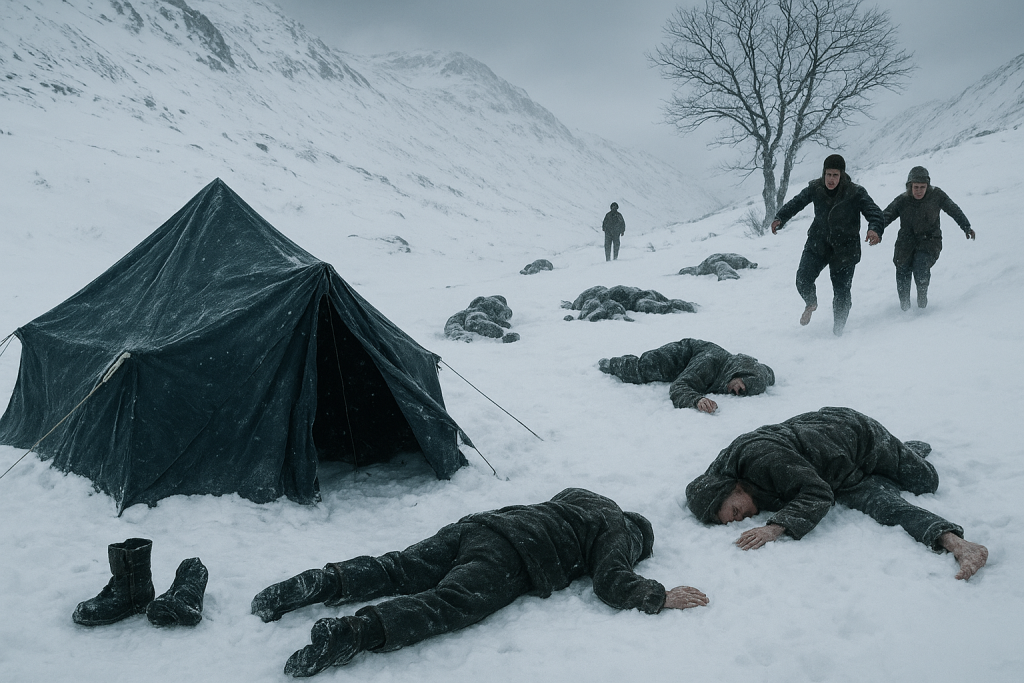
The tent had been cut open from the inside, and the hikers’ belongings — boots, coats, cameras, diaries — were all left behind. Footprints in the snow, barefoot or in socks, led down the slope toward the nearby forest.
The first two bodies, those of Doroshenko and Krivonischenko, were found under a large cedar tree near the edge of the forest, lying side by side. They were barefoot, dressed only in underwear, and had burned hands, as if they had tried to climb the tree or light a fire.
Three more bodies — Dyatlov, Kolmogorova, and Slobodin — were found at varying distances between the cedar and the tent, as if they had tried to crawl back to camp. All showed signs of hypothermia but no fatal injuries.
It took two more months to find the remaining four. Buried under several meters of snow in a ravine, they were dressed more warmly — perhaps wearing clothes stripped from the first victims — but their injuries were far more severe.
- Dubinina had multiple broken ribs and was missing her tongue and eyes.
- Thibeaux-Brignolles had a crushed skull.
- Zolotaryov also had massive chest injuries, comparable to those caused by a car crash.
Yet, strangely, none of their bodies showed external wounds consistent with such trauma.
The Official Investigation
Soviet authorities launched an immediate investigation led by Lev Ivanov, the state prosecutor. His team documented every detail: the positions of the bodies, the contents of the tent, and the hikers’ remaining supplies.
Their findings raised more questions than answers.
- The hikers had clearly fled the tent in panic, cutting their way out rather than using the front flap.
- Radiation was found on some of their clothes, though not at dangerous levels.
- Some victims had strange orange-tinted skin and white hair, likely from decomposition or chemical exposure.
- No signs of struggle or external attack were found.
The official report concluded blandly that the hikers died due to “a compelling natural force.” No further explanation was offered. The case was quickly closed, and files were classified.
Theories and Speculation
Over the decades, dozens of theories have emerged to explain the Dyatlov Pass mystery. Some are grounded in scientific reasoning; others drift toward the paranormal.
1. Avalanche Theory
This is the most widely accepted scientific explanation. According to this theory, a small slab avalanche may have partially buried the tent, forcing the hikers to flee. Disoriented in the darkness and freezing cold, they became separated and succumbed to hypothermia.
However, several problems challenge this idea:
- The slope’s gradient (around 23 degrees) was relatively shallow, making a large avalanche unlikely.
- The tent was still standing when discovered.
- No typical avalanche debris or snow patterns were found.
That said, a 2021 Swiss study supported a modified version of this theory, using computer models originally developed for snow research by Disney’s Frozen animators. The researchers proposed a “delayed slab avalanche” triggered by wind and snow loading — enough to cause panic but not a full collapse. This could explain the internal injuries found on some victims.
2. Katabatic Winds and Disorientation
Another plausible theory suggests hurricane-force katabatic winds — sudden, powerful gusts that rush down slopes — may have struck the camp, making it impossible to stay put. The hikers could have fled in panic, trying to reach the forest for cover but became lost in the blizzard.
3. Infrasound-Induced Panic
Geophysical experts have proposed that rare infrasound waves generated by the mountain’s shape and wind might have triggered a psychological panic. These low-frequency vibrations can cause intense fear, nausea, and disorientation in humans. The group might have experienced irrational terror, fleeing into the night with no clear awareness of danger.
4. Military Experiments
Some researchers believe the hikers accidentally wandered into the site of a Soviet military test, possibly involving parachute mines or experimental weapons. Declassified records show that the Soviet army conducted such tests in the Ural region during that period. The blast waves from low-altitude explosions could have caused internal injuries similar to those observed, without external wounds.
Additionally, local witnesses reported “orange spheres” in the sky around the same time — possibly flares or test missiles. Yet, no official documentation directly connects military activity to the tragedy.
5. UFOs and Paranormal Theories
As with many unexplained phenomena, the lack of clear evidence has spawned supernatural explanations. Some claim the hikers encountered extraterrestrials or mysterious glowing orbs that caused radiation burns. Others suggest secret experiments or even a Yeti attack, inspired by the group’s own joking diary entry titled “The Evening Otorten Yeti.”
While these theories are intriguing, none have any credible evidence to support them.
The 2019 Reinvestigation
In 2019, the Russian Prosecutor General’s Office reopened the case. After reviewing historical records, forensic data, and new modeling, they reaffirmed that the deaths were due to a natural event, specifically a slab avalanche compounded by hypothermia.
However, many researchers and surviving family members remain unconvinced. The precise combination of panic, injuries, and circumstances still feels inconsistent with a simple avalanche scenario. As of 2025, no official or independent investigation has provided a conclusive answer.
Cultural Impact
The Dyatlov Pass Incident has transcended its grim origins to become a symbol of humanity’s confrontation with the unknown. It has inspired:
- Books such as Dead Mountain by Donnie Eichar, which blends science with firsthand accounts.
- Films like The Dyatlov Pass Incident (2013) and documentaries by the BBC and National Geographic.
- Countless online discussions, podcasts, and theories across the world.
For Russians, it remains both a tragedy and a national riddle — one tied to the secrecy of the Soviet era, when information was tightly controlled, and official truth often masked deeper mysteries.
The Human Side
Amid all the speculation, it’s easy to forget the human story: nine young people who were passionate about exploration, camaraderie, and testing their limits. Their recovered diaries show laughter, songs, and shared warmth amid brutal cold. They were engineers, athletes, dreamers — not soldiers or spies.
Even in their final moments, evidence suggests they fought to stay alive: building a small fire under the cedar, trying to return to their tent, huddling together for warmth. Their courage in the face of unimaginable terror and cold deserves to be remembered as much as the mystery itself.
Conclusion
The Dyatlov Pass Incident endures as one of history’s strangest and most unsettling events — a blend of natural disaster, human psychology, and lingering enigma. Despite decades of study, the full truth may never be known.
Whether it was an avalanche, a military accident, or a rare atmospheric phenomenon, what happened on that cold night in February 1959 remains a powerful reminder of nature’s unpredictability and the limits of human understanding.
In the windswept Urals, where the snow still covers the “Mountain of the Dead,” the unanswered questions linger — whispered by the icy gusts that continue to sweep across Dyatlov Pass, where nine souls vanished into mystery forever.